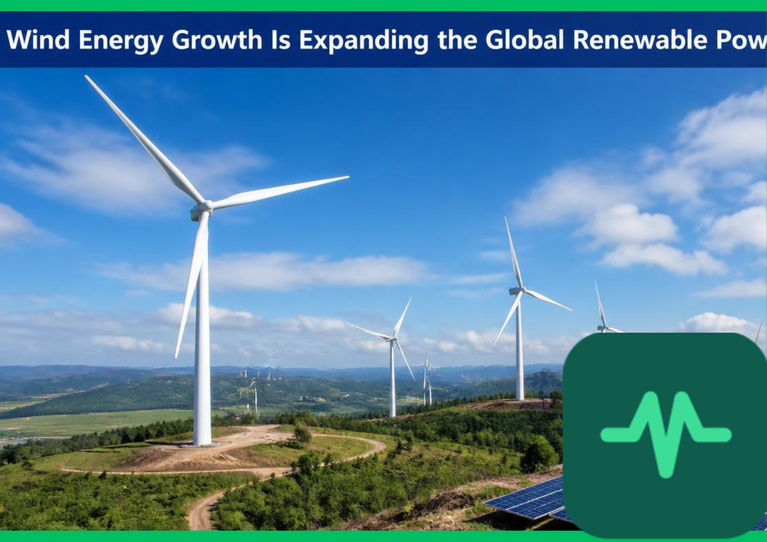
Wind Power Remains a Major Renewable Energy Source
Wind energy growth continues to shape the global electricity market.
Wind power is now one of the world's largest sources of renewable electricity capacity. Alongside solar, it has become a major driver of the expansion of clean electricity.
IRENA's Renewable Capacity Statistics 2026 reports that approximately 159 GW of wind capacity was added globally in 2025. Total renewable capacity additions reached about 692 GW during the year.
The figures show that wind remains a major part of the renewable-energy transition.
However, the industry is also facing challenges.
Projects need suitable locations. They need transmission networks. They also need investment and clear policies.
Solar Is Growing Faster, but Wind Remains Important
Solar has become the largest source of new renewable capacity.
Nevertheless, wind remains essential.
Solar and wind have different generation patterns. Solar production follows daylight hours. Wind generation depends on weather and location.
That difference can be useful.
Electricity systems with a mix of renewable technologies may have more options for balancing supply.
Therefore, wind energy growth should not be viewed separately from solar power growth.
The two technologies are increasingly becoming part of the same electricity system.
Onshore Wind Has a Major Role
Onshore wind farms remain an important part of the global market.
They can be deployed in areas with strong wind resources and suitable land.
However, projects can face planning and permitting challenges.
Communities may have concerns about land use, landscape changes and environmental impacts.
As a result, successful wind development requires more than good wind resources.
It also requires effective planning.
Offshore Wind Offers Another Opportunity
Offshore wind provides access to strong wind resources near coastal regions.
It can also allow countries with limited land availability to expand renewable generation.
However, offshore projects are generally more complex.
Developers must deal with marine construction, underwater cables, ports, vessels and difficult operating conditions.
Costs can therefore be higher than for some onshore projects.
The industry has also faced financial and supply-chain pressures.
Transmission Is Becoming More Important
There is another major issue.
The best locations for wind farms are not always close to major population centres.
That means electricity must often travel long distances.
Transmission networks therefore become essential.
If a country builds wind capacity faster than its grid can absorb it, some available electricity may not reach consumers when it is generated.
This is why renewable-energy expansion must happen alongside grid investment.
Wind Power and Energy Security
Wind energy can also support energy security.
Unlike fossil-fuel power plants, wind turbines do not require a continuous fuel supply.
Once installed, a wind farm can generate electricity without purchasing coal, oil or natural gas.
That can reduce exposure to international fuel-price movements.
For countries that depend heavily on imported fuels, this can be an important advantage.
Africa Has an Untapped Opportunity
Africa has significant renewable-energy potential.
Several countries have good wind resources, particularly in coastal and high-resource areas.
Yet wind deployment remains much smaller than solar deployment in many African markets.
This creates an opportunity.
Countries could potentially combine wind and solar with battery storage and stronger electricity grids.
Such systems could help diversify electricity generation.
However, investment remains critical.
Projects require financing, reliable regulation, suitable infrastructure and long-term market certainty.
What Happens Next?
The next phase of wind energy growth will depend partly on cost.
It will also depend on permitting, supply chains and grid infrastructure.
Developers need confidence that projects can be completed on schedule.
Governments need policies that encourage investment without creating unnecessary costs for consumers.
Meanwhile, communities need to see clear benefits from projects built in their regions.
EcoGreenPulse Analysis
Wind power remains an important part of the clean-energy system even as solar takes a larger share of new capacity.
The strongest electricity systems may not depend on one renewable technology.
Instead, they may combine wind, solar, hydropower, batteries, flexible demand and stronger grids.
That makes wind energy growth part of a much larger story.
The future is not simply about building more turbines.
It is about building an electricity system capable of using renewable power reliably.
Conclusion
Wind energy growth remains essential to the global energy transition.
The technology has reached commercial scale in many markets, but future expansion will depend on infrastructure and investment as much as turbine technology.
As renewable electricity becomes a larger part of global power systems, wind will continue to play an important supporting role alongside solar and other low-emissions technologies.
Sources: IRENA, Renewable Capacity Statistics 2026; IEA, Energy Technology Perspectives 2026.
Comments (0)
Login to leave a comment.
No comments yet. Be the first to share your thoughts!