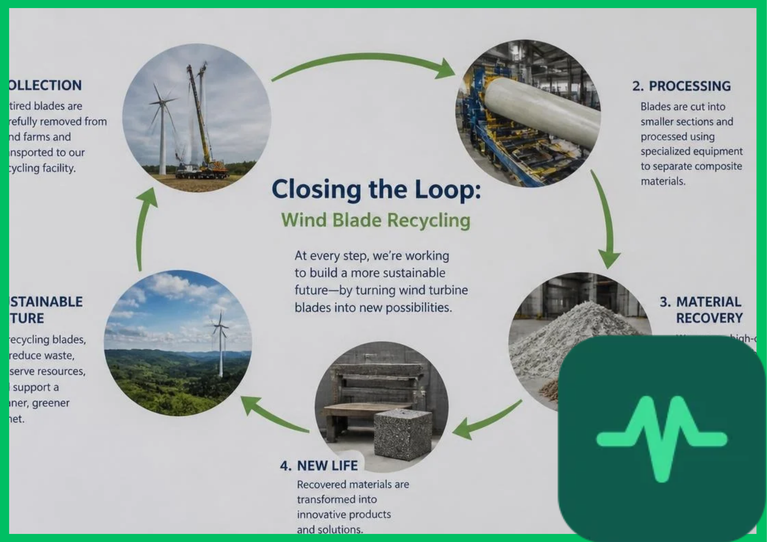
As wind energy deployment scales globally to meet decarbonization targets, the sector faces a significant end-of-life materials management challenge. While traditional steel towers, copper generator windings, and aluminum gearboxes melt down cleanly within standard scrap metal loops, wind turbine blades present a distinct recycling barrier.
Engineered to endure extreme aerodynamic loads, freezing moisture, and high ultraviolet exposure for over 20 to 25 years, turbine blades are composed of high-strength glass and carbon fibers bound within dense thermoset polymer matrices, typically epoxy or polyurethane. Because these cross-linked polymers cannot be remelted like thermoplastics, retired blades have historically been destined for industrial landfills or energy-intensive mechanical downcycling. Achieving true circularity within the wind industry requires scaling chemical and thermal recovery pipelines capable of breaking down these robust composite materials into high-purity secondary raw resources.
The Material Science Bottleneck of Thermoset Composites
To engineer effective recycling systems, it is necessary to examine why wind blade composites resist conventional reclamation methods. Modern turbine blades utilize glass-fiber reinforced polymers (GFRP) and carbon-fiber reinforced polymers (CFRP). During fabrication, the liquid thermoset resin undergoes a chemical curing process, forming irreversible covalent cross-links across the polymer chains.
Unlike thermoplastics (such as polyethylene or PET), which soften when heated, cured thermosets char and combust rather than liquefy under thermal exposure. Consequently, early wind installations decommissioned across Europe and North America faced an economic dead end. Slicing these massive structures—often exceeding 50 to 90 meters in length—with industrial diamond saws for landfill burial undermines the zero-waste philosophy of the renewable energy transition. With industry estimates projecting that global wind blade waste will reach roughly 43 million cumulative metric tons by 2050, scaling advanced material separation pipelines has become an ecological and regulatory mandate.
The Technical Mechanics of Wind Blade Reclamation
Modern composite recycling facilities utilize three core technical pathways to process decommissioned wind blades and extract secondary raw materials:
Mechanical Processing and Co-Processing
Mechanics: Sliced blade sections are fed into heavy industrial shredders and hammer mills, reducing the composite material to coarse granules or fine fibrous powders.
Industrial Application: The resulting fiberglass aggregate is utilized as a structural reinforcement filler in building panels, or co-processed in cement kilns. In cement manufacturing, the organic polymer resin fraction replaces raw coal fuel, while the inorganic silica glass fraction serves as an active mineral raw material for clinker production, reducing raw material demands.
Thermal Pyrolysis
Mechanics: The composite fractions are heated to temperatures between 450°C and 700°C in an oxygen-depleted, inert atmosphere (typically nitrogen).
Industrial Application: The absence of oxygen prevents combustion. Instead, the polymer matrix thermally decomposes into synthetic volatile gases and oils, leaving behind recovered glass or carbon fibers. While pyrolysis is highly effective for reclaiming high-value carbon fibers, the thermal exposure can degrade the tensile strength of glass fibers by up to 50%.
Chemical Solvolysis
Mechanics: Advanced chemical recycling plants submerge composite pieces in a liquid solvent bath—such as water, alcohol, or acid mixtures—augmented by specialized chemical catalysts at controlled pressures and temperatures.
Industrial Application: The solvolysis process selectively targets and cleaves the ester or ether bonds within the cross-linked resin matrix, completely dissolving the polymer binder. The underlying glass and carbon fibers emerge clean and physically intact, retaining up to 90% of their original baseline mechanical properties.
The Closed-Loop Economics of Recovered Fibers
Reclaiming high-purity glass and carbon fibers transforms a major liabilities stream into secondary industrial feedstocks. According to lifecycle energy evaluations compiled by the International Energy Agency (IEA), producing structural components from recycled carbon or glass fibers consumes up to 80% less energy than refining virgin fibers from raw silica sand or petroleum feedstocks.
The recovered glass fibers can be redirected into secondary manufacturing lines to fabricate automotive body structures, maritime hulls, electrical insulation boxes, and soundproof construction insulation. Concurrently, major wind turbine manufacturers are validating new circular chemistries. For example, the deployment of thermoplastic-like epoxy resins allows new-generation blades to be dissolved cleanly at room temperature in mild acidic solutions at end-of-life, enabling the direct reclamation of premium glass fabrics to build next-generation turbine sets.
Logistical Consolidation and Regulatory Pathways
Scaling wind blade circularity from localized pilot plants into a universal industrial standard requires overcoming steep logistical barriers. Transporting oversized, decommissioned fiberglass structures from remote onshore wind fields and deep offshore installations to specialized chemical processing hubs demands heavy specialized transport networks and localized cutting yards.
To address these hurdles, international waste management frameworks under the United Nations Environment Programme (UNEP) are pushing for standardized extended producer responsibility (EPR) mandates. By enforcing strict landfill bans on composite materials—similar to regulations already enacted across several European countries—governments are forcing project developers to integrate recycling costs directly into the initial capital expenditure calculations of wind farm development.
The Horizon of Circular Wind Assets
Wind blade recycling redefines the structural life cycle of renewable energy infrastructure. By employing targeted chemical solvolysis and thermal recovery loops to liberate high-grade fibers from tough resin matrices, materials science allows the clean energy transition to operate without leaving an unsustainable legacy of structural waste. As regional processing infrastructure matures, closed-loop blade manufacturing will solidify wind energy as a fully circular power asset from initial deployment to material rebirth.

Comments (0)
Login to leave a comment.
No comments yet. Be the first to share your thoughts!