You turn on your lights, charge your devices, and cook your dinner.
You never wonder where the electricity flowing through your walls is coming from at that exact second.
For decades, traditional electrical grids relied on predictable, steady power sources. Coal and gas plants burned fuel around the clock, matching human demand with steady mechanical output.
Wind power does not work that way.
Wind is a natural force. It blows strong one moment, fades to a gentle breeze the next, and sometimes stops blowing entirely.
That natural variability leads critics to ask a tough question: How can we rely on an energy source that changes with the weather?
It is a fair question.
According to grid integration reports from the International Energy Agency (IEA), environmental assessments from the United Nations Environment Programme (UNEP), efficiency guidelines from ENERGY STAR, and academic power systems research, modern grids handle variable wind seamlessly.
Through advanced meteorological forecasting, geographical smoothing, and large-scale energy storage, we smooth out the gusts.
Here is how variable wind integration works, why power grids handle intermittency with ease, and how modern engineering turns shifting breezes into reliable baseload power.
The Myth of Grid Intermittency
To understand why variable wind integration succeeds, you have to look past the common myth that wind power causes blackouts.
Critics often claim that if the wind stops blowing, the lights go out.
That argument misunderstands how large electrical grids operate.
A modern power grid is not a fragile single wire connected to a single turbine. It is a massive, interconnected web spanning entire continents, linking thousands of different power sources together.
Wind does not stop blowing everywhere across a continent at the same time.
When the wind slows down over one field or coastal farm, brisk gales may be howling miles away.
Academic power systems research shows that as you connect wind farms across wide geographical regions, individual drop-offs balance each other out.
This principle is known as geographical smoothing.
The wind is always blowing somewhere. When you link distant wind generators into a smart transmission network, variable gusts turn into a steady, reliable stream of overall power.
Predicting the Weather With Precision
Geographical smoothing is only the first layer of grid stability. The second secret is advanced meteorological forecasting.
Grid operators do not wait blindly for the wind to blow. They rely on sophisticated computer models, satellite tracking, and atmospheric sensors.
Meteorologists analyze pressure systems, temperature shifts, and wind speeds hours and days in advance.
Modern forecasting algorithms predict wind generation spikes and lulls with astonishing accuracy.
Armed with those forecasts, grid operators coordinate power supplies ahead of time.
If weather models predict a windy afternoon, operators schedule less output from flexible gas or hydroelectric plants, letting clean wind turbines shoulder the burden.
If a calm spell approaches, other generation assets step in smoothly to keep the electrical frequency stable.
Advanced forecasting removes the element of surprise, turning variable weather into manageable data.
Battery Storage and Grid Balancing
Even with great forecasts, sudden shifts happen. When a gust dies down unexpectedly, the grid needs an immediate backup.
This is where energy storage steps in to save the day.
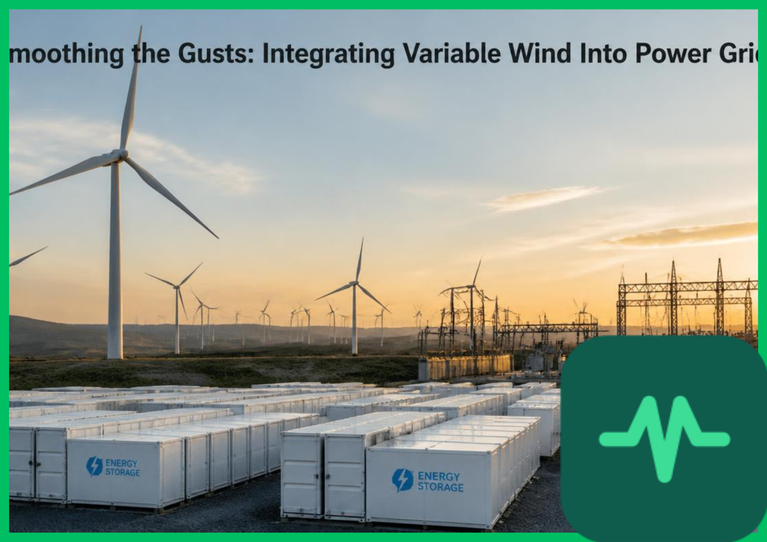
High-capacity battery storage systems, pumped hydroelectric storage, and compressed air reserves act as massive shock absorbers for the electrical grid.
When wind turbines spin fast and generate more electricity than local homes and factories need, excess power does not go to waste.
Smart grid controllers divert that surplus energy straight into battery storage facilities.
Energy flows into chemical cells or pumps water up into mountain reservoirs.
When the wind drops suddenly and generation dips below demand, those batteries discharge their stored power back into the grid in milliseconds.
According to IEA transition roadmaps, pairing wind farms with utility-scale battery storage eliminates intermittency entirely, delivering smooth, dependable power around the clock.
Demand-Side Flexibility and Smart Management
Balancing supply and demand is a two-way street.
For over a century, power grids adjusted supply to match rigid human demand.
Smart grid technology flips that dynamic on its head, letting demand flex to match variable supply.
When wind generation surges on a breezy night, dynamic pricing signals and smart home energy systems automatically activate electric vehicle chargers, heat water tanks, and run industrial processes.
Homes soak up cheap, abundant wind energy the moment it arrives.
When the wind calms down, non-essential loads pause briefly, easing pressure on the grid.
By combining weather forecasting, geographical transmission webs, battery storage, and smart demand response, power systems integrate high shares of variable wind without missing a beat.
Powering a Stable, Renewable Future
Variable wind integration proves that renewable energy does not need to be constant to be reliable.
By upgrading our power grids with digital intelligence, regional connectivity, and storage solutions, we turn shifting natural breezes into a cornerstone of modern civilization.
We no longer need to burn dirty fossil fuels just to keep our lights steady.
Through smart engineering and renewable integration, we master the wind, securing a stable, clean, and sustainable energy future for everyone.

Comments (0)
Login to leave a comment.
No comments yet. Be the first to share your thoughts!