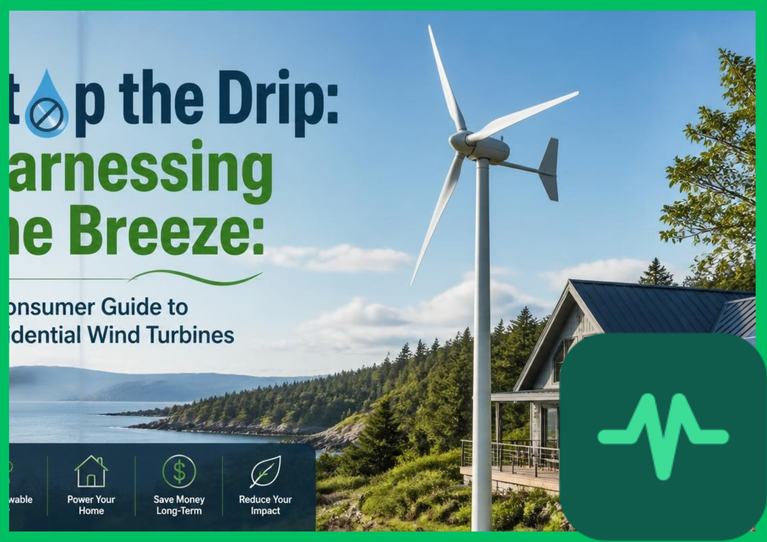
The idea of spinning your own clean power right in your backyard is incredibly appealing.
Investing in residential wind turbines is no longer restricted to industrial engineers or off-grid survivalists. Compact, modern designs are making it possible for individual households to generate meaningful electricity from the moving air. However, wind power is completely different from solar. It requires specific spatial dynamics, a deep understanding of fluid mechanics, and a realistic look at how much moving air your property actually receives.
Before you invest your hard-earned money into a wind setup, you need to understand the core principles that determine whether a home turbine will pay for itself or simply sit idle in the backyard.
How Micro Wind Technology Works
At its core, a wind turbine is the exact inverse of a household fan. Instead of using electricity to spin blades and create wind, a turbine uses the passing wind to spin blades and generate electricity. This rotation spins an internal rotor, which turns an alternator to create usable power for your home's appliances.
When exploring a home wind power generator, you will quickly discover two primary configurations. Each style handles the moving air differently, and choosing the right one depends entirely on your specific property layout.
Horizontal-Axis Turbines
These look like miniature versions of the massive commercial turbines you see on wind farms. They have blades that rotate vertically, like a traditional airplane propeller, and must point directly into the wind to operate efficiently.
- The Strength: They are incredibly efficient at capturing energy from smooth, continuous air currents.
- The Limitation: They require a high tower to escape ground-level turbulence, making them highly visible and less suited for tightly packed neighborhoods.
Vertical-Axis Turbines
These units feature a central shaft where the blades spin horizontally, resembling a vertical eggbeater or an upright barrel.
- The Strength: They can capture wind coming from any direction simultaneously without needing to turn. They also handle turbulent, omnidirectional wind patterns much better, making them far easier to mount at lower heights or even directly on sturdy roof structures.
- The Limitation: They are generally less efficient overall at extracting peak energy from sustained, high-speed breezes compared to horizontal models.
Evaluating Your Property’s Wind Resource
The biggest mistake homeowners make is buying a turbine based solely on how windy their yard "feels." Human beings are terrible at judging average wind speed. We remember the intense gusts during an autumn storm, but we easily forget the long, perfectly calm summer days.
To make a micro wind turbine a financially sound investment, your property must meet specific structural and environmental criteria.
The Magic Number: Sustained Wind Speed
As a universal rule, most residential turbines require a minimum baseline wind speed of about 4 to 5 meters per second (9 to 11 miles per hour) just to start spinning and generating a trickle of electricity. To actually generate enough power to offset your household bills significantly, you ideally need an environment where the average annual wind speed sits closer to 6 or 7 meters per second (13 to 15 miles per hour).
The Enemy Known as Turbulence
Wind close to the ground does not move in a smooth, straight line. It bumps into houses, hits fences, ripples over tree canopies, and swirls around sheds. This rough, choppy air is known as turbulence.
Turbulence is the absolute enemy of clean energy production. It causes turbines to shake, reduces their efficiency, and subjects the internal bearings to severe mechanical stress, leading to premature breakdown. To get away from this turbulent zone, a horizontal turbine must typically be installed on a dedicated tower that sits at least 9 meters (30 feet) higher than any obstacle within a 100-meter (300-foot) radius. This layout means you need a substantial amount of open space to make the setup viable.
Weighing Wind vs Solar for Residential Energy
If you are trying to maximize your household budget, it is vital to understand how wind stacks up against residential solar setups. Instead of viewing them as rival options, the most resilient homes treat them as complementary partners inside a renewable energy for homes strategy.
Space Requirements and Visual Impact
Solar panels sit flat and silent on an existing roof structure. They do not have moving parts, they require virtually zero daily maintenance, and they do not alter the skyline of your property. A wind turbine, conversely, is a dynamic mechanical machine. It requires physical space, routine structural inspections, and can alter the visual landscape of your home.
The Power of 24-Hour Generation
Where wind completely outshines solar is its operational timeline. The sun sets every single evening, but the wind keeps blowing through the night. In many regions, winter is the windiest season of the year—precisely when solar panels produce the least amount of electricity due to shorter days and snow cover. A home turbine can step in to provide steady, round-the-clock power during the exact months when your household heating demands are at their highest.
Making the Final Decision
A residential turbine is a beautiful piece of machinery that can provide deep energy independence, but it is not a plug-and-play appliance. It requires a realistic, data-driven assessment of your property’s geography. If you have the open space, live in a proven wind corridor, and want a reliable way to generate clean electricity through dark winter nights, micro-wind can be a remarkably powerful asset for your family’s budget.


Comments (0)
Login to leave a comment.
No comments yet. Be the first to share your thoughts!