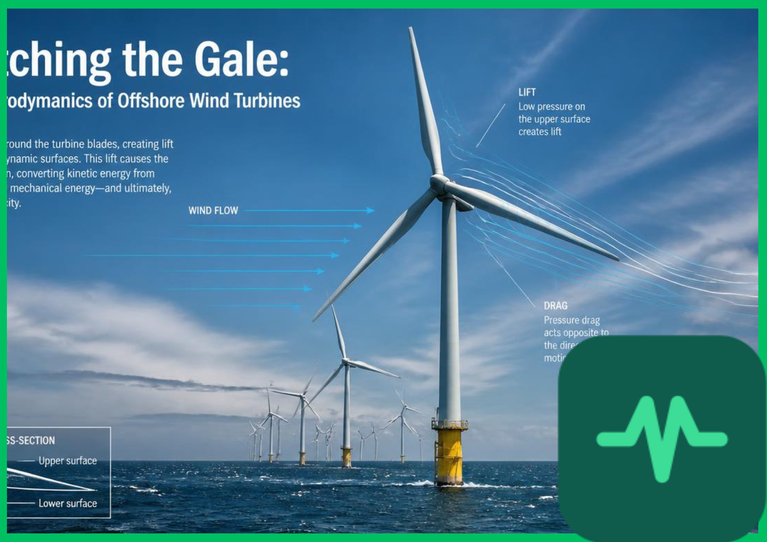
Far in the distance, a row of colossal white towers rises from the waves. Their massive blades spin slowly, gracefully slicing through the maritime air.
You cannot hear them from the shore. You only feel the quiet, profound weight of clean power being born from thin air.
For centuries, humanity harnessed wind power using modest wooden windmills scattered across agricultural fields. Those old mills ground grain and pumped water, but they could never light up a modern city.
Today, a silent engineering revolution is taking place across the oceans.
According to renewable energy tracking data from the International Energy Agency (IEA), environmental assessments from the United Nations Environment Programme (UNEP), and academic aerodynamic research, offshore wind is transforming global power generation.
By pushing out to sea, engineers tap into faster, steadier gales, building machines of astonishing scale.
Here is how offshore wind turbine aerodynamics work, why blade sweep area physics dictate power output, and how megawatt-scale generation powers our sustainable future.
Why Open Waters Deliver Better Wind
To understand why offshore wind turbines generate so much more electricity than land-based towers, you have to look at the fluid dynamics of the atmosphere.
Over land, the wind encounters massive friction. Trees, hills, mountains, buildings, and uneven terrain slow down moving air and create turbulent eddies.
When wind hits those obstacles, it becomes choppy and unpredictable.
The open ocean offers a completely different environment.
With almost zero physical barriers to slow it down, air flows freely and smoothly across vast marine expanses.
Academic marine renewable energy studies confirm that offshore winds blow stronger and steadier than onshore breezes.
Because water absorbs and releases heat slower than land, coastal temperature differences create reliable, powerful daily wind patterns.
Placing wind turbines offshore is not just about finding extra space; it is about harvesting a richer, higher-quality fuel source.
The Physics of Lift and Blade Sweep Area
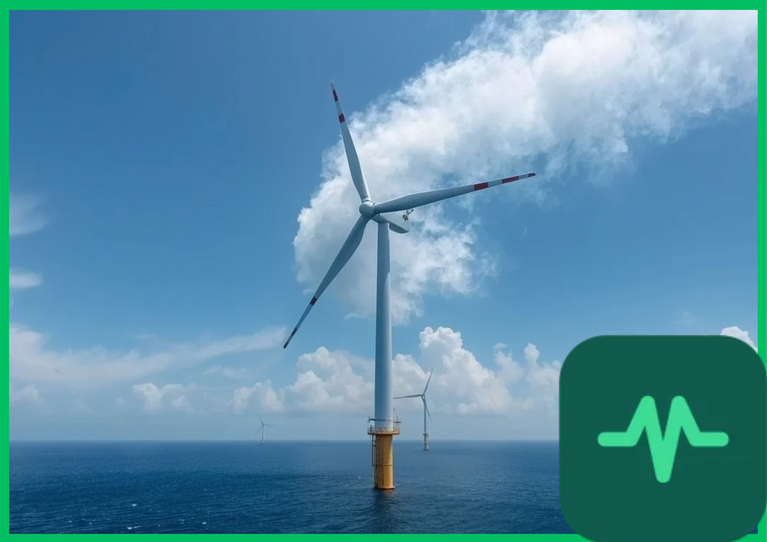
When you look at a modern offshore wind turbine, it looks more like an airplane propeller than an old Dutch windmill.
That shape is no accident. Wind turbines do not capture power by letting the wind push them forward like a sailboat.
They generate power using aerodynamic lift.
The massive blades of an offshore turbine feature an airfoil cross-section, identical to the wings of a commercial passenger jet.
As high-velocity marine air flows across the curved blade, it creates a pressure difference. Low pressure forms on one side, and high pressure pushes from the other.
That aerodynamic lift forces the blades to spin around a central rotor hub.
Blade sweep area physics dictate everything about how much electricity a turbine can produce.
As turbine blades grow longer, the circular sweep area expands exponentially. A rotor spanning 200 meters (approx. 656 feet) from tip to tip sweeps through a massive wall of moving air, capturing vast amounts of kinetic energy.
When you double the length of a blade, you quadruple the sweep area, dramatically multiplying the power output without needing a heavier wind.
Engineering Megawatt-Scale Giants
Building machines of this magnitude requires pushing materials science to its absolute limits.
Modern offshore wind turbines are true engineering marvels, reaching megawatt-scale generation capacities that would have seemed impossible just a few decades ago.
A single offshore turbine can generate anywhere from 10 to 15 megawatts of clean electricity—enough to power thousands of homes simultaneously.
To achieve this scale, blades stretch over 100 meters (approx. 330 feet) long, yet they must remain remarkably light and rigid.
Engineers construct these colossal blades using advanced fiberglass and carbon fiber composites fused with epoxy resins.
As the blade tips whip through the air at high speeds, centrifugal forces pull outward with immense tension.
Inside the nacelle sitting high atop the marine tower, heavy-duty gearboxes or direct-drive permanent magnet generators convert that slow, powerful rotational force into high-voltage electrical current.
Subsea cables then bundle that clean energy, transmitting it safely back to shore.
Protecting Structures in Harsh Marine Environments
The open ocean is a brutal environment. Saltwater corrosion, violent ocean storms, freezing temperatures, and crashing waves test the durability of every component.
Academic structural engineering research highlights how modern offshore turbines withstand these forces.
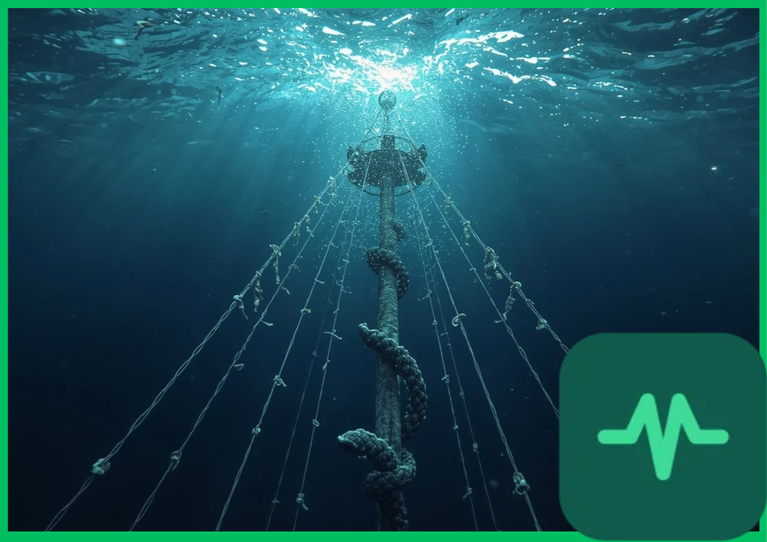
Towers are anchored securely to the seabed using massive steel monopiles driven deep into the ocean floor, or via floating ballast platforms tethered by heavy synthetic mooring lines in deep water.
Advanced aerodynamic controls protect the machine during severe gales.
If wind speeds cross safety thresholds, automated pitch-control motors turn the blades slightly along their long axis, feathering them out of the wind.
This smart aerodynamic braking prevents the rotor from spinning out of control, protecting the turbine from destructive structural vibrations.
Powering a Clean Energy Horizon
Offshore wind turbines prove that human engineering can harmonize with the natural rhythms of our planet.
By capturing the kinetic energy of ocean gales, we generate massive volumes of reliable, zero-emission electricity.
We no longer have to rely on burning finite fossil fuels to keep our industrial societies running.
Through advanced aerodynamics, marine engineering, and smart grid integration, offshore wind stands as a towering pillar of the global clean energy transition.
Every rotation of those giant blades sweeps us closer to a truly sustainable, breathable future for all.
Comments (0)
Login to leave a comment.
No comments yet. Be the first to share your thoughts!