You turn the handle of your shower, waiting for that welcoming rush of hot water to wake up your senses.
For a brief moment, you feel completely relaxed.
Then, you glance at your monthly utility bill sitting on the kitchen counter, and that warm feeling vanishes instantly.
Water heating is one of the biggest energy expenses in any home.
Every single day, traditional water heaters consume massive amounts of electricity or gas to keep hundreds of liters or gallons of water scorching hot around the clock.
They heat water while you are asleep in bed. They heat water while you are away at work.
They burn energy continuously, even when nobody is home to use a single drop.
That constant standby heat loss wastes energy, drains your wallet, and pushes unnecessary carbon emissions into our shared atmosphere.
We cannot build a sustainable future while heating water inefficiently.
What if your water heater could think for itself?
What if it learned your family's daily routine, checked the weather forecast, and only heated water when clean, renewable energy was cheap and abundant?
A quiet, brilliant technological shift is happening inside our utility closets.
According to global energy efficiency reports from the International Energy Agency (IEA), resource protection frameworks from the United Nations Environment Programme (UNEP), appliance efficiency standards from ENERGY STAR, and academic thermal dynamics research, smart water heating controllers are changing how we manage domestic energy.
By timing thermal storage to match renewable generation peaks, we secure endless comfort without wasting power.
Here is how smart water heating controllers work, why automated thermal timing slashes household bills, and how smart plumbing technology secures our sustainable future.
The Hidden Waste of Always-On Water Heaters
To understand why smart controllers matter so much, you have to look at how conventional water heaters operate.
For decades, water heaters relied on simple, dumb thermostats.
When the water inside the tank dropped below a certain temperature, heating elements kicked on instantly at 100% capacity.
It did not matter what time of day it was. It did not matter whether electricity prices were spiking during expensive evening peak hours.
The tank fired up, drawing heavy current straight from the grid.
If you went away on a week-long vacation, your water heater sat at home, burning electricity day and night to keep an empty tank of water piping hot just in case you walked through the door.
That round-the-clock standby waste adds up to a staggering amount of wasted energy over a year.
Worse still, traditional water heaters miss out on the cleanest, cheapest electricity available on modern power grids.
When rooftop solar panels flood local grids with surplus clean energy at noon, conventional water heaters ignore it completely if the tank is already warm.
We needed a way to connect our water heaters to the rhythm of the modern renewable energy grid.
What Is a Smart Water Heating Controller?
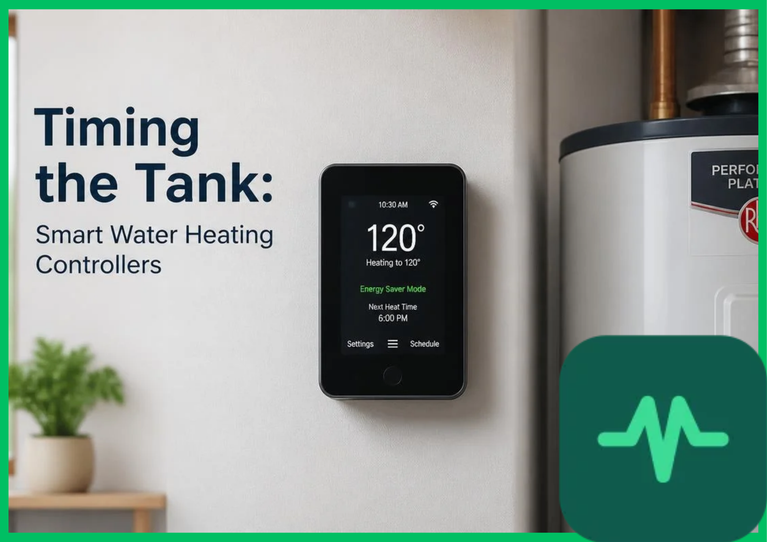
A smart water heating controller is an advanced IoT-enabled device or digital thermostat module attached to a water heater that automates heating cycles using machine learning, local weather data, and real-time electricity pricing signals.
Instead of keeping water scalding hot 24 hours a day, the smart controller studies your household routine.
It learns that your family takes showers between 7:00 AM and 8:00 AM, and runs the dishwasher at 8:00 PM.
The controller lets the water temperature drop safely during the middle of the day when everyone is away.
Then, it triggers the heating elements to turn on right before your morning routine begins, ensuring a full tank of hot water is waiting the exact moment you step into the bathroom.
If your home features rooftop solar panels, the controller programs the tank to soak up surplus midday solar energy, turning your water heater into a thermal battery that stores free sunlight as hot water.
The Science of Thermal Energy Storage
How does storing hot water act like a battery for your home?
It comes down to basic thermodynamics and thermal mass.
Water has a remarkably high specific heat capacity, meaning it can absorb and hold vast amounts of thermal energy without boiling away.
Academic thermal dynamics research shows that a standard 189-liter or 50-gallon insulated water tank can store several kilowatt-hours of electrical energy as heat.
When you use a smart controller to superheat your water tank slightly during periods of cheap, clean renewable generation, you are storing energy in a thermal form.
Later that evening, when electricity prices spike and fossil-fuel peaker plants turn on, your water heater stays completely turned off.
You use the heat stored inside the tank hours earlier.
According to ENERGY STAR and international appliance efficiency evaluations, smart thermal controllers reduce annual water-heating energy costs by up to 20% to 30% simply by shifting heating schedules away from expensive, dirty peak hours.
Environmental Integration and Grid Support
The benefits of smart water heaters extend far beyond individual household savings.
They play a critical role in stabilizing regional power grids.
As cities build more wind and solar farms, grid operators face the daily challenge of balancing supply and demand when the sun sets or the wind stops blowing.
Millions of smart water heaters acting in unison can absorb surplus renewable energy during windy nights or sunny afternoons, acting as a massive flexible load.
According to UNEP resource sustainability frameworks, shifting domestic power loads away from peak hours reduces the need to burn fossil fuels in regional power plants.
IEA energy transition assessments highlight that smart appliances are an essential building block of modern decarbonized cities.
When water heaters coordinate with smart grids automatically, they help balance regional electricity flows without requiring any lifestyle sacrifices from homeowners.
Designing Your Intelligent Water System
Upgrading your home with smart water heating control does not require buying an entirely new plumbing system.
Many modern hybrid heat pump water heaters come with smart controllers built right into their digital interfaces, featuring Wi-Fi connectivity and companion mobile apps.
If you have a standard electric resistance water heater, retrofit smart switches can be installed easily by a qualified technician to bring intelligent scheduling to your existing tank.
You set your comfort preferences on your phone, and the system handles the rest quietly in the background.
You get endless hot water, lower utility bills, and the quiet satisfaction of knowing your home runs on clean energy scheduling.
Timing Our Future Toward Sustainability
Smart water heating controllers prove that minor adjustments to how we manage daily appliances yield profound environmental benefits.
We no longer have to accept the wasteful routine of burning electricity to heat water around the clock.
By timing thermal storage to match renewable energy peaks, we turn ordinary water heaters into smart energy batteries.
We step away from wasteful habits, embracing an intelligent, efficient, and sustainable standard of living.
Through brilliant thermal engineering, smart IoT automation, and deep respect for our planetary climate, timing the tank secures a clean, bright, and sustainable future for every home on Earth.
Comments (0)
Login to leave a comment.
No comments yet. Be the first to share your thoughts!