You turn on the shower tap.
Warm water cascades over your shoulders, washing away the fatigue of yesterday.
You watch the soapy water swirl down the drain and vanish into the dark pipes beneath your floor.
You never give it another thought.
That water flows straight out of your home, disappearing into the municipal sewer system.
It is clean, fresh tap water that you used for a few minutes before treating it like dirty industrial waste.
Across the globe, billions of liters of high-quality water flow down our shower drains, sinks, and washing machines every single day.
We treat our water like a one-use disposable item.
We pump it from rivers, clean it to pristine drinking standards, use it once for a brief task, and flush it away.
That linear water cycle is deeply wasteful.
We cannot build a truly sustainable future while wasting up to 70% of our indoor household water on tasks that do not require drinking-grade purity.
What if every home had a second spin for its water?
What if the water from your morning shower could automatically clean your garden, flush your toilet, or wash your clothes?
A quiet, brilliant household engineering revolution is transforming utility rooms across the globe.
According to global water resource reports from the International Energy Agency (IEA), environmental governance frameworks from the United Nations Environment Programme (UNEP), efficiency benchmarks from ENERGY STAR, and academic wastewater research, smart greywater recycling systems for homes are changing our domestic resource landscape.
By utilizing intelligent filtration, biological treatment, and automated diversion valves, we capture household wastewater and reuse it safely, slashing municipal water consumption.
Here is how smart greywater recycling works, why residential water reuse changes household economics, and how a second spin secures our sustainable future.
The Wasteful Illusion of Single-Use Tap Water
To understand why smart greywater systems matter so much, you have to look at the broken logic of traditional indoor plumbing.
In a typical home, every single drop of water coming out of the tap is treated to the exact same high purity standards as bottled drinking water.
Yet we only drink a tiny fraction of it.
The rest gets used to wash dishes, flush toilets, water lawns, and rinse clothes.
When you flush a toilet with clean drinking water, you commit a massive thermodynamic and ecological inefficiency.
During dry summer months or severe regional droughts, municipal water authorities impose strict watering bans, forcing homeowners to watch their gardens wither while pristine drinking water sits inside toilet tanks.
Skeptics once argued that recycling wastewater at home was unsanitary, complicated, and foul-smelling.
Plumbing engineers, water treatment researchers, and smart appliance designers proved those skeptics wrong.
Modern greywater filtration cleans used water until it is crystal clear, odorless, and safe for non-potable household uses.
What Is a Smart Greywater Recycling System?
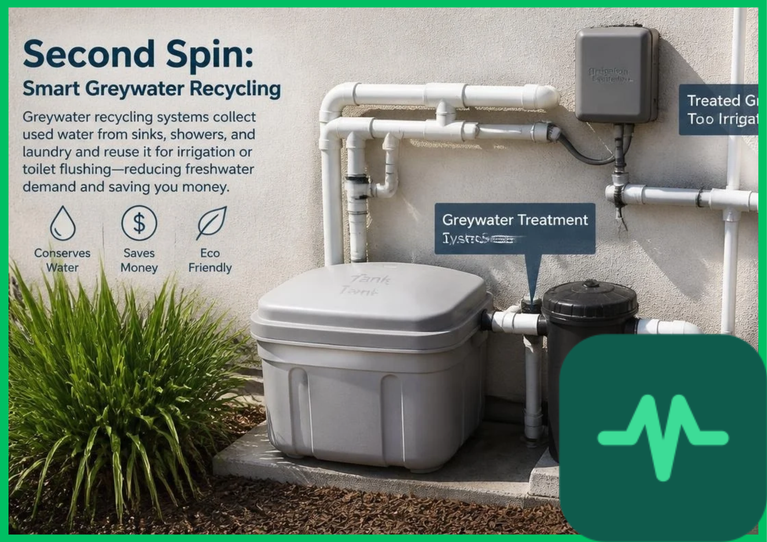
A smart greywater recycling system is an advanced automated household plumbing network that captures gently used wastewater from domestic sources like showers, bathtubs, and washing machines—known as greywater—filters out hair, soap, and bacteria, and redirects that purified water instantly back into toilet cisterns and subsurface irrigation lines.
Instead of letting shower water slip away down the municipal sewer, the system operates through intelligent plumbing automation:
- Drain Diversion: Smart gravity valves intercept greywater flowing from bathroom showers and laundry units before it mixes with blackwater from kitchen sinks or toilets.
- Particle Filtration: Multi-stage mesh screens and sand filters trap lint, hair, and solid debris suspended in the water.
- Biological or Membrane Treatment: Microfiltration membranes or silent aeration chambers break down organic soap residues and eliminate harmful bacteria without using harsh chlorine chemicals.
- Automated Disinfection: Ultraviolet sterilization lamps zap any remaining microorganisms, ensuring the recycled water is completely safe and odorless.
- Smart Distribution Pumps: Pressure sensors send the purified water silently to toilet cisterns or garden drip lines whenever a valve opens.
You take yesterday's shower water and use it to flush today's toilet or water your backyard flowers.
The Science of Microfiltration and Energy Savings
How can a compact home appliance take soapy bathwater and turn it into clear, clean water in a matter of seconds without wasting electricity?
It comes down to gravity-fed filtration physics and low-energy membrane technology.
Academic wastewater research shows that residential greywater is relatively clean compared to raw sewage, containing mostly soap suds, skin cells, and hair.
Because greywater lacks heavy biological contamination, it requires far less intensive treatment than blackwater.
Modern smart greywater systems use ultrafiltration hollow-fiber membranes with microscopic pores measuring less than 0.04 micrometers across.
Those pores block bacteria, viruses, and large organic molecules while letting clean water molecules pass through effortlessly under low pressure.
Furthermore, ENERGY STAR and international appliance efficiency evaluations prove that recycling greywater on-site cuts a household's total municipal water demand by 30% to 50%.
Water bills shrink dramatically. Municipal treatment plants experience less strain during peak summer heatwaves.
Environmental Integrity and Watershed Protection
The environmental benefits of smart greywater recycling systems extend far beyond lowering family utility bills or keeping suburban lawns green during dry spells.
They provide a vital shield for natural rivers, lakes, and underground aquifers.
According to UNEP resource governance frameworks, pulling less water out of natural watersheds prevents environmental degradation in fragile river ecosystems and reduces the energy-heavy pumping required by centralized municipal treatment facilities.
When millions of homes reuse their water locally, cities stop depleting regional water tables and minimize wastewater overflows during heavy rainstorms.
According to IEA clean energy roadmaps, scaling up decentralized water efficiency technologies is an absolute pillar to achieve universal urban resilience under a changing climate.
When every home closes its own water loop, urban civilization lives in harmony with natural water cycles.
Overcoming Plumbing Retrofits and Regulatory Realties
Scaling smart greywater recycling from custom green architecture into universal residential standard practice involves navigating real-world plumbing and regulatory hurdles.
Retrofitting greywater separation pipes into an older, existing home requires careful planning by licensed plumbers to ensure greywater lines remain completely isolated from drinking water supplies.
Plumbing engineers, building code officials, and manufacturers are solving these challenges by designing modular plug-and-play greywater units that install easily beneath bathroom floors, creating standardized color-coded piping guidelines, and updating municipal plumbing codes to encourage residential water reuse.
As automated greywater appliances become more compact and affordable, secondary water recycling is transitioning successfully from luxury eco-homes into standard residential plumbing worldwide.
Giving Water a Second Spin Toward a Sustainable Future
Smart greywater recycling systems prove that human engineering can eliminate domestic water waste through elegant, decentralized efficiency.
We no longer have to accept that keeping our homes clean requires flushing pristine drinking water down our sewer pipes.
By capturing shower and laundry wastewater, purifying it through advanced microfiltration, and giving it a second spin for toilet flushing and garden irrigation, we cut household water use in half.
We step away from wasteful habits, embracing a smart, circular, and enduring standard of domestic living.
Through brilliant water technology, rigorous academic research, and a deep respect for our planetary resources, a second spin secures a clean, reliable, and sustainable future for every household on Earth.
Comments (0)
Login to leave a comment.
No comments yet. Be the first to share your thoughts!