You wash your hands, fill a glass, or water your garden. You expect that water to arrive cleanly and reliably every single time.
Beneath the streets, however, an invisible drama unfolds across miles of underground pipe.
For generations, municipal water networks operated out of sight and out of mind. Aging cast iron and plastic mains carried water beneath city streets for decades without a proper health check.
Pipes cracked. Joints loosened. Millions of gallons or liters of treated drinking water leaked silently into the earth before ever reaching a home or business.
That massive waste strained municipal budgets and depleted natural freshwater reserves.
A quiet digital transformation is sweeping through urban water management worldwide.
According to resource assessments from the United Nations Environment Programme (UNEP), efficiency benchmarks from ENERGY STAR, energy transition frameworks from the International Energy Agency (IEA), and academic infrastructure research, smart technology is stopping the drip.
By combining real-time acoustic sensors, automated pressure tuning, and artificial intelligence, cities are transforming leaky water grids into resilient, efficient systems.
Here is how smart water networks work, why underground leaks evaded detection for so long, and how digital monitoring secures our urban water future.
The Hidden Crisis of Aging Water Mains
To understand why smart technology is vital, you have to look at the staggering scale of municipal water loss.
In many older urban water distribution systems around the world, structural decay takes a heavy toll.
Academic infrastructure studies show that standard municipal networks frequently lose anywhere from 20% to 50% of all treated drinking water to underground leaks, hidden fractures, and faulty pipe joints before it reaches a consumer.
Think about that math.
Water treatment plants spend millions of dollars running massive pumps, filtering impurities, and adding purifying chemicals to make water safe to drink.
Then, half of that treated water leaks straight into the dirt through unseen cracks in the distribution grid.
Historically, utilities only discovered leaks when a major pipe burst catastrophically, creating a massive sinkhole in the middle of a paved street.
Waiting for roads to collapse is not a sustainable water management strategy.
Listening to Pipes With Acoustic Sensors
The foundation of smart water management is continuous, real-time sensing.
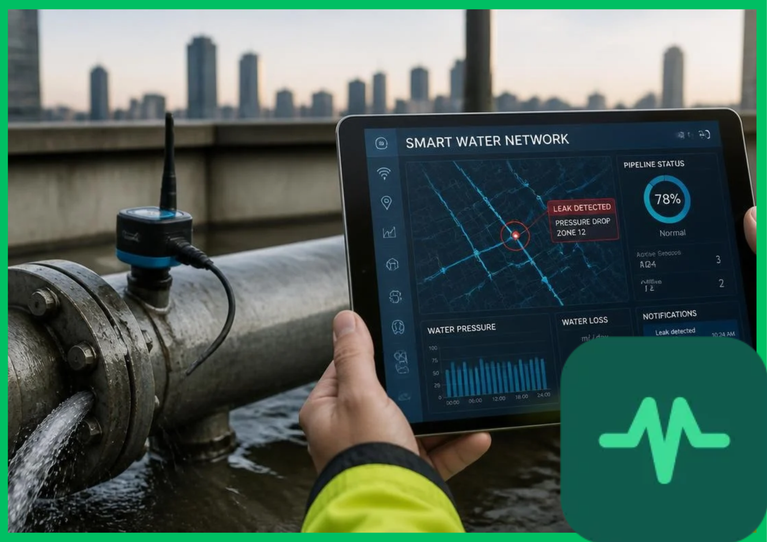
Instead of waiting for a pipe to burst, modern municipal networks deploy advanced acoustic sensors and hydrophones directly onto underground water mains.
Water escaping from a crack under high pressure creates a distinct sound wave. Even when buried deep beneath concrete and soil, pressurized water hisses and vibrates against the pipe wall.
Acoustic sensors listen to those vibrations continuously.
When a new leak forms, the acoustic signature changes instantly.
The sensor data streams back to a centralized utility dashboard, where smart algorithms triangulate the exact location of the fracture within meters.
Maintenance crews receive a precise GPS coordinate long before any water bubbles up to the surface or a sinkhole forms.
They dig up a tiny section of pipe, fix the crack, and prevent thousands of gallons or liters from washing away.
Artificial Intelligence and Pressure Regulation
Acoustic listening devices represent just one layer of modern smart water grids.
Engineering research and UNEP resource frameworks highlight how artificial intelligence and automated pressure management take urban water efficiency to the next level.
Water pressure inside municipal mains fluctuates throughout the day based on human demand.
In the middle of the night, when everyone is asleep, water usage drops close to zero. If pump stations keep pushing high daytime pressure through the pipes during those quiet hours, stress mounts on aging joints, causing new cracks to form.
Smart water networks use automated pressure-regulating valves linked to AI software.
The system adjusts pump speeds and valve positions dynamically across the city, lowering network pressure gently during low-demand hours to protect pipe integrity, then ramping pressure back up smoothly as morning consumption rises.
Machine learning models analyze historical flow rates, soil conditions, and pipe ages to predict where failures are most likely to occur next, allowing utilities to replace weak segments before they ever leak.
Saving Energy and Conserving Precious Resources
Fixing underground leaks does more than save water. It saves a tremendous amount of energy.
Pumping water through miles of municipal pipe requires massive amounts of electrical power.
When a city loses 30% of its water to underground leaks, it means the utility is burning 30% more electricity than necessary at the treatment and pumping station.
According to IEA efficiency tracking reports, reducing water loss through smart sensing networks slashes municipal electricity consumption significantly, cutting greenhouse gas emissions while lowering operating costs for local governments.
By conserving every drop, cities protect vulnerable regional aquifers, preserve river ecosystems, and ensure long-term water security for growing populations.
Flowing Into a Resilient Urban Future
Smart technology proves that aging municipal infrastructure can be brought into the digital age.
We no longer have to accept chronic water waste as an unavoidable cost of urban life.
By combining continuous acoustic monitoring, automated pressure tuning, and artificial intelligence, water utilities can seal the leaks and protect their vital networks.
Through smart engineering and sustainable management, every drop of water reaches its destination safely, securing a resilient, thriving future for our global cities.
Comments (0)
Login to leave a comment.
No comments yet. Be the first to share your thoughts!