The air feels thick, heavy, and damp against your skin.
You can practically feel the moisture hanging in the breeze.
For most of human history, we looked at that atmospheric humidity and felt only sticky discomfort.
We relied entirely on rivers, lakes, and underground aquifers for our survival.
We pumped water from deep below the earth or dammed rushing rivers miles away.
That traditional water model is breaking down.
Climate change, prolonged droughts, and aging municipal pipes leave billions of people facing severe water scarcity.
When taps run dry or groundwater turns brackish, communities face a terrifying reality.
We cannot build a secure, sustainable future while relying solely on depleting rivers and vulnerable underground water tables.
What if we could harvest clean, safe drinking water straight out of the air around us?
What if invisible humidity floating in the sky could quench our thirst during severe droughts and emergencies?
A quiet, brilliant thermodynamic revolution is transforming how we secure clean water across the globe.
Scribd
According to global water assessments from the International Energy Agency (IEA), resource governance frameworks from the United Nations Environment Programme (UNEP), efficiency benchmarks from ENERGY STAR, and academic atmospheric water generator research, harvesting moisture from the air is changing our survival landscape.
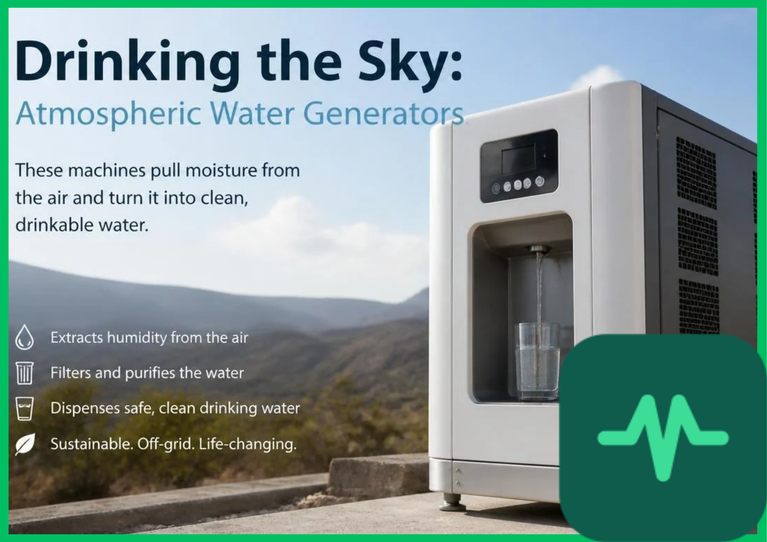
By utilizing advanced vapor-compression cooling and desiccant materials, atmospheric water generator technology converts ambient humidity into fresh drinking water anywhere on Earth.
Here is how atmospheric water generation works, why extracting moisture from the air changes water security economics, and how drinking the sky secures our sustainable future.
The Fragile Limits of Traditional Water Infrastructure
To understand why atmospheric water generators matter so much, you have to look at the mounting stress facing global water grids.
Traditional water systems rely on long-distance pipes, massive concrete reservoirs, and deep extraction wells.
When extreme weather strikes, those centralized systems fail easily.
Severe droughts dry up municipal reservoirs.
Floods wash mud and contaminants into local water treatment plants.
Aging underground pipes leak precious treated water before it ever reaches a household tap.
Communities caught in natural disasters or remote dry regions often wait weeks for bottled water trucked in over broken roads.
Skeptics once argued that pulling water out of the air was too energy-intensive and impractical for everyday use.
Thermodynamic engineers and materials scientists proved those skeptics wrong.
When clean energy powers efficient cooling cycles, the sky becomes an endless, renewable reservoir.
What Is an Atmospheric Water Generator?
An atmospheric water generator is an advanced decentralized appliance that pulls ambient air through a filtration system, cools it below its dew point to condense water vapor into liquid droplets, and purifies that moisture through multi-stage UV and carbon filters into clean, drinkable water.
ResearchGate
Instead of pumping water from a distant river, the machine treats the atmosphere like an open well:
- Air Intake: Quiet internal fans pull ambient air through high-efficiency particulate filters, removing dust, pollen, and airborne pollutants.
- Dew Point Cooling: Refrigeration or thermoelectric coils chill the filtered air past its dew point, forcing suspended water vapor to condense into liquid droplets, much like cold condensation forms on a glass of ice water on a hot day.
- Multi-Stage Filtration: The raw condensed water flows through carbon blocks, sediment filters, and ultraviolet sterilization units to ensure absolute purity and safety.
- Mineralization: Clean, pure water passes through a mineral block to add healthy calcium and magnesium ions, creating crisp, refreshing drinking water.
ResearchGate
You plug the machine into a power source, and it quietly turns invisible humidity into pure drinking water right in your room.
The Science of Condensation and Energy Efficiency
How can a machine extract liters of clean drinking water out of dry or humid air without consuming excessive amounts of electricity?
It comes down to refrigeration thermodynamics and advanced desiccant materials.
Academic research shows that water yield depends directly on ambient temperature and relative humidity.
ResearchGate
In warm, humid climates, atmospheric water generators achieve high production efficiency, turning electricity into abundant drinking water rapidly.
Furthermore, ENERGY STAR and international appliance efficiency evaluations prove that modern vapor-compression systems and desiccant-wheel technologies have slashed energy consumption per liter significantly.
When powered by rooftop solar panels or local renewable microgrids, these generators operate entirely off-grid.
Energy efficiency meets atmospheric abundance.
Environmental Integrity and Emergency Resilience
The environmental benefits of atmospheric water generator technology extend far beyond providing a convenient backup during local water main breaks.
They offer a vital lifeline for climate resilience and decentralized resource management.
According to UNEP resource governance frameworks, decentralized water generation reduces the need for carbon-heavy plastic bottled water production and massive municipal pipeline expansions that disrupt local ecosystems.
When communities install arrays of atmospheric water units as emergency backup reserves, they guarantee local water security during natural disasters without draining fragile rivers or underground aquifers.
According to IEA clean energy roadmaps, scaling up energy-efficient water harvesting technologies is an essential pillar to achieve universal access to clean water under a changing climate.
When every building can harvest its own drinking water from the atmosphere, water scarcity loses its grip on humanity.
Overcoming Energy Demands and Cost Realties
Scaling atmospheric water generators from emergency backup devices into widespread household and municipal use involves navigating real-world energy and economic hurdles.
Operating an active condensation system requires a reliable source of electricity, and high-capacity commercial units require significant capital investment.
Engineers, energy researchers, and manufacturers solve these challenges by pairing atmospheric water units directly with local photovoltaic solar arrays, utilizing advanced metal-organic frameworks that capture moisture passively, and reducing manufacturing costs through modular design.
As material sciences advance and energy efficiency climbs, atmospheric water generation is transitioning successfully from specialized emergency gear into standard sustainable infrastructure worldwide.
Drinking the Sky Toward a Sustainable Future
Atmospheric water generators prove that human engineering can look up at the clouds and find a renewable solution to our most desperate survival challenges.
We no longer have to accept that clean drinking water depends entirely on fragile rivers, distant reservoirs, and leaky municipal pipes.
By condensing invisible humidity into pure, refreshing water through advanced thermodynamics, we unlock an endless reservoir floating right above our heads.
We step away from water vulnerability, embracing a clean, decentralized, and enduring standard of resource independence.
Through brilliant thermodynamics, rigorous academic research, and a deep respect for our planetary cycle, drinking the sky secures a healthy, hydrated, and sustainable future for every community on Earth.
Comments (0)
Login to leave a comment.
No comments yet. Be the first to share your thoughts!