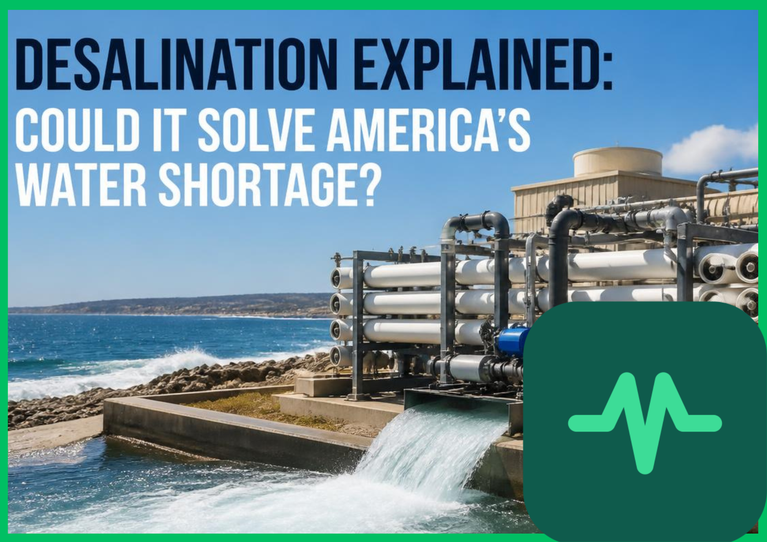
We're surrounded by ocean water on both coasts, endless amounts of it. Yet in California, Arizona, and other states, water shortages keep getting worse every year. What if we could just turn that ocean water into drinking water?
That's exactly what desalination does, and it's genuinely more real than science fiction. Let's talk honestly about how it works, and whether it's actually the solution people hope for.
Desalination, Explained Simply
Desalination is the process of removing salt from seawater, turning it into fresh, drinkable water. It sounds almost too simple when you say it that plainly, but the actual process is genuinely complex and energy-intensive.
The most common modern method, called reverse osmosis, forces seawater through extremely fine membranes that filter out salt and other minerals, leaving behind fresh water on the other side.
Why This Technology Feels So Genuinely Promising
Here's the appeal, and it's genuinely significant. Unlike rainfall or groundwater, ocean water is essentially unlimited, at least along coastal regions. For water-stressed coastal states, this represents a real, potentially drought-proof water source.
California, facing repeated severe droughts, has genuinely invested in desalination as part of its broader water strategy. Other coastal states are watching closely, considering similar investments of their own.
The Honest Problem: Cost
Let's be real about the biggest obstacle here. Desalination is genuinely expensive, both to build and to operate. The energy required to force water through those fine membranes adds up to real, substantial costs.
Desalinated water typically costs considerably more than water from traditional sources, like reservoirs or groundwater. This price gap is exactly why desalination hasn't become the obvious, universal fix people sometimes hope it could be.
Energy Use: A Real Environmental Trade-Off
Here's something worth understanding honestly. Desalination takes real, substantial energy to operate, and if that energy comes from fossil fuels, you're genuinely trading a water problem for a carbon emissions problem.
Some newer desalination facilities are pairing with renewable energy specifically to address this concern, powering the process with solar or wind rather than fossil fuels. This genuinely helps, but it also adds real complexity and cost to already expensive projects.
What Happens to All That Leftover Salt?
This is a genuine environmental concern people don't always think about. Desalination doesn't just remove salt, it produces concentrated brine as a byproduct, and this leftover material has to go somewhere.
If this brine gets discharged carelessly back into the ocean, it can genuinely harm local marine ecosystems near the discharge point. Responsible desalination facilities invest real effort in managing this brine carefully, but it remains a genuine environmental challenge worth taking seriously.
Where Desalination Is Already Working in America
This isn't purely theoretical. Several desalination plants already operate along the California coast, providing real drinking water to communities facing severe drought pressure.
Texas has explored desalination too, particularly for treating brackish groundwater, a less salty version of seawater that's genuinely cheaper to desalinate than full ocean water. Florida has some experience with desalination as well, given its own coastal water challenges.
Why Desalination Alone Won't Solve Everything
Here's an honest, important point. Even where desalination works well, it's genuinely not meant to be the entire solution to water scarcity on its own.
Most water experts see desalination as one piece of a much larger strategy, alongside water conservation, recycling wastewater, and improving agricultural irrigation efficiency. Relying on desalination alone, without addressing water waste and inefficiency, genuinely misses the bigger picture.
Why This Matters Emotionally for Western States
For families living through severe, repeated droughts, watching reservoirs shrink year after year creates genuine anxiety about the future. Desalination offers real, tangible hope, a water source that doesn't depend entirely on unpredictable rainfall.
That emotional relief matters, even accounting for the technology's real cost and environmental trade-offs. Knowing there's a genuine backup option, even an expensive one, provides real psychological comfort for water-stressed communities.
The Technology Keeps Genuinely Improving
Desalination costs have actually fallen significantly over recent decades, as membrane technology and energy efficiency have both genuinely improved. What was prohibitively expensive years ago is becoming somewhat more affordable now, though it still costs more than traditional water sources.
This trend is genuinely encouraging. If costs keep falling and renewable energy keeps getting cheaper too, desalination could become a genuinely larger part of America's water strategy in the coming decades.
Who Actually Pays for Desalinated Water?
This is worth understanding honestly. The higher cost of desalinated water typically gets passed along to consumers through their water bills, at least partially, in communities that rely on it.
This creates genuine tension in policy discussions, balancing the real need for drought-proof water against the real burden of higher water costs for everyday families, particularly those with tighter budgets.
Common Questions About Desalination
Is desalinated water safe to drink?
Yes, when properly treated and regulated, desalinated water meets the same safety standards as water from traditional sources.
Why isn't desalination used more widely across America?
Primarily due to cost. It's significantly more expensive than traditional water sources, which limits widespread adoption despite genuine water scarcity concerns.
Does desalination harm ocean ecosystems?
It can, primarily through the concentrated brine byproduct, if not managed carefully. Responsible facilities invest real effort in minimizing this environmental impact.
Could desalination completely solve water shortages in states like California?
Unlikely on its own. Most experts see it as one piece of a larger strategy alongside conservation and water recycling efforts.
Final Thoughts
Desalination genuinely offers real hope for water-stressed American communities, but it's not the simple, complete fix that headlines sometimes suggest. It's an expensive, energy-intensive technology with real environmental trade-offs of its own.
Still, as costs keep falling and water scarcity keeps growing more serious across the West, desalination will likely play a genuinely larger role in America's water future. It's not a silver bullet, but it's a real, valuable piece of a much bigger puzzle.


Comments (0)
Login to leave a comment.
No comments yet. Be the first to share your thoughts!