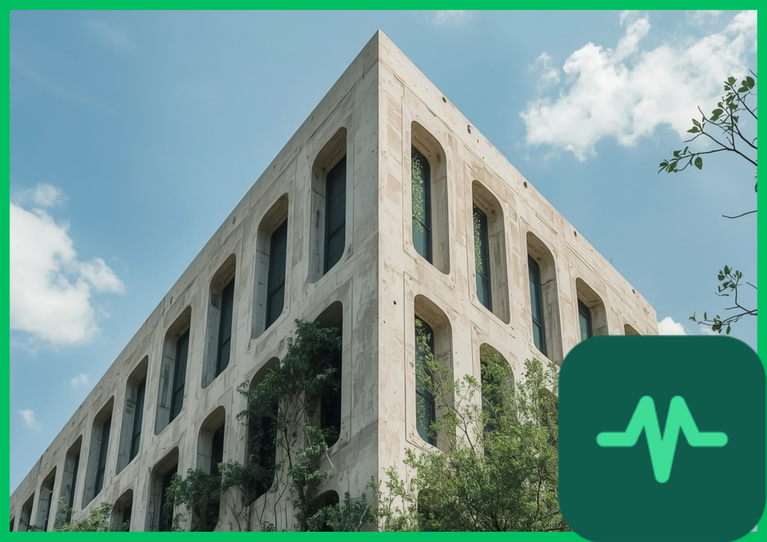
As much as they beautify the environment, they have a side effect. They carry a devastating environmental cost.
Cement production alone accounts for roughly 8% of global carbon dioxide emissions. Manufacturing steel requires burning massive amounts of coal. Our built environment is baked from fossil fuels.
To build a truly sustainable future, we must change what our buildings are made of.
Architects and engineers are turning back to nature, using bio-based construction materials to replace high-emission concrete and steel.
Here is how natural building supplies are transforming modern architecture.
The Hidden Carbon Cost of Concrete and Steel
Concrete is the most consumed man-made material on Earth, second only to water.
Making traditional Portland cement requires heating limestone and clay in massive kilns. This is fueled by coal or gas at blistering temperatures of up to 1,450 degrees Celsius (2,640 degrees Fahrenheit). That chemical reaction releases carbon dioxide stored inside the stone directly into the air.
Steel manufacturing adds even more greenhouse gas emissions to the atmosphere.
When we construct modern buildings, we lock in massive upfront carbon debts before anyone even steps inside.
We need materials that capture carbon rather than emit it.
Mass Timber and Engineered Wood
One of the most exciting breakthroughs in sustainable architecture is the rise of mass timber.
Engineered wood products, like cross-laminated timber, glue laminated timber, and nail laminated timber, bind layers of sustainable wood together under immense hydraulic pressure.
These engineered panels achieve a strength-to-weight ratio that rivals structural steel.
Trees absorb carbon dioxide from the atmosphere as they grow, locking that carbon safely inside the wood fiber for decades or centuries.
When architects build skyscrapers out of mass timber, the building effectively becomes a massive carbon sink, locking away thousands of tons of greenhouse gases instead of emitting them.
Hempcrete and Natural Bio-Composites
Beyond structural wood, innovators are developing remarkable bio-composites for insulation and wall cladding.
Hempcrete is a mixture of industrial hemp hurds (the woody inner core of the hemp plant) mixed with a lime-based binder.
It is lightweight, fire-resistant, provides exceptional thermal insulation, and captures carbon dioxide as the hemp plant grows and as the lime binder cures over time.
Natural insulation materials made from sheep's wool, wood fiber, and straw bales replace toxic fiberglass and petroleum-based foam insulation, creating breathable walls that regulate indoor humidity naturally without artificial dehumidifiers.
Designing a Regenerative Built Environment
Switching to bio-based construction materials represents a philosophical shift in architecture.
Instead of viewing buildings as permanent, sterile concrete boxes, sustainable architecture treats buildings as temporary carbon vaults grown from the earth.
When a mass timber building eventually reaches the end of its functional life decades down the road, its components can be safely repurposed, recycled, or returned to the earth cleanly.
By building beyond concrete, we are transforming our cities from climate liabilities into living, breathing climate solutions.

Comments (0)
Login to leave a comment.
No comments yet. Be the first to share your thoughts!