 )—impose an avoidable electrical baseload on municipal power grids. Hybrid heat pump water heaters (HPWH) bypass this thermodynamic ceiling by utilizing a vapor-compression refrigeration cycle to extract ambient thermal energy from surrounding air, achieving thermal multiplication coefficients of performance (
 ) ranging from 2.5 to 3.5. Quantifying this efficiency requires rigorous analysis of vapor-compression thermodynamics, internal condenser configurations, and ambient air enthalpy bounds.
Vapor-Compression Cycle Mechanics and Refrigerant Physics
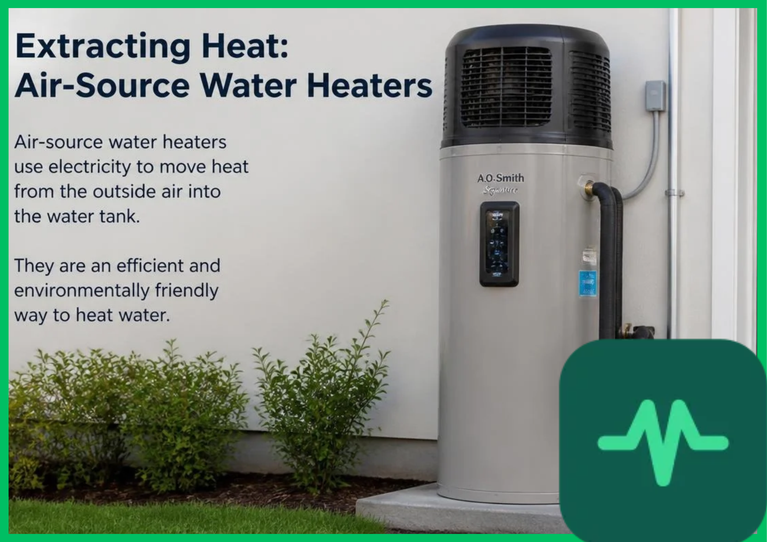
A heat pump water heater operates on the standard vapor-compression refrigeration cycle, redirecting the condenser's heat rejection capacity toward a domestic water storage tank rather than an outdoor space. The system comprises four primary thermodynamic components: an evaporator coil, a hermetic compressor, an internal or external condenser coil, and an expansion device.
Modern HPWH units transition toward low global warming potential (GWP) working fluids, such as R-134a, R-513A, or hydrocarbon blends like R-290 (propane).
- Evaporation: Ambient air is drawn across the finned-tube evaporator coil by an integrated variable-speed fan. Low-pressure liquid refrigerant absorbs sensible and latent heat from the ambient air, boiling into a saturated vapor at temperatures below the surrounding air temperature.
- Compression: The low-pressure vapor enters an inverter-driven rotary compressor. Electrical work input (
 ) compresses the refrigerant vapor to high pressure and high temperature, raising its enthalpy state.
- Condensation: Superheated high-pressure refrigerant flows through the condenser coil, transferring latent heat of condensation directly to the domestic water volume inside the storage tank.
- Expansion: The high-pressure liquid passes through an electronic expansion valve (EEV), undergoing an isenthalpic pressure drop that flashes a fraction of the fluid into a cold liquid-vapor mixture before re-entering the evaporator.
Mathematical Formulation of COP and Uniform Energy Factor (UEF)
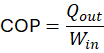
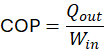
The operating efficiency of a heat pump water heater is quantified via the coefficient of performance ( ), defined as the ratio of useful thermal energy transferred to the water storage tank (
 ) to the total electrical work input consumed by the compressor motor and auxiliary fans (
 ):
Because thermal energy extracted from the ambient air ( ) is added to the electrical work input (
 ), the energy balance dictates that
 , ensuring the resulting
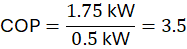
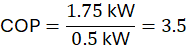
 always exceeds 1.0. For example, a system consuming
 of electrical power while delivering
 of thermal energy to heat stored water achieves a
 of:
To standardize efficiency ratings across regulatory frameworks, testing protocols utilize the Uniform Energy Factor (UEF). UEF measures the total daily hot water energy delivered divided by the total daily electrical energy consumed over a simulated 24-hour use test cycle. High-efficiency hybrid water heaters achieve UEF ratings between 3.0 and 4.0, compared to UEF values of 0.90 to 0.95 for baseline electric resistance tanks.
Ambient Air Enthalpy and Thermal Source Dynamics
Unlike space heating heat pumps that operate outdoors and face severe efficiency drops during sub-zero winter weather, residential heat pump water heaters typically operate indoors within basements, utility rooms, or garages. This indoor installation environment provides a stable thermal source environment, maintaining ambient dry-bulb temperatures generally between  and
 (
 to
 ).
Ambient air enthalpy directly dictates system performance. As ambient air temperature declines, the saturation pressure of the refrigerant drops, reducing mass flow rate and lowering the  . Furthermore, HPWH operation extracts sensible heat and latent moisture from indoor air, producing two distinct environmental co-benefits:
- Space Cooling: Rejects cooled air into the surrounding utility space, providing minor air conditioning benefits during warm seasonal periods.
- Dehumidification: Condenses water vapor from ambient air across cold evaporator fins, draining liquid condensate away via a dedicated purge line and lowering indoor relative humidity.
Technical Data Specifications of Heat Pump Water Heaters
| Technical Parameter | Engineering Specification Range |
|---|---|
Coefficient of Performance ( ) | 2.5 to 3.5 (rated at standard ambient conditions) |
| Uniform Energy Factor (UEF) | 3.0 to 4.0 for hybrid storage units |
| Electrical Power Draw (Compressor) |  to  running power |
| Tank Storage Capacity |  to  (  to  ) |
| Ambient Operating Range |  to  (  to  ) |
| Backup Heating Elements | Dual  electric resistance elements (hybrid mode) |
Condenser Coil Configurations and Thermal Stratification
Internal heat exchanger design is critical for maximizing heat transfer coefficients between refrigerant loops and domestic water volumes. Manufacturers deploy two primary condenser configurations:
- Immersion Condensers: Copper coil heat exchangers submerged directly inside the water tank, providing high direct-contact heat transfer efficiency but requiring penetrations through the tank wall.
- Wrap-Around External Condensers: Microchannel aluminum or copper tubing wrapped tightly around the exterior circumference of the inner steel storage tank, separated by a thermal transfer paste. While external wraps exhibit slightly lower overall heat transfer coefficients than immersion coils, they eliminate internal fluid leak points and prevent scale buildup from hard mineral water.
Thermal stratification within the storage tank ensures that hot water accumulates at the top of the vessel while cold incoming municipal feed water settles at the bottom. Heat pump water heaters maintain gentle circulation velocities, preserving stratification and ensuring that hot water delivery temperatures remain stable at  to
 (
 to
 ) even during high draw events. When high-demand volumetric draw rates exceed heat pump recovery capacity, auxiliary electric resistance heating elements embedded in the upper tank activate temporarily to restore thermal equilibrium.
Empirical Research and Grid Decarbonization Impact
Quantitative assessments published by ENERGY STAR and the International Energy Agency indicate that replacing legacy electric resistance water heaters with high-efficiency heat pump water heaters reduces household water heating electricity consumption by 65% to 75%. This reduction in electrical demand lowers residential load profiles, easing distribution transformer stress and shrinking municipal carbon footprints. As smart grid integration advances, hybrid heat pump water heaters operate as flexible thermal energy storage assets, pre-heating water during periods of high renewable energy generation and curtailing compressor operation during peak grid demand windows.

Comments (0)
Login to leave a comment.
No comments yet. Be the first to share your thoughts!