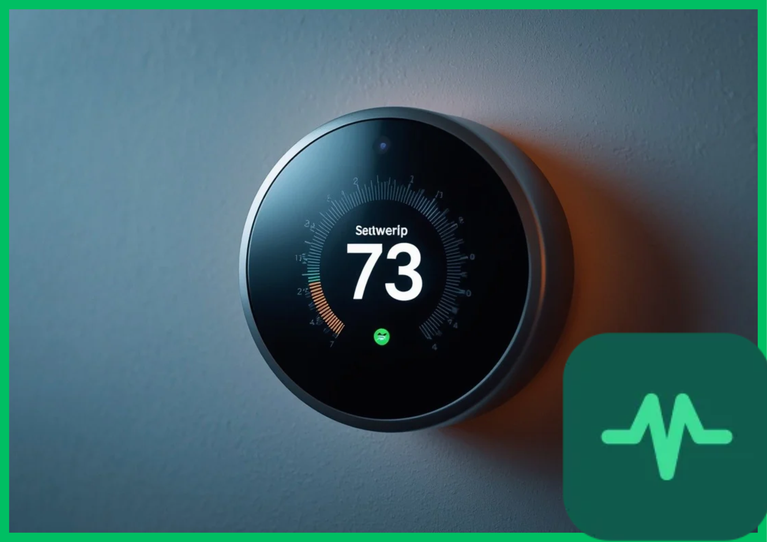
Building Thermal Mass Dynamics and Heat Transfer Physics
A residential structure acts as a complex thermodynamic system governed by thermal capacitance (CthC_{th}Cth) and thermal resistance (RthR_{th}Rth). The rate of heat transfer through a building envelope is defined by Fourier's law of thermal conduction and combined convective-radiative boundary equations. When ambient outdoor temperatures fluctuate, heat flux penetrates exterior wall assemblies, windows, and roof membranes, altering the indoor dry-bulb temperature (TinT_{in}Tin).
Thermal mass—comprising concrete foundations, drywall panels, masonry, and structural framing—stores sensible thermal energy (QsQ_sQs), expressed mathematically as:
Qs=m⋅cp⋅ΔTQ_s = m \cdot c_p \cdot \Delta TQs=m⋅cp⋅ΔT
where mmm represents mass, cpc_pcp denotes specific heat capacity, and ΔT\Delta TΔT represents the temperature differential. Traditional thermostats react exclusively to immediate indoor temperature readings, initiating high-capacity HVAC cycles only after thermal drift occurs. In contrast, smart thermostat thermal inertia optimization models the physical time constant (τ=Rth⋅Cth\tau = R_{th} \cdot C_{th}τ=Rth⋅Cth) of the specific building envelope. By calculating how rapidly structural mass absorbs or releases thermal energy, algorithms predict indoor thermal decay curves, initiating variable-capacity heating or cooling proactively rather than reactively.
Proportional-Integral-Derivative (PID) Control Loops in HVAC Systems
To eliminate thermal overshoot and steady-state error, smart thermostats execute Proportional-Integral-Derivative (PID) control algorithms within the HVAC equipment modulation loop. A PID controller continuously calculates an error value e(t)e(t)e(t) as the difference between the desired temperature setpoint and the measured indoor temperature, applying a correction based on proportional, integral, and derivative terms:
u(t)=Kp⋅e(t)+Ki∫0te(τ)dτ+Kdde(t)dtu(t) = K_p \cdot e(t) + K_i \int_{0}^{t} e(\tau) d\tau + K_d \frac{de(t)}{dt}u(t)=Kp⋅e(t)+Ki∫0te(τ)dτ+Kddtde(t)
- Proportional Gain (KpK_pKp): Adjusts output power proportionally to the current temperature error magnitude, preventing rapid oscillation but leaving a minor steady-state offset.
- Integral Term (KiK_iKi): Integrates accumulated historical error over time, eliminating steady-state temperature offsets caused by persistent ambient heat loss or solar gain.
- Derivative Term (KdK_dKd): Analyzes the rate of change of temperature error, dampening system response as the indoor climate approaches the target setpoint to prevent compressor overshoot or overheating.
By continuously tuning these control parameters, smart thermostats modulate inverter-driven compressors and variable-speed fan blowers smoothly, maintaining indoor temperatures within tight tolerances of ±0.2∘C\pm 0.2^\circ\text{C}±0.2∘C (±0.36∘F\pm 0.36^\circ\text{F}±0.36∘F) while minimizing electrical start-up current surges.
Predictive Pre-Heating, Pre-Cooling, and Weather Integration
Smart thermostat algorithms incorporate predictive regression models that ingest external meteorological data, solar irradiance forecasts, occupancy occupancy schedules, and historical thermal response matrices via cloud API feeds.
During peak electricity tariff periods or high grid carbon intensity intervals, predictive algorithms execute pre-cooling or pre-heating strategies. By shifting HVAC operation outside peak hours, the building leverages its structural thermal mass as a passive thermal battery. For example, a heating system elevates indoor temperatures by 1.0∘C1.0^\circ\text{C}1.0∘C (1.8∘F1.8^\circ\text{F}1.8∘F) prior to a forecasted cold front or peak pricing window, shutting down compressor operation during the peak window while structural thermal capacitance maintains comfortable interior temperatures. This predictive load-shifting reduces peak electrical demand without degrading occupant thermal comfort metrics.
Technical Data Specifications of Smart Thermostat Parameters
| System Parameter | Engineering Specification Range |
|---|---|
| Indoor Temperature Tolerance | ±0.1∘C to ±0.3∘C (±0.18∘F to ±0.54∘F) |
| PID Control Loop Sampling Rate | 0.1 Hz to 1.0 Hz continuous telemetry |
| Building Thermal Time Constant (τ) | 2 hours to 12 hours depending on envelope mass |
| Compressor Minimum Off-Time | 3 minutes to 5 minutes cycle protection |
| Occupancy Detection Latency | <60 seconds via PIR and mmWave radar |
| Outdoor Weather Sync Interval | 15-minute meteorological API refresh cycle |
Energy Efficiency Realities and Empirical Benchmarks
Empirical research published by ENERGY STAR and academic building science consortia demonstrates that algorithmic smart thermostat optimization reduces annual residential heating and cooling energy consumption by 10% to 15%. These efficiency gains stem from three primary operational mechanisms:
- Elimination of Unoccupied Conditioning: Automated occupancy detection utilizing passive infrared (PIR) sensors and millimeter-wave radar sets back temperature setpoints when spaces are vacant, reducing sensible heat losses proportional to the indoor-outdoor temperature differential.
- Reduction of Compressor Cycling Wear: Preventing short-cycling extends compressor longevity and maintains steady-state operating coefficients of performance (COP\text{COP}COP). Variable-capacity heat pumps operating under PID modulation achieve higher seasonal efficiencies than binary staging units.
- Dynamic Setpoint Optimization: Integrating outdoor reset curves adjusts supply water or air temperatures dynamically based on ambient conditions, preventing excessive energy input during mild weather regimes.
As global residential building stocks electrify via heat pump deployment, smart thermostat thermal inertia optimization serves as an essential grid-interactive tool. By dynamically aligning HVAC electrical loads with variable renewable energy generation, algorithmic climate control reduces residential carbon emissions while lowering utility expenditure burdens for occupants.

Comments (0)
Login to leave a comment.
No comments yet. Be the first to share your thoughts!