You turn on the hot water tap in your bathroom sink.
Within seconds, steaming water flows freely, warming your hands and easing you into the day.
You take that hot water for granted.
We all do.
Yet heating water accounts for a massive chunk of the energy consumed in a typical home.
For generations, standard water heaters relied on a crude, wasteful method.
They used electric resistance coils or burned fossil gas to generate heat from scratch.
It felt like using a blowtorch to toast a single marshmallow.
Every time you took a shower or washed a load of laundry, your water heater burned through staggering amounts of electricity or gas, driving up your utility bills and pumping carbon pollution into our shared atmosphere.
We cannot build a clean energy future while heating water with wasteful, outdated resistance coils.
What if your water heater could pull warmth straight out of the surrounding air?
What if it could deliver endless hot water while cutting your electricity use by more than half?
A quiet, brilliant thermodynamic revolution is transforming our homes.
According to global energy reports from the International Energy Agency (IEA), resource protection frameworks from the United Nations Environment Programme (UNEP), efficiency benchmarks from ENERGY STAR, and academic thermodynamics research, heat pump water heater efficiency is changing our domestic energy landscape.
By using compressor-driven air-source technology to move ambient heat into your storage tank instead of creating heat from scratch, we slash household electricity consumption.
Here is how air-source water heating works, why ambient heat recovery changes home economics, and how extracting heat secures our sustainable future.
The Wasteful Trap of Resistance Water Heaters
To understand why heat pump water heaters matter so much, you have to look at how conventional water heaters operate.
Standard electric resistance water heaters work much like a giant toaster hidden inside a metal tank.
Electricity flows through metal coils, heating them up red-hot to warm the water surrounding them.
Physics reveals a frustrating limitation.
Resistance heaters convert electricity into heat on a one-to-one ratio.
For every single unit of electrical energy they consume, they deliver just one unit of heat.
They create zero extra energy.
Gas-powered water heaters burn fossil fuels directly, pumping toxic emissions into your home and neighborhood.
Skeptics once argued that upgrading household water heaters was too expensive or complicated for ordinary families.
Thermodynamics and engineering proved the skeptics wrong.
You do not need to create heat from scratch.
Ambient air surrounding your water heater is already packed with free thermal energy.
You just need a machine to capture it.
What Is an Air-Source Water Heater?
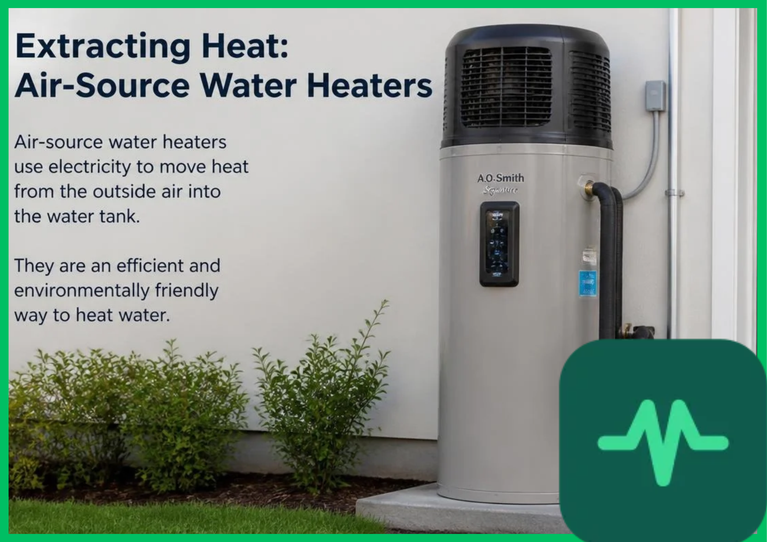
An air-source water heater—commonly known as a hybrid heat pump water heater—is a high-efficiency domestic appliance that uses a refrigeration compressor and evaporator coils to absorb thermal energy from ambient room or outdoor air, transferring that captured warmth directly into a stored water tank.
Instead of generating heat using electric resistance coils, an air-source system acts like a refrigerator working in reverse.
A small fan pulls air across an evaporator coil filled with liquid refrigerant.
Even on a cool day, that air holds plenty of heat.
The refrigerant absorbs the warmth, turning into a gas.
A compressor squeezes the gas, raising its temperature significantly.
That superheated gas flows through a condenser coil wrapped around the water tank, dumping its heat straight into your domestic water supply.
The refrigerant cools down, liquidifies, and repeats the cycle.
You get piping-hot water using a fraction of the electricity required by a standard resistance heater.
The Science of Ambient Heat Recovery and Efficiency
How can a machine move more heat energy into a water tank than the electrical energy it consumes from your wall outlet?
It comes down to thermodynamics and the coefficient of performance.
Academic thermodynamics research shows that air-source heat pumps do not generate heat; they move it.
Because they move existing heat rather than creating it from electricity, their efficiency rating climbs far above 100%.
In fact, modern heat pump water heaters achieve a coefficient of performance of 3 to 4, meaning they deliver 3 units to 4 units of heat energy for every 1 unit of electricity they consume.
That translates to an efficiency rating of 300% to 400%.
According to ENERGY STAR and international appliance efficiency evaluations, replacing an old electric resistance water heater with an air-source model cuts annual water heating electricity consumption by up to 70%, saving families hundreds of dollars every single year.
Furthermore, because these units pull heat out of the surrounding air, they provide a bonus side benefit.
They dehumidify and cool the basement or utility room where they sit, keeping your home comfortable during humid summer months.
Environmental Integrity and Global Decarbonization
The environmental benefits of high-efficiency water heating extend far beyond lowering family utility bills or cooling a basement.
They form a crucial pillar for global carbon reduction.
According to UNEP resource governance frameworks, upgrading residential appliances to high-efficiency heat pump systems is one of the fastest, most cost-effective ways to lower urban electricity demand.
When millions of homes switch from wasteful resistance coils to air-source water heaters, regional power grids experience a massive drop in peak load.
That reduction allows utility companies to retire old coal and gas peaker plants much faster.
According to IEA clean energy roadmaps, scaling up residential heat pump technology is an essential step to eliminate fossil fuel use in buildings worldwide.
When every home extracts clean ambient warmth, our entire society grows more sustainable.
Overcoming Installation and Space Realties
Upgrading a home to an air-source water heater involves navigating real-world spatial considerations.
Heat pump water heaters stand slightly taller than old resistance tanks and require adequate airflow around the unit to pull in ambient warmth effectively, meaning they need a room with sufficient cubic volume or ducting options.
Homeowners and plumbers solve these challenges by installing units in spacious basements, utility rooms, or garages where natural air circulation is abundant.
As manufacturing techniques improve and compact, quiet designs enter the market, air-source water heaters are transitioning from specialty green upgrades into standard residential plumbing choices across the globe.
Extracting Our Heat Toward a Sustainable Future
Air-source water heaters prove that smart engineering can harness ambient energy right inside our own homes.
We no longer have to accept that taking a hot shower requires burning fossil fuels or wasting electricity on crude resistance coils.
By using refrigeration compressors to extract free thermal energy from the air, we heat our water with breathtaking efficiency.
We step away from wasteful energy use, embracing a smart, efficient, and enduring standard of domestic living.
Through brilliant thermodynamics, rigorous academic research, and a deep respect for our shared environment, extracting heat secures a clean, bright, and sustainable future for every household on Earth.

Comments (0)
Login to leave a comment.
No comments yet. Be the first to share your thoughts!