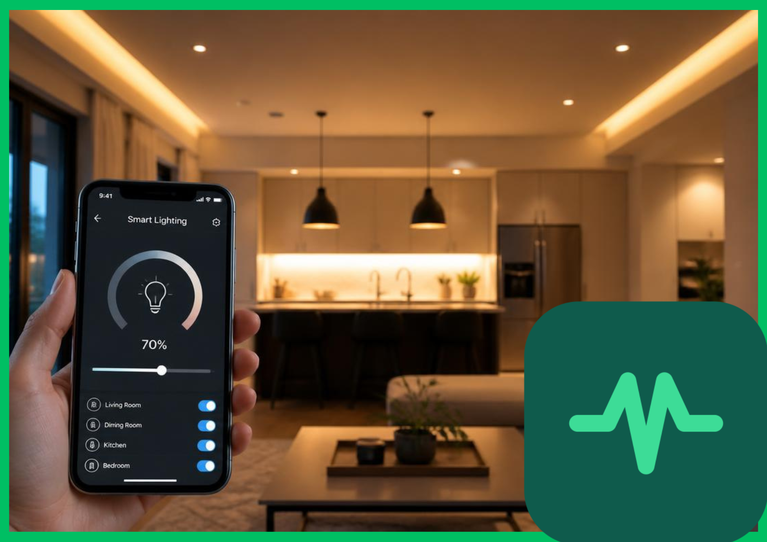
Except smart lighting quietly changes more than people expect. Not just how a room looks, but how much energy actually gets used along the way.
The first, obvious savings: LED technology itself
Most smart bulbs are built on LED technology, which already uses a fraction of the electricity older bulbs required. Even before you add any smart features, simply switching to LED delivers real, meaningful savings.
That's the foundation. Everything smart lighting adds afterward builds on top of that.
Where the real savings actually come from
Here's the part people miss. The biggest savings from smart lighting rarely come from the bulb itself. They come from the habits it quietly encourages.
Automatic schedules mean lights turn off in empty rooms without anyone remembering to flip a switch. Motion sensors mean hallways and closets light up only when someone's actually there. Away-mode settings mean your whole house isn't lit up while you're at work or on vacation.
None of these features feel dramatic on their own. But multiplied across every room, every day, they add up to genuine, steady savings.
The dimming feature nobody talks about
Most smart bulbs let you dim lights right from an app. This feels like a comfort feature, but it's also a savings feature.
A bulb dimmed to 50 percent brightness typically uses meaningfully less electricity than one running at full brightness. If you tend to keep lights dimmer in the evening anyway, smart bulbs simply make that habit effortless.
Comparing the upfront cost
Smart bulbs cost more than a basic LED bulb. There's no getting around that honestly.
But because they already start from LED's lower energy baseline, and because they encourage habits that reduce unnecessary use, most households recover that extra cost over time through the electricity they save.
The exact timeline depends on how many bulbs you switch and how consistently you use the smart features. A single smart bulb in a rarely-used room won't do much. A whole-home setup with schedules and sensors adds up faster.
Where smart lighting makes the biggest difference
Outdoor lighting is a strong starting point. Motion-activated smart lights outside your home mean you're not running porch lights all night for no reason.
Hallways, closets, and bathrooms are excellent second choices. These are rooms people frequently forget to switch off manually, since no one lingers there long.
Bedrooms and living rooms benefit most from scheduling and dimming, since lighting habits there tend to be more routine and predictable.
A few honest limitations
Smart bulbs require a stable Wi-Fi connection to function fully. A spotty home network can occasionally cause delays or missed commands.
They also have a genuine cost barrier for whole-home setups. Replacing every bulb in a large house isn't cheap, even with LED's lower running costs factoring in.
And if you already diligently turn off lights when leaving a room, the added savings from automation will naturally be smaller, since you're already doing manually what the smart bulb would otherwise handle.
A realistic way to start
You don't need to replace every bulb at once. Start with the rooms where lights get left on the most, or the outdoor areas where motion sensing makes the most obvious sense.
Watch how the habit shifts. Notice what you stop thinking about entirely, because the bulb now handles it for you.
The honest bottom line
Smart lighting won't transform your electricity bill on its own. But paired with LED's efficiency and a few thoughtful automations, it creates a quiet, steady form of savings that simply keeps happening in the background.
Sometimes, the best kind of saving is the one you never have to think about again.
Comments (0)
Login to leave a comment.
No comments yet. Be the first to share your thoughts!