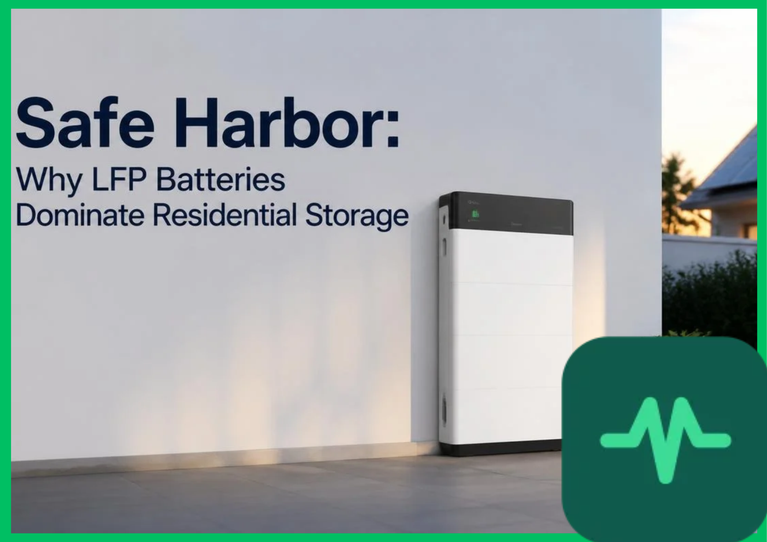
It stores clean solar energy captured from your roof during the day, holding that power safely in reserve.
When evening falls or the local power grid fails, that battery springs into action, keeping your lights on and your refrigerator running without a single sound.
You feel a deep sense of security. Your home is protected, powered, and self-sufficient.
Battery safety matters deeply when you store massive amounts of electrical energy right where your family sleeps.
For years, early residential energy storage systems relied on standard nickel-manganese-cobalt or older lithium-ion chemistry. While those batteries packed high energy density, they carried a hidden vulnerability to thermal stress and fire risks.
A quiet chemical shift has transformed how we store electricity in our homes.
According to energy storage reports from the International Energy Agency (IEA), resource safety guidelines from the United Nations Environment Programme (UNEP), residential efficiency metrics from ENERGY STAR, and comprehensive academic battery research, lithium iron phosphate (LFP) chemistry has become the undisputed champion of residential storage.
By prioritizing molecular safety, thermal stability, and incredible long-cycle durability, LFP batteries provide a true safe harbor for modern sustainable homes.
Here is how LFP battery chemistry works, why non-flammable battery safety changes residential storage, and how iron-based cells secure our energy future.
The Hidden Anxiety of Early Home Storage
To understand why LFP batteries conquered the residential market, you have to look at what happened with older battery technologies.
When homeowners first started installing battery backups paired with rooftop solar panels, engineers adapted high-nickel lithium-ion chemistries originally designed for consumer electronics and electric cars.
Those batteries worked well for packing maximum power into tight spaces.
They also carried strict thermal management requirements.
If a traditional high-nickel battery cell suffered a physical puncture, an internal manufacturing defect, or an electrical short circuit under heavy load, it could experience thermal runaway.
A single failing cell could trigger a chain reaction, generating intense heat and combustible gases that occasionally led to residential fires.
Imagine lying in bed at night, knowing a volatile chemical reaction could theoretically trigger in your basement or garage if a system malfunctioned.
That background anxiety held back mass adoption.
Homeowners needed a battery chemistry that was fundamentally, chemically incapable of catching fire under normal residential stress.
What Is an LFP Battery?
A lithium iron phosphate battery—widely known as an LFP battery—takes a completely different chemical approach.
Instead of relying on expensive, reactive cobalt or volatile nickel, an LFP cell uses iron and phosphate as its primary cathode materials.
Iron and phosphate are among the most abundant, stable, and non-toxic elements on Earth.
When you look inside an LFP cell, the crystal structure formed by the iron phosphate bonds is remarkably strong.
Those chemical bonds hold tightly together even when subjected to extreme electrical currents, overcharging, or severe physical damage.
The olivine crystal structure of iron phosphate prevents oxygen atoms from breaking free during thermal stress.
Without loose oxygen feeding a fire, thermal runaway is virtually eliminated.
Academic materials research shows that LFP cells remain chemically stable at temperatures exceeding 250°C to 300°C (approx. 482°F to 572°F) where other chemistries would fail catastrophically.
The Power of Non-Flammable Battery Safety
The real superpower of LFP chemistry is absolute peace of mind.
When testing facilities put LFP cells through extreme abuse testing—nail penetration, severe overcharging, crushing weight, and external blowtorches—the results are astonishing.
Traditional batteries erupt in violent flames under those conditions.
LFP batteries simply vent a small amount of harmless gas, stay cool, and refuse to catch fire.
This non-flammable battery safety changed everything for residential energy storage.
Homeowners no longer need complex, expensive liquid cooling systems or heavy blast-shield containers to keep their home battery banks safe.
An LFP battery can sit securely in an indoor garage, a basement utility closet, or an outdoor weather box, operating quietly and safely year after year.
According to ENERGY STAR safety benchmarks, non-flammable LFP systems meet the strictest global fire codes for residential installations worldwide.
Long-Cycle Durability and Lifetime Value
Safety is only half the story. LFP batteries also deliver unmatched economic and functional longevity.
When you invest in a residential energy storage system, you want it to last for decades, cycling every single day as it charges from solar panels and discharges during evening peak hours.
Traditional high-nickel batteries degrade steadily over 2,000 to 3,000 charge cycles, losing significant capacity as internal chemical structures wear down.
LFP batteries operate on an entirely different durability curve.
Academic electrochemical research demonstrates that high-quality LFP residential cells easily achieve 6,000 to 8,000 charge-discharge cycles while retaining over 80% of their original storage capacity.
If you cycle your home battery once every single day, an LFP system lasts for 15 to 20 years or more before showing noticeable wear.
That incredible lifespan changes the financial math of home energy storage.
Homeowners enjoy reliable solar backup and lower utility bills for decades, eliminating the cost and hassle of early battery replacements.
Securing Home Energy Independence
LFP batteries prove that sustainable technology does not require compromising on safety or reliability.
We no longer have to accept volatile chemistry in our living spaces just to store clean renewable energy.
By combining molecular stability, non-flammable safety, and multi-decade durability, LFP batteries provide a true safe harbor for modern households.
UNEP resource governance frameworks highlight that iron and phosphate are widely available, conflict-free minerals that avoid the severe mining abuses associated with cobalt and rare earth metals.
You protect your home, you lower your carbon footprint, and you achieve true energy independence without a single worry.
Through brilliant chemistry and uncompromising safety standards, LFP batteries anchor the sustainable smart homes of today and tomorrow.
Comments (0)
Login to leave a comment.
No comments yet. Be the first to share your thoughts!