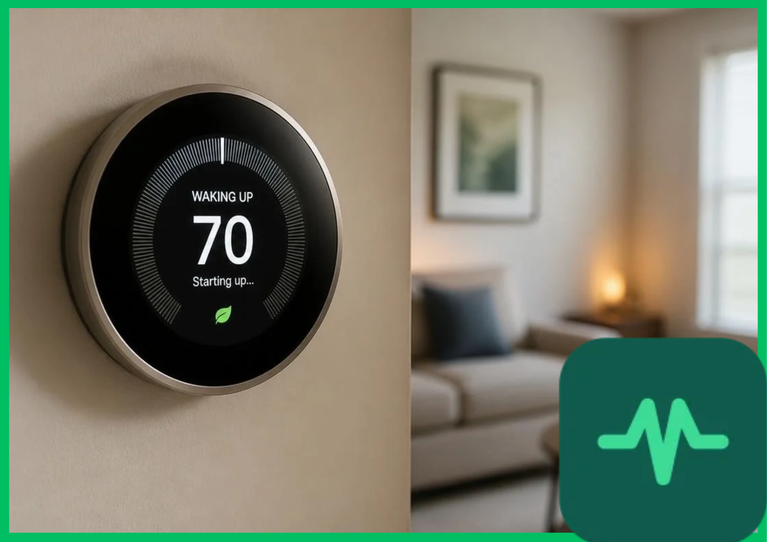
A heavy, stuffy heat greets you in the hallway.
Your home feels like an oven because your heating and cooling system ran at full blast all day long, completely ignoring the fact that nobody was home.
You sigh, walk over to the wall dial, and adjust the temperature.
Then you open your monthly utility bill, and that sinking feeling hits your chest again.
Heating and cooling make up the largest share of energy use in almost every home.
For generations, we controlled our indoor climate with dumb, static thermostats.
You set a temperature, and the system held it rigidly around the clock. It heated or cooled empty bedrooms while you were away at work. It wasted power all night while you slept under warm blankets.
That round-the-clock waste burns fossil fuels, pumps carbon into our shared atmosphere, and drains your hard-earned money.
We cannot build a sustainable future while heating and cooling empty spaces.
What if your home climate system could think for itself?
What if it learned your daily routine, anticipated weather changes, and kept your rooms comfortable only when you actually needed them?
A quiet, brilliant digital revolution is transforming our living spaces.
According to global energy efficiency reports from the International Energy Agency (IEA), resource protection frameworks from the United Nations Environment Programme (UNEP), appliance guidelines from ENERGY STAR, and academic smart grid research, smart thermostat energy savings are changing domestic energy consumption.
By using machine learning algorithms and automated climate control, we slash domestic energy waste without sacrificing an ounce of personal comfort.
Here is how smart climate automation works, why automated heating efficiency changes household economics, and how intelligent thermostats secure our sustainable future.
The Blind Waste of Traditional Dial Thermostats
To understand why smart climate automation matters so much, you have to look at the flaw of traditional heating and cooling controls.
For decades, thermostats were mechanical switches.
They had zero memory and zero intelligence.
If you wanted your house cool when you woke up at 7:00 AM, you had to remember to adjust the dial before bed. If you forgot to turn down the heat when you left for a week-long vacation, the furnace kept your empty house cozy the entire time.
Most people set a single temperature and left it there forever.
That lazy habit resulted in a staggering amount of wasted energy.
Energy is lost through drafty walls and windows, but the biggest waste comes from conditioning empty rooms.
Heating an empty house for ten hours a day is like leaving your car engine idling in the driveway while you sit inside your office.
It burns fuel for no reason.
We needed a system that connects indoor climate control to real human lives.
What Is Smart Climate Automation?
Smart climate automation is an advanced IoT software platform that uses occupancy sensors, geofencing, and machine learning algorithms to adjust your home heating and cooling automatically based on your real-time location and daily habits.
Instead of forcing you to program complicated weekly schedules by hand, the smart thermostat studies your routine.
It notices when you wake up, when your family leaves for work or school, and when you return home in the evening.
If everyone leaves the house on a Tuesday morning, the geofencing software in your smartphone signals the thermostat.
The system dials back the heating or cooling automatically, letting the indoor temperature drift safely toward an eco-friendly standby level.
Then, an hour before you finish work, the system wakes up.
It calculates local weather forecasts, outdoor wind speeds, and thermal building mass, turning on the HVAC system just in time to bring your rooms to a cozy 21°C or 70°F the exact moment you walk back through the door.
You never lift a finger, yet you save energy every single day.
The Science of Machine Learning and HVAC Optimization
How does a small digital device on your wall predict your comfort needs with such startling accuracy?
It comes down to adaptive machine learning and thermal modeling.
Academic smart grid research shows that advanced thermostats analyze historical weather data and thermal response times to optimize home heating efficiency.
Traditional thermostats operate like a blunt instrument—turning the furnace on at full blast until the target temperature is reached, then shutting it off completely until the room drops another degree.
That crude cycling wastes energy and causes temperature swings.
Smart automation uses continuous algorithmic loops.
It learns how fast your specific home loses heat in a 0°C or 32°F winter freeze versus a mild autumn day.
It ramps compressor speeds and burner outputs smoothly, maintaining stable indoor temperatures while consuming minimum electrical power.
According to ENERGY STAR and international appliance efficiency evaluations, automated climate scheduling reduces annual residential heating and cooling energy use by up to 10% to 15%.
The software eliminates unnecessary runtime, extending the mechanical lifespan of your expensive HVAC equipment while lowering utility bills.
Environmental Integrity and Regional Grid Support
The benefits of smart climate automation extend far beyond individual household savings.
They play a critical role in stabilizing regional power grids during extreme weather events.
When a summer heatwave strikes a city, millions of air conditioning units turn on simultaneously, pushing electrical grids to the brink of blackouts.
Smart thermostats participate in automated demand response programs, coordinating with utility operators in the background.
During peak electricity strain, the system pre-cools homes slightly during off-peak morning hours, then backs off compressor loads for a brief window during peak evening hours.
The homeowner feels zero loss of comfort, but the regional grid avoids rolling blackouts and expensive fossil-fuel peaker plants stay turned off.
According to UNEP resource sustainability frameworks, widespread adoption of smart climate control reduces total urban energy demand significantly.
IEA energy transition assessments highlight that digital demand-side management is the cheapest, cleanest way to balance modern renewable power grids.
Designing Your Personal Comfort Hub
Upgrading to a smart climate system is one of the easiest home improvements you can make.
Most smart thermostats are designed for simple DIY installation, replacing old mechanical wall dials in less than thirty minutes using standard wiring.
Companion smartphone apps let you monitor and adjust your home climate from anywhere in the world.
If you arrive home early from a trip, you can tap your screen and warm up the living room before you even pull into the driveway.
You set your personal comfort preferences, and the system handles the background mechanics of sustainable living quietly and effortlessly.
Waking Up Toward a Sustainable Future
Smart climate automation proves that digital intelligence can solve everyday energy waste without requiring lifestyle sacrifices.
We no longer have to accept the clumsy routine of heating and cooling empty homes around the clock.
By letting machine learning algorithms manage our indoor climate, we turn ordinary HVAC systems into smart energy savers.
We step away from wasteful habits, embracing a comfortable, efficient, and enduring standard of living.
Through brilliant software engineering, machine learning optimization, and deep respect for our planetary climate, waking the thermostat secures a clean, bright, and sustainable future for every home on Earth.
Comments (0)
Login to leave a comment.
No comments yet. Be the first to share your thoughts!