 ), vapor-compression heat pumps move heat via a working fluid, achieving thermal multiplication coefficients ranging from 2.0 to over 5.0. Quantifying this operational efficiency requires rigorous thermodynamic analysis of the heat pump coefficient of performance (
 ), refrigerant phase change properties, and ambient temperature boundary conditions.
Thermodynamic Principles and the Carnot Efficiency Limit
The theoretical upper bound for any thermodynamic cycle operating between two thermal reservoirs is defined by the Carnot efficiency limit. For a vapor-compression heat pump operating in heating mode, the maximum theoretical Coefficient of Performance ( ) is a function of absolute temperatures measured in Kelvin (
 ):
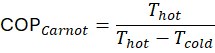
where  represents the absolute condensation temperature of the refrigerant within the condenser coil, and
 represents the absolute evaporation temperature of the refrigerant within the evaporator coil.
As the temperature differential ( ) across the system increases—such as when outdoor ambient temperatures drop during severe winter weather—the theoretical Carnot limit degrades rapidly. Real-world vapor-compression cycles operate below this ideal Carnot threshold due to irreversible mechanical and thermodynamic losses, including compressor volumetric inefficiencies, refrigerant pressure drops through piping and valves, superheating, subcooling, and heat transfer thermal resistance across coil walls.
Refrigerant Thermodynamic Properties and Cycle Mechanics
The operational heart of a heat pump is the vapor-compression cycle, consisting of four primary thermodynamic processes: evaporation, compression, condensation, and expansion. Modern heat pump designs transition away from high global warming potential (GWP) hydrofluorocarbons (HFCs) toward low-GWP refrigerants such as difluoromethane (R-32), propane (R-290), and carbon dioxide (R-744).
- Evaporation: Low-pressure, low-temperature liquid-vapor refrigerant mixture enters the outdoor evaporator coil. Thermal energy transfers from ambient air or ground loops into the refrigerant at constant pressure, causing the liquid to boil into a saturated vapor.
- Compression: The low-pressure vapor enters an inverter-driven scroll or rotary compressor. Mechanical work input (
 ) compresses the refrigerant vapor to high pressure and high temperature, elevating its enthalpy state in accordance with polytropic compression curves.
- Condensation: High-pressure superheated refrigerant vapor enters the indoor condenser coil. As indoor air or water flows across the coil, the refrigerant rejects latent heat of condensation, transitioning back into a high-pressure liquid state.
- Expansion: The high-pressure liquid passes through an electronic expansion valve (EEV) or thermostatic expansion valve (TXV), causing an isenthalpic pressure drop that flashes a fraction of the liquid into a cold, low-pressure vapor-liquid mixture before re-entering the evaporator.
Mathematical Formulation of Coefficient of Performance (COP)
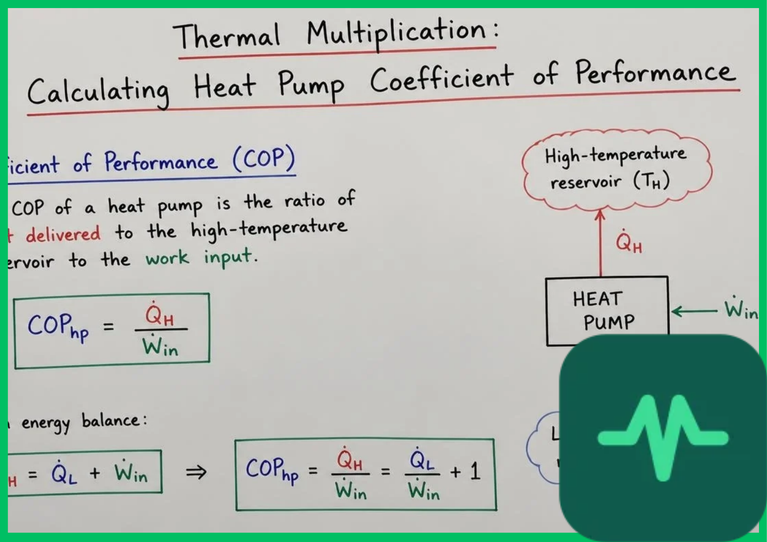
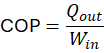
The actual operating Coefficient of Performance ( ) of a heat pump is defined as the ratio of useful thermal energy delivered to the heated space (
 ) to the total electrical work input required by the system (
 ):
The thermal output delivered by the condenser ( ) equals the sum of the heat absorbed from the ambient source at the evaporator (
 ) and the electrical work added by the compressor motor (
 ):

Substituting this energy balance into the  equation yields:
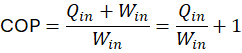
This mathematical formulation demonstrates that  is always greater than 1.0 for a functional vapor-compression cycle, provided the thermal energy extracted from the ambient source (
 ) is positive. For example, if a heat pump consumes
 of electrical power to drive the compressor and auxiliary fans while delivering
 of thermal energy to the indoor heating distribution network, the resulting
 is:
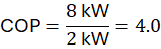
This indicates that the system delivers four units of thermal energy for every single unit of electrical energy consumed, achieving a 400% thermal efficiency equivalent relative to direct electric resistance heating.
Ambient Temperature Dependency and Part-Load Performance
Heat pump performance is highly sensitive to ambient dry-bulb temperature fluctuations. As outdoor temperatures decline, two adverse physical phenomena occur simultaneously: the temperature differential ( ) across the compressor increases, raising compressor work input (
 ), and air density decreases, reducing the volumetric heat extraction capacity (
 ) of the outdoor evaporator coil.
Standard rating conditions specified by international testing standards (such as ISO 13565 and AHRI 210/240) evaluate heat pump performance across standardized outdoor temperature operating points:
- Mild Ambient Operating Point: Outdoor dry-bulb temperature at
 (
 ), yielding peak
 values typically between 3.8 and 5.2.
- Moderate Ambient Operating Point: Outdoor dry-bulb temperature at
 (
 ), where frost accumulation on outdoor coil fins begins to require periodic reverse-cycle defrost cycles.
- Low Ambient Operating Point: Outdoor dry-bulb temperature at
 (
 ), where
 values commonly decline to between 2.2 and 2.8.
- Severe Low Ambient Operating Point: Outdoor dry-bulb temperature at
 (
 ) to
 (
 ), requiring vapor-injection compressor technologies to maintain heating capacity and prevent COP degradation below 1.5.
Frost formation on the outdoor coil acts as an insulating thermal barrier and restricts airflow across fin channels. Automated defrost cycles temporarily reverse the refrigeration cycle to melt frost accumulation, injecting thermal energy drawn from the indoor space and causing temporary dips in seasonal heating efficiency.
Seasonal Performance Metrics: SCOP and HSPF2
Because instantaneous  fluctuates dynamically with changing weather conditions throughout an entire annual heating season, rating agencies utilize aggregated seasonal performance metrics to evaluate real-world energy efficiency:
- Seasonal Coefficient of Performance (SCOP): Utilized primarily in European regulatory frameworks, SCOP measures total thermal energy delivered across an entire standardized heating season divided by total electricity consumption, accounting for varying climate zones (warmer, average, and colder European climates).
- Heating Seasonal Performance Factor 2 (HSPF2): Utilized in North American standards, HSPF2 calculates the total heating output in British Thermal Units (
 ) during a typical heating season divided by the total electrical energy input in Watt-hours (
 ), expressed as a dimensionless ratio or converted to
 .
Modern inverter-driven compressors modulate rotational speed continuously between 20% and 120% of rated capacity, matching heating loads precisely. Part-load operation at lower compressor speeds significantly reduces internal mechanical friction losses and increases heat exchanger surface area ratios relative to refrigerant mass flow, elevating part-load  values above nominal full-load ratings.
Empirical Research and Grid Decarbonization Impact
Quantitative assessments published by the IEA and United Nations Environment Programme (UNEP) confirm that replacing fossil-fuel gas boilers and oil furnaces with high-efficiency heat pump systems reduces primary energy consumption by 40% to 65% across temperate and cold climate zones. Academic research models indicate that even when electricity is generated via fossil-fuel power plants featuring 40% thermal conversion efficiency, a heat pump operating at an average seasonal  of 3.0 delivers a primary energy efficiency equivalent of 120%, outperforming direct combustion heating technologies. As electrical grids integrate higher shares of variable renewable generation, advanced grid-interactive heat pumps utilize thermal mass storage to shift electricity consumption loads dynamically, stabilizing grid frequency while maximizing thermal multiplier efficiency.



Comments (0)
Login to leave a comment.
No comments yet. Be the first to share your thoughts!