
Predictive Load Shifting and Building Thermal Mass Modeling
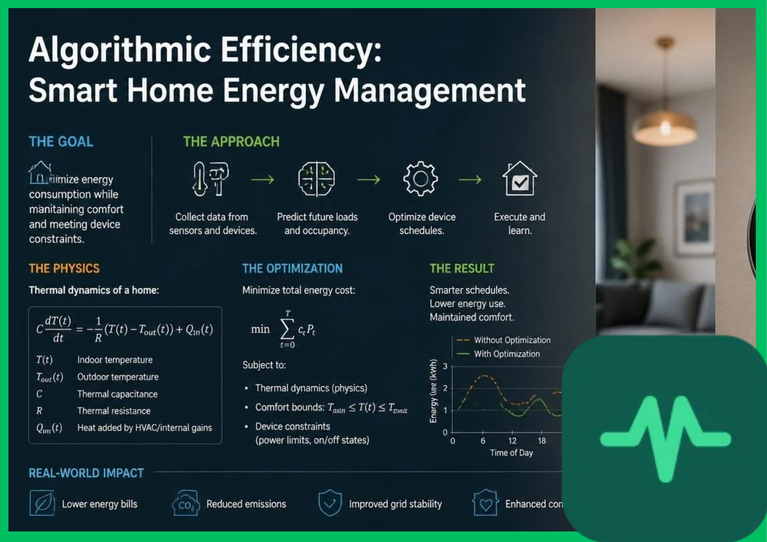
The foundational algorithmic objective governing smart home energy management is predictive load shifting, which decouples electrical appliance operation from immediate occupant demand by leveraging the inherent thermal and electrical capacitance of residential infrastructure. Residential heating, ventilation, and air conditioning (HVAC) systems represent the largest single electrical load in domestic dwellings, frequently consuming 40% to 50% of total household energy.
Predictive algorithms utilize autoregressive integrated moving average (ARIMA) models or recurrent neural networks (RNNs) trained on historical weather forecasts, solar generation telemetry, and occupant behavior patterns to forecast net electrical demand across 24- to 48-hour rolling horizons. Rather than operating HVAC compressors reactively when indoor temperatures drift outside comfort bands, the HEMS algorithm models building envelope thermal mass as an RC-equivalent (resistance-capacitance) electrical circuit:

where  represents the aggregate thermal capacitance of building structural walls and indoor air (
 ),
 is thermal resistance of the insulation envelope (
 ),
 and
 are indoor and outdoor temperatures,
 is thermal energy delivered by the heat pump, and
 is solar heat gain.
By solving this differential equation dynamically, the algorithm pre-cools or pre-heats the building envelope during intervals of low electricity prices or high solar generation, shifting peak HVAC electrical demand away from expensive evening peak pricing windows.
Dynamic Tariff Optimization and Cost Minimization Functions
Modern smart electrical grids utilize dynamic pricing structures—including real-time pricing (RTP), time-of-use (ToU) tariffs, and critical peak pricing (CPP)—where electricity costs fluctuate hourly based on wholesale generation market clearing prices. Unmanaged domestic energy consumption under dynamic tariffs results in high utility expenditures.
Smart home energy management system algorithms mitigate cost volatility by formulating real-time constrained optimization problems. The primary objective function executed by the HEMS optimization engine minimizes total daily electricity expenditure over a finite scheduling horizon ( ), formulated mathematically as:

where  represents electrical power drawn from the utility grid at time step
 ,
 is real-time dynamic electricity purchase price,
 is surplus solar power exported to the grid,
 is feed-in tariff remuneration rate, and
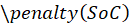 accounts for battery state-of-charge degradation constraints.
Optimization constraints enforce physical equipment boundaries, including maximum inverter power ratings ( ), battery state-of-charge operational limits (
 ), and thermal comfort temperature bounds (
 [
 ]). Mixed-integer linear programming (MILP) solvers execute these algorithms every 15 minutes, re-optimizing appliance schedules in response to shifting weather and market price inputs.
Technical Data Specifications of Smart Home Energy Management Parameters
| HEMS Algorithmic Parameter | Engineering & Software Specification Standard |
|---|---|
| Optimization Scheduling Horizon | 24- to 48-hour rolling predictive window |
| Optimization Execution Frequency | Every 15 minutes via MILP solvers |
| Thermal Building Model Architecture | Resistance-Capacitance (RC) electrical equivalent |
| Battery SoC Operating Boundaries |  operational window to limit degradation |
| Dynamic Tariff Pricing Intervals | Hourly real-time pricing (RTP) or ToU blocks |
| HVAC Comfort Temperature Band |  to  (  to  ) |
| Communication Interoperability Protocol | OpenADR 2.0b / IEEE 2030.5 smart grid standards |
Solar Self-Consumption Ratios and Battery State-of-Charge Management
Maximizing solar self-consumption ratios represents a core algorithmic function in residential microgrids equipped with rooftop photovoltaic arrays and stationary lithium-ion battery storage. When photovoltaic generation exceeds instantaneous household baseload demand, unmanaged systems export surplus clean energy back to municipal distribution grids under diminishing feed-in tariffs.
HEMS algorithms optimize battery charging schedules to capture surplus photovoltaic energy locally rather than exporting it at unremunerative rates. The solar self-consumption ratio ( ) is quantified mathematically as:

When photovoltaic generation ( ) peaks at midday, the HEMS algorithm directs surplus electrical power into stationary battery storage and schedules flexible, deferrable domestic loads—such as domestic hot water heat pump water heaters, electric vehicle Level 2 chargers, and pool filtration pumps—to activate simultaneously. This algorithmic load synchronization elevates household self-consumption ratios from baseline unmanaged levels of 30% up to 80% or higher, maximizing return on investment for distributed renewable assets.
Automated Demand Response and Grid Interoperability Protocols
Beyond local cost minimization, smart home energy management system algorithms participate actively in automated demand response (ADR) programs managed by utility distribution system operators (DSOs). When regional electrical grids experience severe capacity constraints or peak generation deficits during extreme weather events, DSOs broadcast automated price or curtailment signals to residential HEMS networks.
Upon receiving an automated demand response signal via standardized communication protocols such as OpenADR 2.0b or IEEE 2030.5, the HEMS algorithm executes pre-programmed load shedding and curtailment protocols automatically. The algorithm curtails non-critical loads, shifts electric vehicle charging windows, and discharges stored battery energy into the home electrical busbar or exports power back to the grid. This coordinated demand-side flexibility stabilizes municipal distribution transformers, prevents localized brownouts, and provides ancillary grid services without requiring manual occupant intervention.



Comments (0)
Login to leave a comment.
No comments yet. Be the first to share your thoughts!