
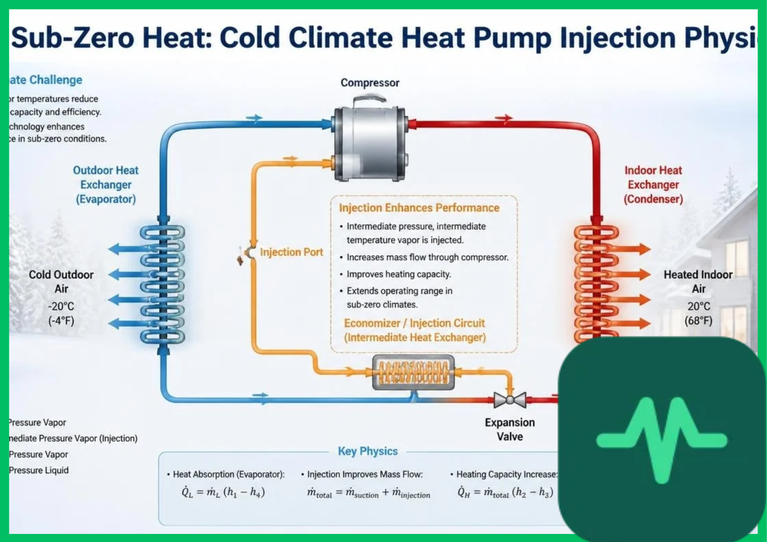
 ) collapse when ambient temperatures drop below
 (
 ). Enhanced vapor injection (EVI) technology resolves these thermodynamic barriers by injecting intermediate-pressure refrigerant vapor into the compression chamber, elevating refrigerant mass flow rates and maintaining high heating capacities in sub-zero environments down to
 (
 ). Analyzing vapor-compression cycle mechanics, flash tank subcooling, and scroll compressor thermodynamics is essential for evaluating cold climate heat efficiency.
Thermodynamic Limitations of Standard Heat Pumps in Sub-Zero Environments
The foundational physical limitation governing standard vapor-compression heat pumps in cold climates is the declining temperature difference between the outdoor ambient heat source and the indoor conditioned space. As outdoor ambient temperatures plunge toward sub-zero levels, the evaporating temperature ( ) of the refrigerant drops precipitously, widening the thermodynamic lift across the system.
This extended temperature lift reduces the density of refrigerant vapor entering the compressor suction port, causing a direct reduction in volumetric mass flow rate. Consequently, the heating capacity of standard heat pumps drops by 30% to 50% at  (
 ) compared to rated nominal capacity at
 (
 ). To compensate for this thermal deficit, unaugmented systems rely on inefficient auxiliary electric resistance heating elements or fossil fuel backup boilers, driving up building electricity consumption and straining municipal electrical grids during peak winter heating demand intervals.
Enhanced Vapor Injection (EVI) Scroll Compressor Mechanics
To counteract capacity degradation without incurring compressor motor burnout or excessive discharge temperatures, cold climate heat pumps utilize specialized scroll compressors equipped with an intermediate vapor injection port. The scroll compressor architecture features an orbiting scroll set that traps refrigerant pockets, compressing them progressively from suction pressure to discharge pressure.
EVI systems introduce an intermediate-pressure vapor stream directly into the compression pockets midway through the compression cycle. This intermediate vapor injection provides internal desuperheating of the compression gas, lowering the final discharge temperature and preventing thermal stress on compressor scroll wraps and lubricating oils. Furthermore, injecting high-pressure vapor increases total mass flow through the condenser coil without requiring an oversized compressor displacement volume, boosting overall heating capacity by 20% to 40% under extreme sub-zero operating conditions.
Refrigerant Enthalpy Expansion and Flash Tank Subcooling
The thermodynamic cycle of an enhanced vapor injection heat pump incorporates an auxiliary brazed plate heat exchanger or an electronic expansion valve (EEV) feeding a flash tank separator. High-pressure liquid refrigerant exiting the condenser is divided into two distinct flow paths: a primary liquid line and a secondary injection line.
The secondary liquid stream expands through an auxiliary injection expansion valve, flashing into a two-phase mixture inside the flash tank separator. The vapor phase is routed directly into the compressor intermediate injection port, while the saturated liquid phase passes through a subcooler heat exchanger, subcooling the primary liquid refrigerant entering the main expansion valve by  to
 (
 to
 ). This dual-expansion process increases the refrigerating effect per unit mass and expands the overall enthalpy difference across the outdoor evaporator coil, elevating system thermodynamic efficiency.
Technical Data Specifications of Cold Climate Heat Pump Parameters
| Cold Climate Heat Pump Parameter | Engineering Specification Standard |
|---|---|
| Ambient Operating Temperature Limit |  to  (  to  ) |
Sub-Zero Heating Coefficient of Performance ( ) |  at  (  ) ambient temperature |
| Compressor Modulation Capacity Range | 15% to 120% inverter-driven variable speed output |
| Refrigerant Working Fluid Options | R32, R454B, or R290 (Propane) low-GWP working fluids |
| Intermediate Injection Pressure Ratio |  geometric mean |
| Defrost Cycle Initiation Trigger | Real-time coil delta- and ambient humidity telemetry |
| Primary Condenser Water Supply Output | Up to  to  (  to  ) hot water |
Sub-Zero Heating Coefficient of Performance ( ) Mechanics
Evaluating cold climate heat pump performance requires examining sub-zero heating coefficients of performance ( ) and capacity maintenance metrics. While standard heat pumps exhibit
 values plummeting below
 at
 (
 ), EVI-augmented heat pump systems sustain
 values between
 and
 across identical sub-zero thermal environments.
The heating coefficient of performance is formulated mathematically as:
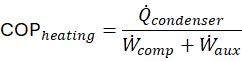
where  represents thermal energy delivered to the indoor heating distribution loop,
 is compressor electrical power consumption, and
 includes fan and control power. By maintaining high
 levels in sub-zero conditions, cold climate heat pumps deliver two to three units of thermal energy for every unit of electrical energy consumed, outperforming traditional resistance heating systems.
Defrost Cycle Physics and Frost Accumulation Management
Frost accumulation on outdoor heat exchanger coil fins represents another critical thermodynamic hurdle in sub-zero heating operation. When ambient temperatures hover between  and
 (
 and
 ) under high relative humidity, moisture condenses and freezes onto exterior evaporator fins, blocking airflow and insulating the coil surface. This frost layer degrades heat transfer coefficients and drops evaporating pressures.
Cold climate heat pumps deploy automated defrost cycle physics governed by microprocessors that monitor real-time pressure ratios, coil temperature differentials, and cumulative compressor run-time. Upon reaching critical frost thresholds, the reversing valve switches the system temporarily into cooling mode, routing high-temperature discharge gas directly into the outdoor coil to melt frost accumulation rapidly. Advanced control algorithms minimize defrost frequency, reducing thermal interruption penalties.


Comments (0)
Login to leave a comment.
No comments yet. Be the first to share your thoughts!