

Microclimate Modification and Crop Transpiration Rates
The foundational physical mechanism governing agrivoltaic systems is microclimate modification induced by overhead photovoltaic panel shading. Elevated solar panels intercept incoming direct solar radiation, casting dynamic shadow patterns across the underlying agricultural canopy. This physical interception reduces net radiation flux reaching the crop surface, lowering ambient air temperatures by  to
 (
 to
 ) during peak midday solar irradiance intervals.
Reduced solar radiation and lower ambient temperatures alter the vapor pressure deficit (VPD) between the plant leaf interior and the surrounding air. Vapor pressure deficit drives plant water loss through transpiration. By suppressing extreme midday VPD spikes, agrivoltaic shading lowers crop transpiration rates ( ), conserving soil moisture and enhancing water-use efficiency (WUE) across sensitive C3 and C4 crop species—such as leafy greens, berries, tomatoes, and forage grasses.
Stomatal conductance—the rate of gas exchange and carbon dioxide uptake through leaf stomata—remains optimized for longer daily durations because crops experience less heat stress and water deficit during afternoon thermal peaks.
Photosynthetically Active Radiation (PAR) and Dual-Use Solar Geometry
Optimizing crop yields beneath agrivoltaic installations requires precise management of photosynthetically active radiation (PAR), encompassing the spectral waveband between  and
 utilized by plant chlorophyll for biochemical photosynthesis. Unlike broad-spectrum solar irradiance that heats leaf tissue without contributing to biomass accumulation, PAR must penetrate the overhead photovoltaic canopy in balanced proportions.
Dual-use solar geometry utilizes customized structural mounting heights ( to
 [
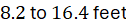 ] above ground level) and optimized row spacing or tracker rotation algorithms. Engineers deploy three primary geometric configurations:
- Fixed-Tilt Spaced Arrays: Panels are installed at fixed tilt angles with widened inter-row gaps, permitting direct sunlight penetration during morning and evening hours while providing shade during midday radiation peaks.
- Vertical Bifacial Arrays: Vertical east-west facing bifacial photovoltaic panels capture early morning and late afternoon solar radiation while occupying minimal horizontal footprint, maximizing PAR penetration across wide inter-row agricultural tractor lanes.
- Single-Axis Tracking Systems: Motorized trackers rotate photovoltaic panels synchronously to follow the solar azimuth, balancing electricity generation with regulated intermittent light casting across underlying crops.
Technical Data Specifications of Agrivoltaic Parameters
| Agrivoltaic & Microclimate Parameter | Engineering & Agronomic Specification Standard |
|---|---|
| Mounting Structure Clearance Height |  to  ( 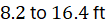 ) above ground |
| Photosynthetically Active Radiation (PAR) |  to  spectral waveband transmission |
| Midday Ambient Air Temperature Reduction |  to  (  to  ) under canopy shadow |
| Land Equivalent Ratio (LER) Target | 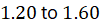 combined productivity metric |
| Photovoltaic Cell Operating Temp Drop |  to  (  to  ) via crop transpiration |
| Typical Crop Water-Use Efficiency Gain | 10% to 30% reduction in irrigation water demand |
| Bifacial Module Back-Side Gain | 5% to 15% additional energy yield from ground reflection |
Land-Use Efficiency Metrics: Land Equivalent Ratio (LER)
Evaluating the economic and biological performance of agrivoltaic systems requires specialized land-use efficiency metrics. The standard benchmark for assessing dual-use productivity is the Land Equivalent Ratio (LER), adapted from intercropping agricultural science. LER measures the relative land area required under monoculture production to achieve the identical combined yields of agricultural crops and electricity produced by a single agrivoltaic hectare.
The Land Equivalent Ratio is formulated mathematically as:
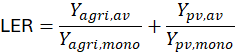
where  represents agricultural crop yield per hectare under agrivoltaic shading,
 is crop yield under standard agricultural monoculture,
 is electricity generation per hectare from the agrivoltaic array, and
 is electricity generation from a conventional single-use photovoltaic solar farm.
An LER value exceeding  (typically ranging from
 to
 in optimized agrivoltaic installations) demonstrates that dual-use cultivation produces significantly more combined biological and electrical value than devoting equivalent land areas separately to agriculture or solar energy generation.
Mutual Thermodynamic Benefits: Crop Transpiration Cooling of Photovoltaic Panels
Agrivoltaic system efficiency is augmented by a mutual thermodynamic feedback loop between crop transpiration and photovoltaic cell performance. Standard photovoltaic modules experience efficiency losses due to elevated operating temperatures, governed by negative temperature coefficients ( ). As modules absorb solar radiation, cell temperatures rise to
 (
 ), degrading electrical output.
In agrivoltaic configurations, water vapor transpired by underlying crops creates a cooler microclimate beneath and immediately surrounding the solar panels. Convective heat transfer lifts this cooler moisture-laden air upward, suppressing photovoltaic module operating temperatures by  to
 (
 to
 ). Lower cell operating temperatures preserve nominal voltage output, boosting annual electrical generation efficiency by 2% to 5% compared to high-heat terrestrial solar installations.
Furthermore, bifacial photovoltaic modules mounted over reflective agricultural mulch or green vegetation capture reflected albedo radiation on their rear surfaces, generating an additional 5% to 15% bifacial energy gain without requiring expanded land footprints.




Comments (0)
Login to leave a comment.
No comments yet. Be the first to share your thoughts!