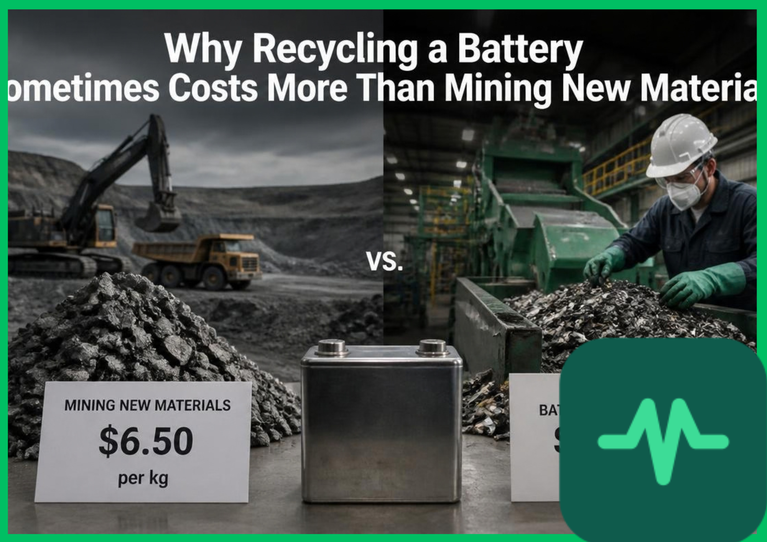
Why this assumption doesn't always match reality
Collecting, transporting, sorting, and processing used batteries all require genuine, real cost. Depending on current raw material prices and how efficiently a specific recycling process actually operates, these combined costs can sometimes exceed what it would cost to simply extract the same materials through traditional mining instead.
This creates a genuinely honest, if uncomfortable, economic reality. Recycling isn't automatically cheaper just because it involves already-existing material rather than newly extracted material.
Why collection and logistics add real, significant cost
Unlike a mine, which concentrates raw material in one specific location, used batteries exist scattered across millions of individual vehicles and devices, spread across enormous geographic areas. Collecting and transporting all these scattered batteries to a proper recycling facility involves genuine, significant logistical cost that a concentrated mining operation simply doesn't face in the same way.
This scattered collection challenge represents one of the most significant, honest cost factors that can make recycling less immediately cost-competitive than some people initially assume it should be.
Why raw material price fluctuations matter enormously here
When newly mined raw material prices are relatively low, recycled material struggles to compete purely on cost, since the whole economic case for choosing recycled material over freshly mined material depends partly on how these two prices compare at any given moment.
When raw material prices rise significantly, recycled material becomes considerably more cost-competitive by comparison. This means recycling's basic economics can shift considerably based on broader raw material market conditions that recyclers themselves don't directly control.
Why processing efficiency continues improving over time
Newer recycling methods and increasing operational scale have been steadily improving processing efficiency, gradually reducing the cost gap between recycled and newly mined materials. This mirrors patterns seen in many other recycling industries, where efficiency naturally improves as the industry matures and gains more collective experience.
This suggests today's honest cost challenges won't necessarily persist indefinitely, as continued investment and technological improvement gradually narrow this gap further over time.
Why governments and companies still support recycling despite this cost challenge
Even when recycled material doesn't immediately win on pure cost alone, genuine, other benefits justify continued investment and support. Reduced dependence on mining, which carries its own significant environmental and social costs, represents a real, substantial benefit beyond simple material cost comparison alone.
Supply security also matters considerably here. Recycled material offers a source that doesn't depend on new mining projects, foreign supply chains, or the specific geographic locations where economically viable raw material deposits happen to exist.
Why scale genuinely matters for closing this cost gap
As more batteries reach the end of their useful life, following the substantial electric vehicle growth discussed extensively elsewhere, recycling facilities will have access to considerably more material to process, potentially achieving better economies of scale that help reduce per-unit processing costs over time.
This suggests the current cost challenge partly reflects the recycling industry's relatively early stage of development, rather than representing some permanent, unavoidable economic limitation inherent to battery recycling generally.
Why policy support has played a genuine role here too
Various supportive policies in different regions have helped bridge this cost gap during recycling's earlier development stages, recognizing the genuine, broader societal value recycling provides beyond what pure market pricing alone might currently reflect or reward.
This kind of support reflects a common pattern across many emerging industries, where genuine broader benefits justify policy support during an earlier period before the underlying economics can eventually stand more fully on their own.
Why battery design improvements could help close this gap further
As discussed elsewhere, designing batteries specifically for easier future disassembly and recycling can meaningfully reduce processing costs later. Better-designed batteries genuinely support more efficient, less costly recycling, helping close this economic gap from the design side rather than purely relying on improved processing technology alone.
Why this honest economic reality doesn't undermine recycling's genuine value
Understanding that recycling doesn't always win on pure cost alone doesn't mean recycling lacks genuine value. It means the full case for recycling involves multiple real factors together, environmental impact, supply security, and long-term sustainability, not simply immediate cost comparison against newly mined materials in isolation.
Why this connects to the broader circular economy conversation
This honest cost challenge represents exactly the kind of practical, real-world complexity that genuine circular economy efforts need to navigate carefully, rather than assuming recycling automatically wins on every single measure compared to traditional extraction methods.
Recognizing and addressing this challenge directly, rather than avoiding honest discussion of it, ultimately supports building a more genuinely sustainable, economically viable recycling industry over the coming years.
What this means for how you think about recycling news
When you read about battery recycling progress or new facilities, understanding this honest economic context helps you interpret that news more accurately, recognizing genuine progress while also understanding the real, ongoing economic challenges the industry continues working to address.
The bottom line
Recycling battery materials doesn't always cost less than mining new raw materials, a genuinely honest economic reality shaped by collection logistics, processing costs, and fluctuating raw material prices.
Despite this real challenge, recycling continues receiving substantial investment and support because of its genuine, broader benefits around reduced mining dependence and improved supply security. As the industry continues maturing and scaling up, this cost gap should keep narrowing, supporting a genuinely more sustainable, economically viable circular economy for battery materials over time.


Comments (0)
Login to leave a comment.
No comments yet. Be the first to share your thoughts!