You feel a quiet sense of satisfaction knowing you are doing your part to protect the planet.
What happens to that container once the recycling truck hauls it away?
For decades, sorting consumer waste was a slow, labor-intensive human chore. Workers stood alongside fast-moving conveyor belts, frantically pulling plastic bottles, cardboard, and aluminum cans out of mixed waste streams by hand.
That manual system was overwhelmed long ago by the sheer volume of modern consumer packaging.
A high-tech revolution is transforming waste management plants across the globe.
By combining high-speed optical sensors with artificial intelligence, material recovery facilities are sorting complex waste streams with unprecedented speed and accuracy.
Here is how automated sorting technology is revolutionizing global recycling.
The Chaos of Modern Consumer Waste
To understand why automated sorting is necessary, you have to look at the complexity of modern packaging.
Consumer products are rarely made from a single, simple material anymore.
A single food wrapper might feature multiple bonded layers of plastic, aluminum foil, and paper inks. A transparent plastic cup might look like recyclable polyethylene terephthalate, but actually be crafted from non-recyclable polystyrene or compostable bioplastic.
Human sorters cannot visually identify complex chemical compositions zooming past on a high-speed conveyor belt at three meters per second.
Mistakes happen, contaminants slip through, and entire batches of recyclable materials get rejected and sent to landfills due to contamination.
Optical Scanners and Infrared Vision
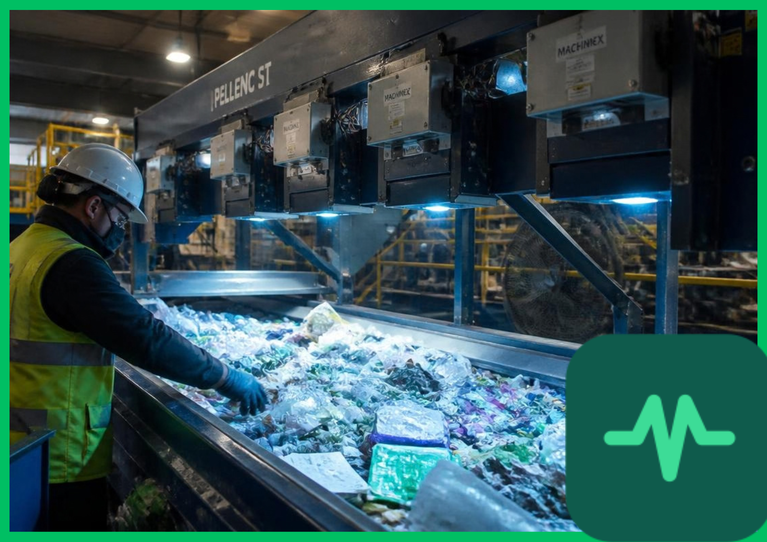
Modern automated recycling plants replace human eyes with high-resolution optical scanners.
As mixed waste hurtles along high-speed conveyor belts, overhead optical sensors flash broad-spectrum light down onto the materials.
Different materials reflect and absorb light in unique ways across the infrared spectrum.
An optical scanner identifies the distinct infrared signature of a clear PET plastic bottle, a high-density milk jug, or an aluminum can in a fraction of a millisecond.
The instant the scanner identifies the material, it signals a row of precision high-pressure air jets positioned at the end of the conveyor belt.
As the item flies off the edge of the belt, a sharp blast of compressed air knocks it precisely into the correct collection bin below.
This process repeats thousands of times every minute with astonishing precision.
Artificial Intelligence and Machine Learning
Sorting clear plastic bottles from aluminum cans is only the beginning. Advanced facilities integrate artificial intelligence and machine learning models to handle complex sorting challenges.
Cameras powered by computer vision algorithms analyze shape, color, brand logos, and texture in real time.
If a new type of packaging enters the waste stream, the AI model learns its visual characteristics instantly, continuously updating its sorting parameters without human reprogramming.
This machine intelligence ensures that recyclable materials are sorted into pure, high-value commodity streams that manufacturers actually want to buy and reuse.
Building a True Circular Material Economy
Technology alone cannot solve the global waste crisis; consumers and manufacturers must also reduce unnecessary packaging.
However, advanced optical sorting and artificial intelligence provide the critical infrastructure needed to make recycling economically viable at a global scale.
By transforming chaotic dumps of mixed refuse into clean, sorted raw materials, automated recycling tech closes the loop on everyday waste and builds a genuinely circular material economy.



Comments (0)
Login to leave a comment.
No comments yet. Be the first to share your thoughts!