You pause, wondering if they actually belong in the recycling collection.
You drop them into the bin, hoping for the best.
Once that bin leaves your curb, it travels to a local recovery facility. For decades, sorting that chaotic mix of materials relied entirely on human hands. Workers stood beside roaring conveyor belts, pulling items apart hour after hour in dusty, difficult conditions.
Human hands could never keep up with the sheer volume of global waste.
A quiet digital transformation is sweeping through industrial recovery plants worldwide.
According to resource efficiency frameworks from the United Nations Environment Programme (UNEP), circular economy studies from the International Energy Agency (IEA), and academic waste management research, advanced technology is changing everything.
Automated material recycling uses high-speed sensors, optical sorters, and artificial intelligence to sort waste with incredible precision.
Here is how automated sorting works, why machine vision outperforms manual labor, and how smart sorting secures a true circular economy.
The Chaos of Mixed Waste Streams
To understand why sorting technology is vital, you have to look at the sheer complexity of modern trash.
Consumers discard millions of tons of mixed packaging every day. Plastics of every color, chemical composition, and thickness mix together with paper, cardboard, glass, and aluminum.
If a recycling batch contains too many contaminated materials or wrong plastics, the entire truckload gets rejected and sent to a landfill.
Manual sorting lines could pull out obvious items, but human workers cannot read chemical polymers with their eyes. They cannot separate a clear polyethylene container from a polypropylene tray moving at high speed on a fast conveyor belt.
Recovery facilities needed an upgrade.
They needed tools that could see through the chaos and identify materials at a molecular level in milliseconds.
Optical Sorting and Light Signatures
The backbone of modern automated recycling is optical sorting technology.
An optical sorter uses the physics of light waves to identify different materials.
As mixed recyclables travel up a high-speed conveyor belt, they pass under a powerful overhead light source.
Different materials—plastics, papers, glasses, and metals—absorb and reflect light waves in unique ways, creating a distinct optical signature.
An advanced spectrometer mounted above the belt reads those light reflections instantly.
The system recognizes whether a speeding item is a clear plastic bottle, a colored detergent jug, or a piece of cardboard.
Once the spectrometer identifies the material, a high-speed computer calculates its exact location on the moving belt in fractions of a second.
Just as the item reaches the edge of the belt, a bank of precision pneumatic nozzles fires a sharp blast of compressed air, blowing the targeted object up and over a divider into the correct collection bin.
This entire sequence happens thousands of times every hour.
The Rise of Artificial Intelligence and Robotics
While optical sorters excel at separating general material types, recent advancements incorporate artificial intelligence and machine learning to handle even trickier waste streams.
Academic waste research and industrial engineering evaluations highlight how AI vision systems revolutionize sorting.
Cameras capture continuous video streams of the moving waste pile.
Deep learning algorithms trained on millions of object images analyze the shapes, brand logos, textures, and structures of incoming items.
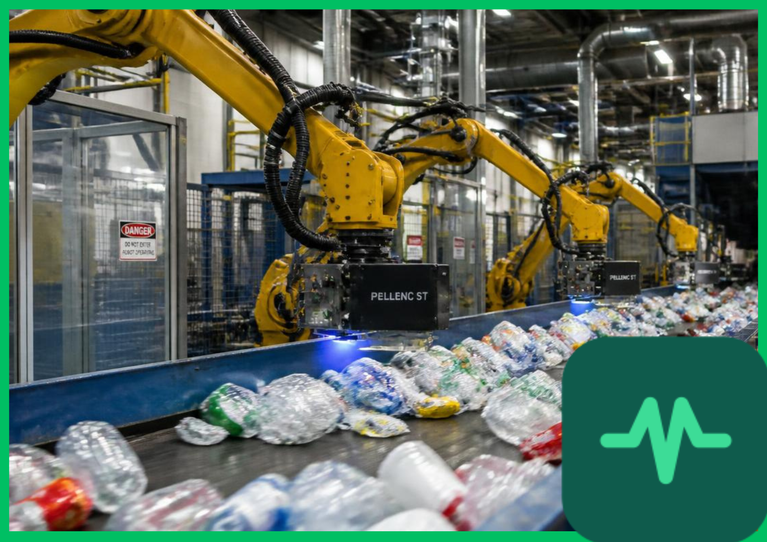
When the AI spots a valuable recyclable or a dangerous contaminant—like a lithium-ion battery that could start a fire in the facility—it guides robotic sorting arms.
These robotic pickers use pneumatic suction or mechanical claws to grab specific items off the belt with human-like dexterity and superhuman speed.
The more data the AI processes, the faster and more accurate it becomes at recognizing new packaging designs.
Driving the Global Circular Economy
Automated sorting is not just about cleaning up trash. It is the engine that drives a sustainable circular economy.
When recycling plants achieve high sorting accuracy, they produce pure streams of secondary raw materials.
Manufacturers receive clean, high-grade plastic flakes, pure aluminum ingots, and sorted paper pulp that match the quality of virgin materials.
According to UNEP resource assessments, using recycled secondary inputs consumes a fraction of the energy required to extract fresh raw materials from the earth, slashing industrial carbon footprints.
By taking human workers out of dangerous sorting environments and placing precision technology on the line, recovery facilities become safer, faster, and far more reliable.
Sorting Our Way to a Cleaner Future
Technology proves that we can fix the flaws in our consumption habits.
By combining optical light detection, artificial intelligence, and automated robotics, we turn industrial waste streams into valuable resources.
We stop burying our mistakes in massive landfills.
Through smart material sorting, every discarded package finds a second life, building a clean, efficient, and truly circular world for the future.



Comments (0)
Login to leave a comment.
No comments yet. Be the first to share your thoughts!