
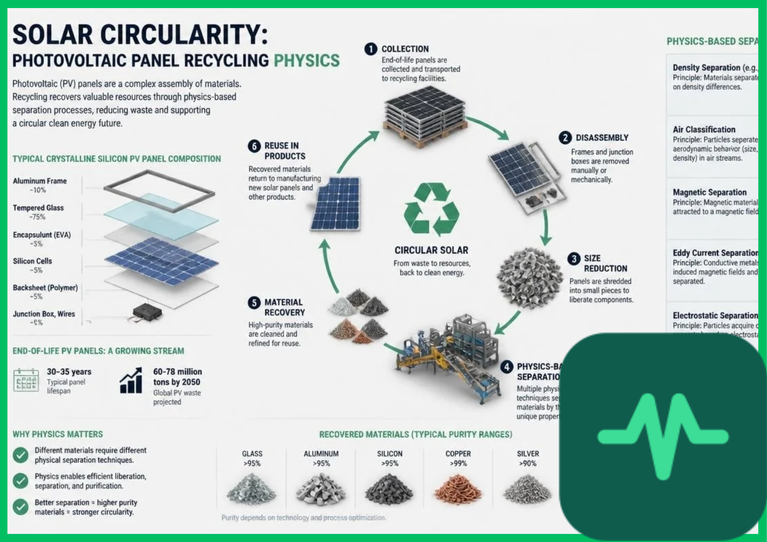
Mechanical De-framing and Component Stripping
The foundational initial phase of industrial photovoltaic module recycling involves mechanical disassembly and component stripping. Decommissioned solar panels are fed into automated de-framing workstations where hydraulic shears and pneumatic clamps strip away the extruded anodized aluminum perimeter frames. Simultaneously, automated routers or manual cutting tools remove plastic junction boxes containing copper bypass diodes, terminal wiring blocks, and silicone potting compounds.
The stripped module—consisting of the glass-encapsulated laminate sandwich—is subsequently routed to mechanical crushing or thermal delamination processing lines. While mechanical shredding processes grind entire modules into mixed particulate fractions, advanced recycling facilities prioritize thermal delamination to preserve the structural integrity of the large-format front glass sheet and underlying silicon wafer matrix.
Thermal Pyrolysis Separation and EVA Delamination Chemistry
The core chemical challenge governing photovoltaic panel recycling lies in degrading the cross-linked ethylene vinyl acetate (EVA) polymer encapsulant that bonds the front tempered glass sheet, silicon wafer matrix, and backsheet into a monolithic laminate. EVA is a copolymer of ethylene and vinyl acetate that undergoes chemical cross-linking via organic peroxide catalysts during initial module manufacturing, forming a rigid, insoluble, and thermally stable three-dimensional polymer network.
To break these covalent carbon-carbon and ester bonds, modules or stripped laminates enter industrial thermal pyrolysis furnaces operating in inert atmospheres (such as nitrogen [ ] gas) at temperatures ranging from
 to
 (
 to
 ). At these thermal thresholds, the EVA polymer matrix decomposes via thermal cracking into volatile organic compounds—including acetic acid, ethylene, and carbon oxides—which are captured and combusted in secondary thermal oxidizers to supply internal furnace heating requirements. Pyrolysis cleanly strips away the organic encapsulant, allowing the top low-iron tempered glass sheet to detach completely from the internal silicon cell matrix without mechanical breakage or surface scratching.
Technical Data Specifications of Photovoltaic Recycling Parameters
| Photovoltaic Recycling Parameter | Engineering Specification Standard |
|---|---|
| Typical Module Glass Mass Fraction | 70% to 75% low-iron tempered glass composition |
| Thermal Pyrolysis Processing Temp |  to  (  to  ) in inert  |
| Encapsulant Polymer Decomposition | Ethylene vinyl acetate (EVA) thermal cracking |
| Glass Recovery Purity Threshold |  optical-grade glass reclaim yield |
| Silicon Wafer Recovery Yield |  intact or reclaimable semiconductor wafers |
| Chemical Etching Reagents | Hydrofluoric acid ( ) and nitric acid (  ) |
| Recovered Silver Purity Standard |  precious metal bullion refining |
Silicon Wafer Reclamation and Chemical Etching
Following thermal delamination, the fragile silicon solar wafer matrix is recovered, but it remains contaminated with surface silver grid lines, aluminum back-surface fields, and silicon nitride ( ) anti-reflective coating layers. Reclaiming high-purity silicon for subsequent photovoltaic manufacturing requires multi-stage hydrometallurgical chemical etching.
Recovered silicon wafers are immersed in specialized chemical bath reactors containing aqueous solutions of hydrofluoric acid ( ) and nitric acid (
 ). This chemical etching process selectively dissolves silver front-contact fingers and aluminum busbars without attacking the underlying silicon substrate. Subsequently, chemical polishing and reactive ion etching remove surface impurities and p-n junction diffusion layers. The purified reclaimed silicon ingots or wafers match the electrical resistivity and purity benchmarks of virgin semiconductor-grade silicon, enabling direct re-melting into crystal pullers for new solar cell production.
Glass Recovery Purity and Downstream Industrial Applications
Tempered low-iron glass accounts for the overwhelming majority of total photovoltaic module mass, making glass recovery the primary economic driver of recycling facility operations. Achieving high glass recovery yields requires preventing iron contamination and residual polymer bonding during thermal pyrolysis and mechanical separation.
Cleaned recovered glass exhibits optical clarity, low iron oxide content ( ), and chemical purity exceeding 99%, making it suitable for direct re-introduction into high-end industrial manufacturing. Unlike lower-grade crushed container glass, recovered photovoltaic glass is utilized directly as a primary batch raw material in float glass production lines, architectural glass fabrication plants, or fiberglass insulation manufacturing facilities. Re-melting high-purity recovered glass reduces melting energy requirements by 15% to 20% compared to virgin silica sand batch processing, substantially lowering embodied carbon emissions across the solar supply chain.
Precious Metal Extraction and Environmental Compliance
Beyond glass and silicon, photovoltaic modules contain valuable trace quantities of critical and precious metals, including silver busbars and copper ribbon connectors. In hydrometallurgical refining circuits, the acid solutions generated during silicon etching undergo selective solvent extraction and electrowinning to precipitate high-purity silver bullion ( purity) and copper cathodes.
Furthermore, advanced recycling facilities maintain strict environmental compliance regarding off-gas emissions during thermal pyrolysis. Because EVA decomposition generates corrosive acetic acid and halogenated compounds when older backsheets containing polyvinyl fluoride (PVF) are processed, industrial exhaust streams pass through wet scrubbers, limestone absorption columns, and activated carbon filters, neutralizing acidic gases and capturing volatile organic compounds before atmospheric release.
The Final Take
Mastering photovoltaic solar panel recycling glass recovery transforms renewable energy waste management by converting end-of-life solar modules into high-purity glass, silicon, and precious metals. Citing IEA waste assessments and UNEP circular economy literature, combining thermal pyrolysis separation with hydrometallurgical chemical etching achieves recovery efficiencies exceeding 99% for glass and 85% for silicon wafers. By scaling industrial recycling capacity, the global clean energy sector establishes a fully circular manufacturing economy.

Comments (0)
Login to leave a comment.
No comments yet. Be the first to share your thoughts!