 ) annually by 2040. Pyrometallurgical smelting processes—traditionally utilized to recover base metals—consume high thermal energy (
 to
 [
 to
 ]) and oxidize valuable lithium into slag waste. In contrast, hydrometallurgical recycling and direct cathode regeneration employ aqueous chemical leaching, selective solvent extraction, and precipitation to recover over 95% of critical metallic constituents with significantly lower embodied carbon footprints.
Pre-Treatment and Black Mass Liberation Physics
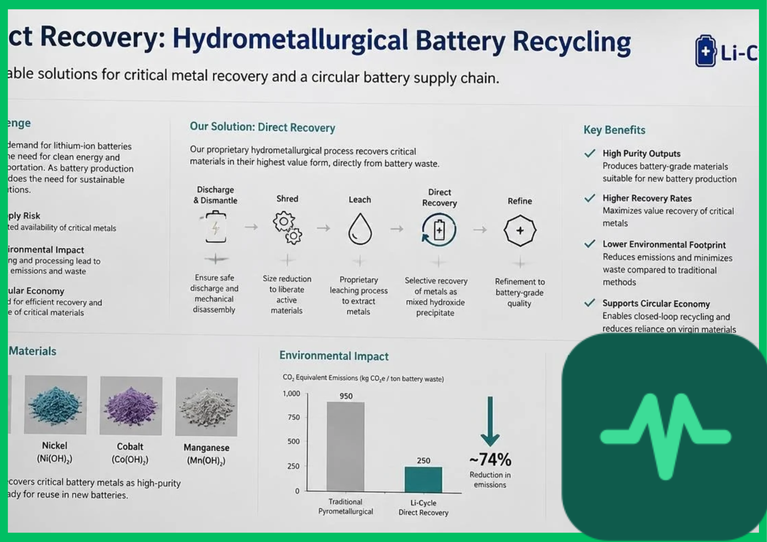
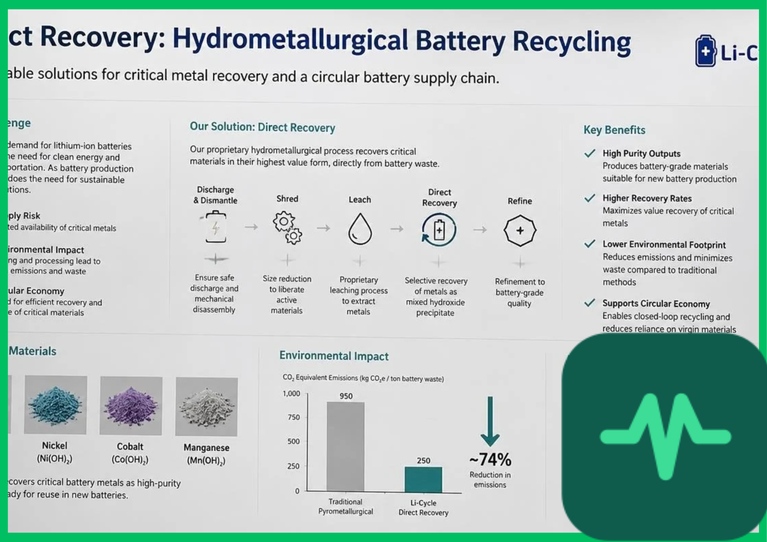
The hydrometallurgical recycling workflow commences with mechanical pre-treatment, discharging, disassembly, and automated shredding of spent lithium-ion battery modules. Shredding occurs inside inert nitrogen atmospheres or cryogenic freezing chambers to prevent exothermic fires triggered by residual cell energy or reactive electrolyte solvents (such as lithium hexafluorophosphate  dissolved in organic carbonates).
Following physical separation via magnetic and air-classification systems, the resulting powdery output is termed black mass. Black mass comprises a complex mixture of graphitic anode carbon, aluminum and copper current collector foils, and crushed cathode active materials (such as nickel-manganese-cobalt oxides or lithium iron phosphate). Removing impurities like fluorine and aluminum prior to chemical dissolution is essential to protect downstream leaching equipment from corrosion and chemical contamination.
Hydrometallurgical Leaching Chemistry and Redox Reactions
Black mass processing proceeds to hydrometallurgical leaching, where solid-phase metal oxides are dissolved into aqueous ionic solutions. Acid leaching typically utilizes sulfuric acid ( ), hydrochloric acid (
 ), or organic acids (such as citric or oxalic acid) combined with reducing agents like hydrogen peroxide (
 ) or sodium bisulfite.
The chemical reduction of insoluble trivalent cobalt ( ) and tetravalent manganese (
 ) to soluble divalent ionic species (
 and
 ) is governed by thermodynamic reduction-oxidation (redox) reactions:


Operating at temperatures between  and
 (
 to
 ) with acid concentrations ranging from
 to
 achieves leaching efficiencies exceeding 98% for lithium, nickel, cobalt, and manganese within 60 to 120 minutes.
Selective Solvent Extraction and Fractional Precipitation
Following filtration to remove insoluble graphitic carbon and silica residues, the multi-component leach liquor undergoes selective solvent extraction (SX) or fractional precipitation. Solvent extraction utilizes specific organic extractants—such as di-(2-ethylhexyl) phosphoric acid (D2EHPA) or 2-ethylhexyl phosphonic acid mono-2-ethylhexyl ester (P507)—dissolved in kerosene or aliphatic diluents. By adjusting the equilibrium pH of the aqueous phase sequentially, engineers selectively transfer target metal ions from the aqueous phase into the organic phase.
Nickel, cobalt, and manganese are separated through multi-stage countercurrent extraction circuits. Lithium remains in the final aqueous raffinate, where it is subsequently recovered via high-purity sodium carbonate ( ) or lithium phosphate (
 ) precipitation, yielding battery-grade lithium carbonate or lithium hydroxide with purity levels surpassing 99.5%.
Technical Data Specifications of Hydrometallurgical Parameters
| Hydrometallurgical Parameter | Engineering Specification Range |
|---|---|
| Leaching Operating Temperature |  to  (  to  ) |
Acid Concentration Range ( ) |  to  aqueous solution |
| Redox Reducing Agent | Hydrogen peroxide ( ) 30% v/v |
| Metal Leaching Recovery Efficiency |  for  ,  ,  , and  |
| Solvent Extraction pH Windows |  (  ),  (  ),  (  ) |
| Final Precipitated Purity Level |  battery-grade metal compounds |
| Wastewater Neutralization Requirement | Lime ( ) precipitation circuits |
Direct Cathode Regeneration vs. Full Hydrometallurgical Refining
While hydrometallurgical refining breaks down spent cathode materials completely into individual elemental ions, direct cathode recycling (direct closed-loop regeneration) bypasses total dissolution. Direct recycling preserves the crystalline structure of the cathode active material by physically separating the delaminated particles, repairing surface micro-cracks, and replenishing lost lithium ions via hydrothermal or solid-state re-lithiation annealing at  to
 (
 to
 ).
Direct closed-loop regeneration reduces energy consumption by over 50% compared to full hydrometallurgical chemical extraction, though it requires highly sorted, homogeneous feedstock streams to prevent cross-contamination between different cathode formulations (such as lithium iron phosphate versus nickel-manganese-cobalt).
Life-Cycle Assessments and Circular Economy Realities
Quantitative life-cycle assessments (LCAs) published by the UNEP and academic recycling research consortia confirm that hydrometallurgical battery recycling and direct cathode recovery reduce greenhouse gas emissions by 65% to 80% compared to primary mining and refining of virgin nickel, cobalt, and lithium ores. Closed-loop chemical recycling processes conserve millions of gallons of water through internal wastewater treatment and evaporation loops, minimizing hazardous liquid discharge. As international environmental regulations mandate strict producer responsibility and minimum recycled content thresholds for newly manufactured electric vehicle batteries, hydrometallurgical recovery and direct closed-loop regeneration establish an essential industrial foundation for global circular clean energy economies.

Comments (0)
Login to leave a comment.
No comments yet. Be the first to share your thoughts!