 , limiting the gravimetric energy density of standard electric vehicle battery packs. Substituting or blending graphite with elemental silicon raises theoretical specific capacity up to
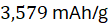 for
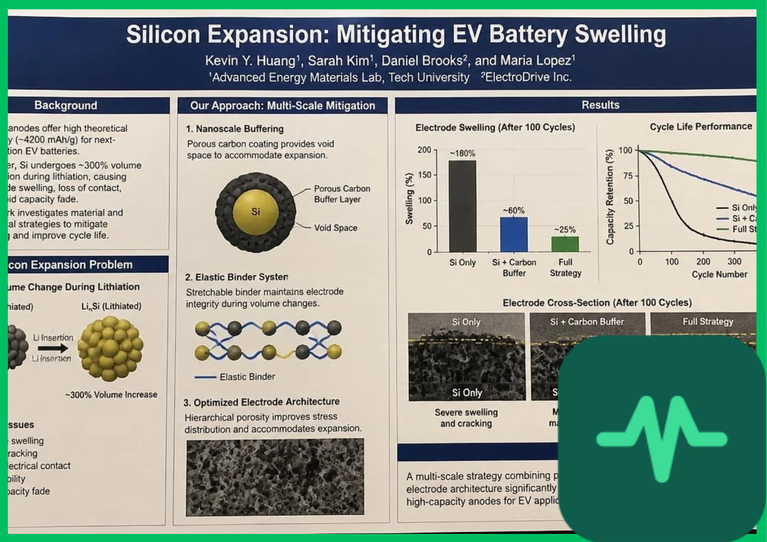
 alloying phases, increasing total cell energy density by 20% to 40%. However, alloying lithium with silicon induces volumetric expansion exceeding 300% during full lithiation cycles. Managing this extreme mechanical stress requires advanced material engineering, including silicon-graphite composite architectures, elastic polymer binder formulations, nano-sized particle structuring, and controlled external cell compressive fixtures.
Electrochemical Alloying Mechanics and Volumetric Expansion Stress
The fundamental physical driver of silicon anode swelling is the nature of the lithiation process itself. Unlike graphite anodes that store lithium ions via intercalation—inserting  ions between stable carbon hexagonal layers with minimal volume change (typically 10% to 13%)—silicon undergoes an alloying reaction.
During charging, lithium ions migrate through the liquid or solid electrolyte and react with silicon atoms, forming a series of lithium-silicon alloy phases:


This phase transformation breaks covalent silicon-silicon bonds and reorganizes the crystal lattice, resulting in an isotropic volumetric expansion of 300% to 400% at full state of charge ( SoC).
This massive dimensional fluctuation exerts severe mechanical stress on the surrounding electrode architecture. Without structural mitigation, repeated expansion and contraction cycles pulverize the silicon particles, fracture the conductive carbon black network, delaminate the active material layer from the current collector foil, and accelerate electrolyte consumption via continuous solid-electrolyte interphase (SEI) reformation.
Silicon-Graphite Composite Engineering and Nano-Structuring
To mitigate catastrophic particle pulverization, industrial cell manufacturers avoid pure silicon anodes in favor of silicon-graphite composite structures, where silicon content is restricted to 5% to 20% by weight. Blending silicon nanoparticles or sub-micron silicon suboxides ( ) into a porous graphite matrix cushions volumetric changes while retaining enhanced specific capacity.
Advanced nano-structuring techniques further mitigate mechanical stress:
- Hollow Silicon Nanospheres: Engineering hollow, porous silicon spheres provides internal void space that accommodates outward and inward expansion during lithiation and delamination, preventing macroscopic electrode swelling.
- Core-Shell Morphologies: Encapsulating silicon nanoparticles inside conductive carbon shells (carbon-coated silicon composites) maintains electrical contact during volume contraction while regulating SEI formation exclusively on the outer carbon surface.
- Silicon Suboxides (
 ): Utilizing amorphous silicon suboxides introduces an inactive
 and
 matrix during initial charge cycles, buffering volume expansion and limiting overall electrode swelling to manageable thresholds.
Elastic Polymer Binders and Self-Healing Chemistry
Traditional poly(vinylidene fluoride) (PVDF) binders possess high stiffness and weak van der Waals interactions, making them inadequate for holding expanding silicon particles together. When silicon anodes swell by 300%, rigid PVDF binders crack, causing electrical isolation and rapid capacity fade within 50 cycles.
Modern high-performance silicon anodes replace legacy binders with functionalized elastic polymer binders possessing self-healing chemical properties and high tensile elasticity. These advanced binders—such as carboxymethyl cellulose (CMC) blended with polyacrylic acid (PAA), alginate polymers, or supramolecular hydrogen-bonded networks—contain abundant carboxyl ( ) and hydroxyl (
 ) functional groups.
These functional groups form stable covalent and hydrogen bonds with the native oxide layer on silicon surfaces. The high elasticity of the polymer network allows the binder to stretch up to 300% without breaking, accommodating particle expansion during charging and relaxing back to its original geometry during discharge, preserving electronic conductivity across the electrode sheet.
Technical Data Specifications of Silicon Anode Parameters
| Electrochemical & Mechanical Parameter | Engineering Specification Range |
|---|---|
| Pure Silicon Theoretical Capacity | 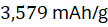 at full  phase |
| Graphite Theoretical Capacity |  benchmark intercalation |
| Silicon Anode Volumetric Expansion | 300% to 400% volume increase at  SoC |
| Optimal Silicon-Graphite Blending Ratio | 5% to 20% silicon mass fraction |
| Elastic Binder Tensile Elongation | 150% to 300% elastic deformation threshold |
| Required External Cell Stack Pressure |  to  (  to  ) |
| Initial Coulombic Efficiency (ICE) | 88% to 92% initial charge-discharge ratio |
Solid-Electrolyte Interphase (SEI) Layer Regeneration Kinetics
Volumetric expansion introduces severe chemical instability through continuous solid-electrolyte interphase (SEI) layer breakdown. Every time a silicon particle expands, its outer surface cracks, exposing fresh, un-reacted silicon to the liquid carbonate electrolyte.
This newly exposed surface reacts instantly with lithium ions and electrolyte solvents to form a new SEI layer. This continuous cracking and healing cycle consumes active lithium inventory and liquid electrolyte, leading to accelerated capacity fade, impedance growth, and high internal gas generation.
Mitigating SEI destruction requires formulating advanced fluoroethylene carbonate (FEC) electrolyte additives. FEC decomposes preferentially on the silicon surface during initial formation cycles, creating a robust, flexible, fluorine-rich SEI film that accommodates high mechanical strain without fracturing, drastically reducing parasitic electrolyte consumption.
Module-Level Mechanical Restraint and Compression Fixtures
At the battery pack and module level, managing silicon anode expansion requires engineering rigid structural compression fixtures. Unrestrained silicon pouch cells bow outward, increasing internal electrical resistance and degrading thermal contact with cooling plates.
Battery management systems and mechanical engineers design structural clamping modules that apply a constant compressive pre-load ranging from  to
 (
 to
 ). This controlled mechanical restraint suppresses out-of-plane electrode swelling, maintains uniform internal stack pressure, and enhances inter-particle contact.
Quantitative electrochemical analyses published by academic battery research consortia and the IEA confirm that combining nano-composite structuring, elastic binders, FEC electrolyte additives, and module-level compressive restraint successfully stabilizes silicon anodes, enabling high-energy-density electric vehicle batteries with long operational lifespans.

Comments (0)
Login to leave a comment.
No comments yet. Be the first to share your thoughts!