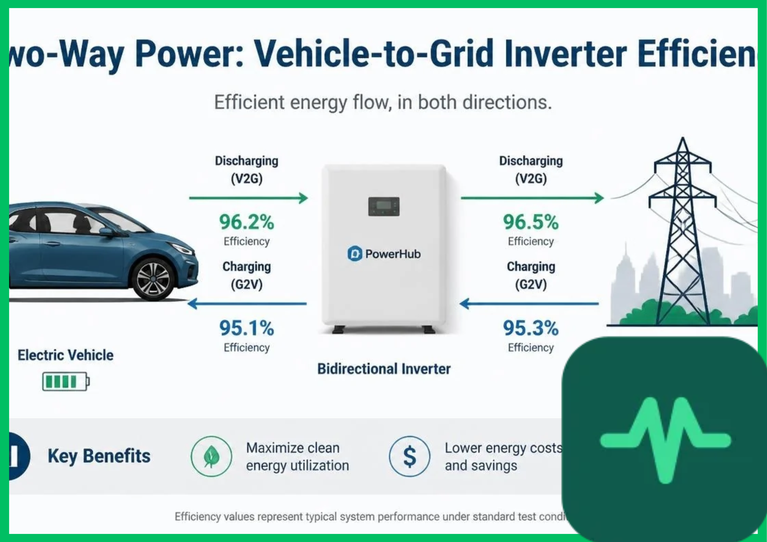
Bidirectional DC-AC Power Conversion Topologies
The core architecture of a V2G system relies on a two-stage power conversion topology: an isolated DC-DC converter interfacing with the high-voltage EV battery pack, and a grid-tied DC-AC inverter synchronizing power flow with the local utility grid.
The DC-AC inverter stage typically utilizes a full-bridge or three-phase neutral-point-clamped (NPC) topology. During vehicle discharging (V2G mode), the inverter transforms high-voltage DC power from the DC-link capacitor bank into a three-phase sinusoidal AC waveform matching the grid frequency ( or
 ) and phase angle. Conversely, during vehicle charging (G2V mode), the power electronics reverse operation, rectifying grid AC voltage into regulated DC voltage.
Maintaining high conversion efficiency across both operating directions requires minimizing semiconductor conduction losses and switching transient losses. Advanced dual-active-bridge (DAB) DC-DC converters provide galvanic isolation between the vehicle chassis and the grid, protecting vehicle occupants while stepping high battery voltages ( to
 DC) down to intermediate DC-link levels or matching grid-tied inverter input requirements.
Silicon Carbide (SiC) Inverter Switching and Thermal Efficiency
Achieving high round-trip V2G efficiency requires replacing legacy silicon insulated-gate bipolar transistors (IGBTs) with wide-bandgap silicon carbide ( ) MOSFET semiconductor modules. Silicon carbide power switches possess superior material properties, including a wide bandgap energy (
 vs.
 for silicon), high breakdown electric field strength, and high electron saturation velocity.
These material characteristics reduce power losses significantly during pulse-width modulation (PWM) switching operations conducted at high frequencies ( to
 ):
- Switching Losses (
 ):
 MOSFETs exhibit near-zero tail current during turn-off transients, cutting switching energy losses by 70% to 80% compared to silicon IGBT counterparts.
- Conduction Losses: Low drain-source on-state resistance (
 ) minimizes resistive heating during high-current power transfer.
- Thermal Performance: High thermal conductivity enables efficient heat dissipation through direct-bonded copper (DBC) ceramic substrates, maintaining semiconductor junction temperatures safely below
 (
 ).
Advanced  inverters achieve peak conversion efficiencies exceeding 98.5%, minimizing thermal energy waste during bi-directional power transfers.
V2G Power Flow Dynamics and Grid Synchronization
Controlling power flow magnitude and direction between an electric vehicle and the electrical grid requires precise real-time synchronization governed by digital signal processors (DSPs) executing phase-locked loop (PLL) algorithms. The inverter must continuously track grid voltage phasor angles, frequency, and amplitude to inject clean sinusoidal current without introducing phase shifts or harmonic pollution.
Grid interconnection standards—such as IEEE 1547 and IEC 61850—mandate strict power quality criteria for distributed energy resources:
- Total Harmonic Distortion (THD): Injected AC current must maintain a THD below 5% to prevent electrical resonance and transformer overheating on local utility distribution feeders.
- Power Factor Control: Bidirectional inverters must adjust reactive power (
 ) independently of active power (
 ), providing voltage support to stabilize local grid fluctuations.
- Anti-Islanding Protection: In-built safety protocols detect grid outages instantaneously (within
 ), terminating power export immediately to protect utility linemen repairing downstream distribution lines.
Technical Data Specifications of V2G Inverter Parameters
| Electrical & Thermal Parameter | Engineering Specification Range |
|---|---|
| Peak Bidirectional Conversion Efficiency | 97.5% to 98.8% DC-AC / AC-DC round-trip |
| DC Bus Operating Voltage Range |  to  DC high-voltage bus |
| Grid AC Output Voltage (Three-Phase) |  to  AC line-to-line |
| Inverter PWM Switching Frequency |  to  operational range |
| Total Harmonic Distortion (THD) |  current distortion at rated load |
| Semiconductor Technology | Wide-bandgap Silicon Carbide ( ) MOSFET |
| Maximum Power Export Capacity |  (Residential) to  (Commercial) |
Battery Degradation and Electrochemical Wear Realities
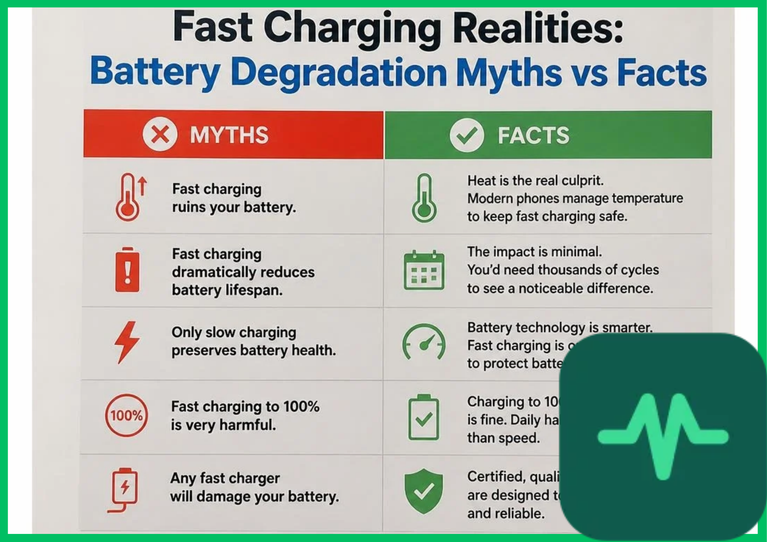
A primary operational concern surrounding frequent vehicle-to-grid cycling is accelerated lithium-ion battery degradation. Exporting energy from an EV battery pack requires additional equivalent full cycles (EFCs), raising questions regarding thermal stress and chemical wear on active cathode and anode materials.
Electrochemical degradation during V2G operations is governed by depth of discharge (DoD), C-rate of charge and discharge, and internal cell temperatures. Operating at moderate C-rates ( to
 ) and maintaining narrow state-of-charge windows (between 20% and 80%) minimizes mechanical stress on graphite crystal lattices and prevents solid-electrolyte interphase (SEI) layer thickening. Furthermore, active liquid thermal management systems must remain operational during V2G power export, maintaining cell temperatures within the optimal window of
 to
 (
 to
 ) to prevent accelerated capacity fade.
Grid Integration Economics and Round-Trip Efficiency
Evaluating the economic viability of V2G systems requires analyzing aggregate round-trip efficiency ( ), which accounts for energy losses across the inverter conversion stages, battery coulombic efficiency, and thermal management auxiliary loads:


Modern bidirectional inverter systems achieve aggregate round-trip efficiencies between 85% and 92%. While thermodynamic and electrical losses preclude 100% recovery, intelligent software dispatching ensures vehicles discharge primarily during peak pricing intervals or emergency grid support events, offsetting battery aging costs through utility demand-response revenue streams.
Quantitative clean-energy integration assessments published by the IEA and academic smart grid research consortia confirm that deploying wide-bandgap silicon carbide bidirectional inverters stabilizes fluctuating renewable generation networks. By mastering vehicle-to-grid bidirectional inverter efficiency, modern power electronics transform electric vehicles from passive electrical loads into active, flexible grid storage assets.
Comments (0)
Login to leave a comment.
No comments yet. Be the first to share your thoughts!