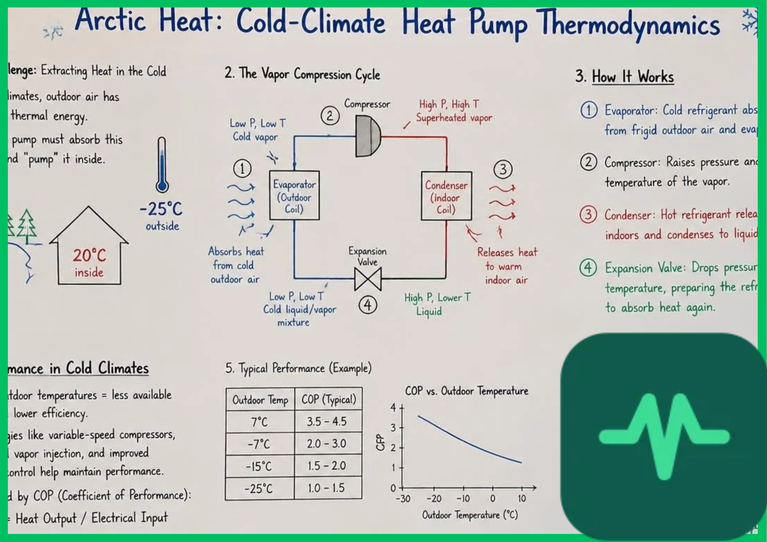
 (
 ). Traditional heat pumps lose mass flow rate and suction pressure as outdoor air temperatures decline, forcing reliance on inefficient auxiliary electric resistance heating elements. Engineering advanced cold-climate heat pumps requires overcoming these thermodynamic bottlenecks through enhanced vapor injection (EVI) compressors, optimized two-stage vapor-compression cycles, low-temperature refrigerant formulations, and precise defrost cycle control.
Thermodynamic Limitations of Standard Vapor-Compression Cycles at Low Ambient Temperatures
The standard vapor-compression cycle relies on extracting thermal energy from ambient air via an outdoor evaporator coil, transferring heat to a refrigerant, and rejecting thermal energy indoors via a condenser. The theoretical efficiency limit of this thermodynamic cycle is governed by the Carnot coefficient of performance for heating ( ):
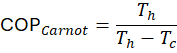
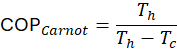
where  represents the absolute condensation temperature inside the indoor unit and
 represents the absolute evaporation temperature of the outdoor coil in Kelvin. As outdoor ambient temperature (
 ) drops toward
 to
 (
 to
 ), the temperature differential (
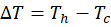 ) widens significantly.
This widening temperature delta creates severe operational challenges within standard single-stage compressors:
- Mass Flow Rate Reduction: Low outdoor air temperatures decrease refrigerant vapor density, reducing the mass flow rate entering the compressor suction port and lowering total heating capacity output.
- Elevated Compression Ratios: Pressure ratios across the compressor surge above 8:1 or 10:1, increasing discharge gas temperatures, accelerating mechanical wear, and triggering thermal protection cutoffs.
- Volumetric Efficiency Loss: High pressure differentials increase internal refrigerant leakage across scroll wraps or piston rings, sharply reducing volumetric efficiency and dropping the operational COP toward 1.0.
Enhanced Vapor Injection (EVI) and Two-Stage Compression Physics
To maintain high heating capacity and thermal efficiency in sub-zero environments, cold-climate air source heat pumps integrate enhanced vapor injection (EVI) compressors coupled with an auxiliary flash tank or internal heat exchanger (IHEX). EVI technology injects intermediate-pressure superheated refrigerant vapor directly into the compression chamber midway through the compression stroke.
The EVI vapor injection thermodynamic sequence operates via a specialized circuit:
- Subcooling: A fraction of the high-pressure liquid refrigerant exiting the condenser passes through an electronic expansion valve (EEV), undergoing isenthalpic expansion to intermediate pressure. This flashing process subcools the primary liquid refrigerant stream entering the main expansion valve, increasing the specific enthalpy difference across the outdoor evaporator.
- Flash Vapor Generation: The flashed refrigerant vapor absorbs heat, turning into a saturated intermediate-pressure vapor.
- Mid-Cycle Injection: This intermediate-pressure vapor is injected directly into the scroll compressor housing through dedicated injection ports, cooling the compressor discharge gas and expanding total refrigerant mass flow without requiring an oversized motor.
This intermediate vapor injection expands the operational envelope, allowing cold-climate heat pumps to deliver 80% to 100% of their rated heating capacity at  (
 ) while maintaining robust COP values between 2.0 and 2.8.
Refrigerant Selection and Low-Temperature Glide
Optimizing cold-climate heating performance requires transitioning away from legacy hydrofluorocarbons toward advanced working fluids possessing favorable thermodynamic properties and low global warming potential (GWP). Manufacturers increasingly utilize difluoromethane (R-32) or hydrocarbon blends like propane (R-290).
R-290 exhibits exceptional thermodynamic performance at low evaporating temperatures, maintaining high volumetric refrigeration capacity and low discharge temperatures in sub-zero conditions. Furthermore, utilizing zeotropic refrigerant mixtures introduces a controlled temperature glide during phase change. Matching this refrigerant temperature glide to the sensible temperature change of the outdoor air across the evaporator coil minimizes thermodynamic irreversibilities, improving second-law exergetic efficiency.
Technical Data Specifications of Cold-Climate Heat Pump Parameters
| Technical Parameter | Engineering Specification Range |
|---|---|
Coefficient of Performance (COP at  /  ) | 2.0 to 2.8 under full load operation |
Heating Capacity Retention at  | 80% to 100% of nominal rated capacity |
| Minimum Operating Ambient Temperature |  to  (  to  ) |
| Compressor Displacement Technology | Inverter-driven twin-rotary or EVI scroll |
| Maximum Discharge Pressure Limit |  to  ( 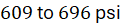 ) |
| Seasonal Performance Factor (SPF) | 3.5 to 4.8 across temperate-to-cold zones |
| Refrigerant Mass Flow Enhancement | 20% to 35% increase via EVI injection |
Defrost Cycle Physics and Frost Accumulation Kinetics
Operating an air source heat pump in sub-zero ambient conditions with high relative humidity triggers rapid frost accumulation on the outdoor evaporator coil fins. When outdoor coil surface temperatures drop below the dew point and fall below  (
 ), water vapor in the ambient air freezes upon contact, forming a crystalline frost layer.
This frost layer acts as an effective thermal insulation barrier, increasing air-side pressure drop across the finned-tube coil, restricting volumetric airflow, and severely degrading heat transfer coefficients. To clear accumulated frost, the heat pump control system initiates a reverse-cycle defrost or hot-gas bypass defrost:
- Reverse-Cycle Defrost: The four-way reversing valve switches refrigerant flow direction, routing high-temperature hot gas directly from the compressor discharge into the outdoor coil, melting the frost layer from the inside out.
- Hot-Gas Bypass Defrost: Diverts hot discharge gas directly into the outdoor distributor without reversing the entire refrigeration cycle, minimizing indoor thermal comfort disruption.
Advanced predictive defrost algorithms utilize differential pressure transducers, optical frost sensors, and dynamic ambient psychrometric monitoring to initiate defrost cycles exclusively when thermal performance degradation warrants it, avoiding energy-wasting timed defrost routines.
Seasonal Performance Factors (SPF) and Grid Decarbonization Realities
Evaluating the real-world efficiency of cold-climate heat pumps requires analyzing Seasonal Performance Factors (SPF) or Seasonal Coefficient of Performance (SCOP) metrics over an entire annual heating season. Unlike instantaneous COP ratings measured at single test points, SPF calculates the total thermal energy delivered to a building divided by the total electrical energy consumed annually across fluctuating hourly outdoor temperatures.
Empirical research and technical evaluations published by the IEA and academic building engineering consortia demonstrate that modern cold-climate heat pumps achieve annual SPF values between 3.5 and 4.8, consuming significantly less primary energy than fossil fuel combustion boilers or direct electric resistance heaters. As electrical grids integrate higher fractions of variable renewable generation, cold-climate heat pumps operate as flexible thermal storage assets, pre-heating building thermal mass during periods of high wind and solar generation. By advancing thermodynamic compressor design and vapor injection physics, cold-climate heat pumps establish a highly efficient foundation for global building decarbonization.
Comments (0)
Login to leave a comment.
No comments yet. Be the first to share your thoughts!