You feel cool, refreshing air wash over you as you move from room to room.
Then, you walk down the hallway toward the guest bedroom and notice a stark difference.
That room feels stuffy, trapped in a pocket of stagnant, warm air while the rest of the house stays cool.
Every home has unique quirks when it comes to temperature control.
When you start shopping for a new heating and cooling system, you run into a major architectural choice.
How should conditioned air travel through your living spaces?
Some homes rely on a hidden network of metal ducts tucked away behind walls and ceilings. Other homes use sleek, wall-mounted units installed directly in individual rooms.
That single design choice changes how efficiently your home uses energy, how much control you have over room temperatures, and how comfortable you feel year-round.
Choosing the right setup matters.
According to global heating reports from the International Energy Agency (IEA), resource efficiency frameworks from the United Nations Environment Programme (UNEP), appliance efficiency benchmarks from ENERGY STAR, and academic thermodynamic research, understanding airflow mechanics helps you find the perfect system.
By comparing how ducted and ductless heat pumps operate, you can choose a climate setup that matches your living space and lifestyle.
Here is how heat pump airflow systems work, why duct networks suffer from hidden energy losses, and how zoned climate control shapes our sustainable future.
The Hidden Network of Ducted Systems
To understand the difference between these two approaches, you have to look at how traditional central heating works.
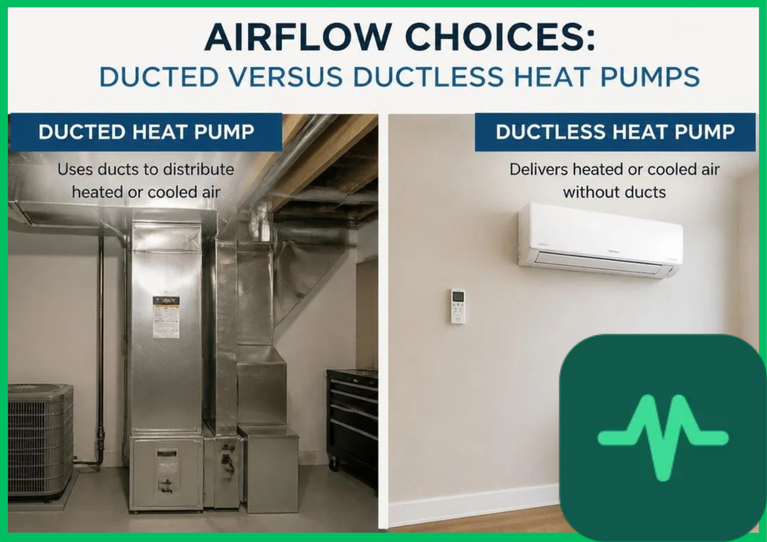
Ducted heat pump systems use a centralized indoor air handler connected to a sprawling network of metal or flexible tubes hidden inside your walls, floors, and attic space.
A powerful central fan pulls indoor air through return vents, pushes it across a refrigerant coil to heat or cool it, and forces it back out through supply registers in every room.
The main advantage of a ducted system is aesthetic and seamless.
You only see small metal grilles on your walls or ceilings. The machinery stays hidden out of sight, pumping conditioned air quietly to every corner of the house.
If your home already has existing ductwork left over from an old gas furnace or air conditioner, connecting a central ducted heat pump is straightforward and cost-effective.
When those ducts get old, however, hidden problems begin to surface.
The Silent Waste of Leaky Ducts
Out of sight often means out of mind.
Many homeowners assume their hidden metal ducts form a sealed, perfect highway for airflow.
Academic thermal research proves otherwise.
In many residential buildings, duct networks run through unconditioned spaces like hot attics or freezing crawlspaces.
Over time, joints loosen, seals crack, and flexible ducts tear.
According to ENERGY STAR efficiency evaluations, homes with leaky ductwork lose up to 25% to 30% of their conditioned air before it ever reaches the living spaces.
Your heat pump works overtime, pumping heat into your attic instead of your bedroom.
Furthermore, central ducted systems treat the entire house as a single zone.
If you spend your entire evening in the living room while the bedrooms sit empty, a traditional ducted system still forces you to heat or cool every unoccupied room in the house.
That brute-force approach wastes massive amounts of electricity.
Ductless Mini-Splits: Precision Zoned Comfort
Ductless heat pump systems—often called mini-splits—take a completely different approach to airflow.
They throw out the network of hidden ducts entirely.
Instead of a single central blower, a ductless system pairs an outdoor compressor with one or more compact indoor air-handling units mounted directly on walls or ceilings in specific rooms.
A small, three-inch hole drilled through your exterior wall connects the indoor and outdoor units, carrying refrigerant lines, electrical wires, and a condensation drain.
That direct connection eliminates duct losses completely.
Every watt of thermal energy produced by the compressor goes straight into the room where you actually need it.
Furthermore, ductless systems provide true zoned climate control.
You can set your home office to a cool 20°C or 68°F while keeping the guest bedroom at a warmer setting, or turn off climate control entirely in empty rooms.
According to UNEP sustainable housing frameworks, eliminating duct losses and adopting room-by-room zoning cuts residential heating and cooling energy consumption drastically.
The Science of Inverter Airflow and Quiet Operation
Both ducted and modern heat pump systems benefit enormously from variable speed inverter technology.
Older air handlers blasted air at 100% fan speed, creating loud rushing noises and sudden drafts every time the system kicked on.
Modern heat pump blowers adjust their fan speeds continuously.
They whisper softly in the background, maintaining a steady, gentle flow of conditioned air that prevents hot and cold stratification in your rooms.
Academic HVAC studies show that continuous, low-speed airflow maintains more stable indoor humidity levels than old-fashioned start-stop systems.
Whether you choose a central ducted layout or wall-mounted mini-splits, variable speed fans ensure absolute comfort without annoying drafts or loud noises.
Choosing Your System for a Sustainable Future
Which airflow setup fits your living space?
If your home already features a modern, well-sealed duct network in good condition, installing a central ducted heat pump provides whole-home comfort with minimal structural disruption.
If you live in an older home without ducts, want to add climate control to a room addition, or want absolute control over individual room temperatures to slash your energy bills, ductless mini-splits deliver unmatched efficiency.
According to IEA decarbonization roadmaps, upgrading residential heating and cooling to high-efficiency heat pumps is essential for global climate targets.
Whether you choose ducted air distribution or ductless zone control, modern heat pumps transform how we experience indoor comfort.
Through smart engineering, efficient airflow design, and thoughtful energy stewardship, heat pumps secure a clean, comfortable, and sustainable future for every home on Earth.
Comments (0)
Login to leave a comment.
No comments yet. Be the first to share your thoughts!