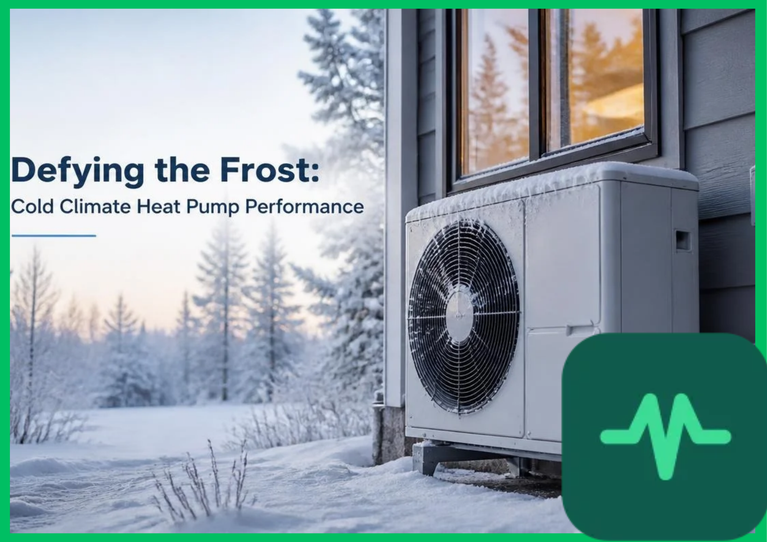
Frost coats your windowpanes in delicate white patterns. Outside, temperatures have plunged well below freezing.
For generations, keeping your home warm on a morning like this meant firing up a gas furnace or an oil boiler. You listened to the heavy clanking of metal ducts and smelled the dry heat rushing through the vents.
We accepted that harsh winters required burning fossil fuels. We assumed that warmth came at a heavy carbon cost.
A persistent myth claimed that heat pumps could never survive deep winter freezes. People said these machines worked fine in mild coastal regions, but failed completely when snow covered the ground.
That old myth kept millions of homes chained to oil and gas infrastructure for decades.
Modern engineering shattered that limitation.
According to global heating reports from the International Energy Agency (IEA), resource efficiency frameworks from the United Nations Environment Programme (UNEP), appliance efficiency benchmarks from ENERGY STAR, and academic thermodynamics research, cold climate heat pump performance is transforming winter heating across the globe.
By harnessing advanced inverter compressors and clever thermodynamic principles, modern heat pumps extract warmth from freezing subzero air without missing a beat.
Here is how cold-weather heat pumps work, why variable speed compressors change the physics of heating, and how winter thermal performance secures our sustainable future.
The Myth of Subzero Failure
To understand why cold-climate heat pumps represent such a massive leap forward, you have to look at where the skepticism originated.
Early generations of heat pumps installed decades ago operated on fixed-speed compressors.
When outdoor temperatures dropped below freezing, those older units struggled.
Their heating capacity plummeted. They froze over with thick blocks of ice, forcing inefficient electric resistance backup coils to kick on and drive monthly electricity bills sky-high.
Contractors took one look at freezing northern winters and told homeowners to stick with gas furnaces.
The reputation stuck. People assumed heat pumps were strictly fair-weather machines.
Behind that old reputation, laboratory scientists and thermodynamic engineers were quietly redesigning the technology from the ground up.
They realized that ambient air contains usable thermal energy even when it feels bitterly cold to human skin.
Absolute zero is -273°C or -460°F. As long as outdoor temperatures sit above that extreme scientific floor, thermal energy exists in the air waiting to be moved.
The challenge was not finding heat; the challenge was building a machine smart enough to harvest it at -15°C or approx. 5°F.
The Science of Variable Speed Inverter Compressors
The secret weapon inside every modern cold-climate heat pump is the variable speed inverter compressor.
Older heat pumps worked like a light switch: they were either running at 100% capacity or turned completely off.
That brute-force approach created massive temperature swings and struggled against freezing outdoor air.
An inverter compressor acts more like a sports car accelerator pedal.
It adjusts its motor speed smoothly and continuously, ramping up or slowing down based on exact real-time heating demands.
When a bitter frost hits overnight, the inverter compressor speeds up. It increases the refrigerant flow rate through the system, squeezing every drop of thermal energy out of the freezing outdoor air.
Academic thermodynamics research shows that variable speed drives maintain steady indoor comfort even when outdoor temperatures plunge to -20°C or approx. -4°F.
You no longer experience cold drafts or sudden temperature drops. The system hums quietly in the background, delivering continuous, reliable warmth.
Low-Temperature Heating Physics in Action
How does a machine extract heat when the world outside feels frozen solid?
It comes down to refrigerant chemistry and pressure management.
Inside the outdoor unit, a liquid refrigerant circulates through copper coils.
Because this refrigerant has a boiling point far colder than the outdoor air, it absorbs ambient thermal energy easily—even on a freezing winter day.
The liquid refrigerant boils into a vapor, capturing that warmth.
The variable speed compressor then squeezes that vapor hard.
Physics dictates that when you compress a gas, its temperature rises drastically.
That superheated vapor flows indoors through refrigerant lines, releasing its intense thermal energy into your home's air distribution system or water radiant loops.
According to ENERGY STAR efficiency evaluations, modern cold-climate heat pumps deliver more energy as heat than the electrical energy they consume to run the compressor—achieving efficiencies of 200% to 300% or higher, even in freezing weather.
Global Savings and Emissions Reductions
Upgrading to a cold-climate heat pump does more than keep your family cozy during winter storms. It slashes global carbon emissions.
Heating residential buildings accounts for a massive share of global energy consumption and greenhouse gas pollution.
According to IEA heating transition assessments, replacing fossil-fuel boilers with high-efficiency heat pumps is the single most effective action homeowners can take to decarbonize buildings.
UNEP resource efficiency guidelines highlight that cold-climate heat pumps eliminate local air pollution caused by burning oil and gas in neighborhoods, improving public health in densely populated cities.
Furthermore, because these systems run purely on electricity, they integrate seamlessly with renewable wind and solar power grids.
When your electricity grid shifts toward clean energy, your home heating cleans up right along with it.
Defying the Frost for a Sustainable Future
Cold climate heat pump performance proves that clean energy technology has conquered its toughest environmental hurdles.
We no longer have to accept that surviving a freezing winter requires burning fossil fuels or settling for inefficient heating systems.
By harnessing variable speed inverter compressors, understanding low-temperature heating physics, and trusting advanced thermodynamic engineering, we redefine winter comfort.
We step away from carbon-heavy gas and oil reliance, embracing a clean, efficient, and reliable standard of living.
Through brilliant scientific innovation, smart appliance design, and deep respect for our planetary climate, heat pumps defy the frost and secure a warm, sustainable future for every home on Earth.

Comments (0)
Login to leave a comment.
No comments yet. Be the first to share your thoughts!