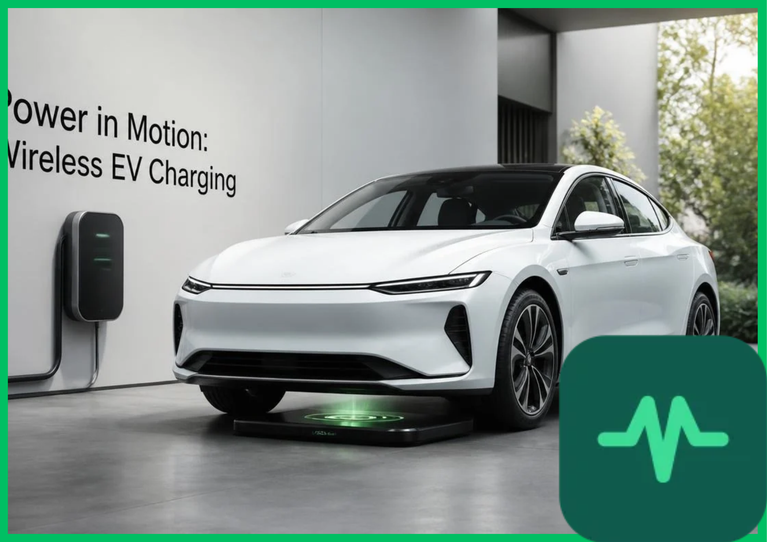
You shift the car into park, step out, and walk inside your house.
You do not fumble with heavy rubber cables.
You do not plug in a cord or wipe rain off a muddy charging plug.
You simply walk away.
Beneath your car, a quiet magnetic field activates.
Energy flows silently across the air gap from a pad on the garage floor straight into a receiver plate mounted under the vehicle chassis.
Your car battery charges effortlessly while you sleep.
For over a decade, electric vehicle ownership required a clumsy daily ritual.
We dragged heavy, wet charging cords across dirty pavement.
We fought with stiff cables in freezing winter storms.
We worried about damaged plug pins and worn insulation.
That manual plugging routine felt like an annoying chore left over from the early days of personal electronics.
We cannot build the ultimate clean transportation future while forcing drivers to wrestle with messy cords every single time they park.
What if charging your car was as effortless as setting your smartphone down on a bedside nightstand?
What if highways could charge your electric vehicle automatically while you drive across town at highway speeds?
A quiet, brilliant electromagnetic revolution is transforming roads and driveways across the globe.
According to global clean transport reports from the International Energy Agency (IEA), resource protection frameworks from the United Nations Environment Programme (UNEP), efficiency benchmarks from ENERGY STAR, and academic electromagnetic research, wireless inductive charging for electric vehicles is changing our mobility landscape.
By utilizing magnetic resonance to transfer electrical energy safely across air gaps without physical wires, we make electric car charging completely invisible and effortless.
Here is how wireless power works, why in-motion roadway charging changes transportation economics, and how power in motion secures our sustainable future.
The Messy Reality of Plug-In Charging Cables
To understand why wireless EV charging matters so much, you have to look at the minor frustrations of plug-in cords.
Cables are heavy, awkward, and exposed to harsh weather.
In heavy rain, deep snow, or freezing sub-zero cold, handling high-voltage plastic cables is unpleasant.
Public charging stations often suffer from vandalism, broken connector latches, and weather damage, leaving drivers stranded with dead batteries because a physical plug failed.
For commercial fleets, autonomous delivery robots, and public transit buses, plugging in manually adds labor costs and slows down automated operations.
Skeptics once argued that transferring electricity through thin air was inefficient, dangerous, and impractical for heavy vehicles.
Electromagnetic physicists and power engineers proved those skeptics wrong.
You do not need a copper wire to bridge a gap if you harness the invisible power of high-frequency magnetic fields.
What Is Wireless Inductive EV Charging?
Wireless inductive EV charging is an advanced power transfer technology that uses resonant magnetic coupling between a primary transmitter coil embedded in the ground and a secondary receiver coil mounted beneath a vehicle chassis to transfer high-voltage electrical energy across an air gap without physical cables.
Instead of plugging in a cord, the vehicle interacts with its environment through pure physics:
- Ground Transmitter: A flat copper coil buried flush inside your garage floor or highway asphalt generates an alternating magnetic field using high-frequency electricity.
- Vehicle Receiver: A matching copper coil mounted under your car catches those invisible magnetic waves when parked directly above the pad.
- Resonant Tuning: Both coils tune to the exact same electromagnetic frequency, allowing energy to transfer across a 15-centimeter or 6-inch air gap with astonishing efficiency.
- Automated Safety: Sensors verify that no metal debris or living creatures sit between the pads before ramping up high-power energy transfer.
You park over the pad, and power flows instantly.
You never touch a wire.
The Science of Magnetic Resonance and In-Motion Power
How can electricity jump across empty space from a concrete floor straight into a moving automobile without losing half its energy along the way?
It comes down to electromagnetic induction and resonant frequency tuning.
Academic electromagnetic research shows that wireless charging systems operate at frequencies between 80 kilohertz and 90 kilohertz, creating a focused magnetic tunnel that links transmitter and receiver coils tightly together.
When applied to dynamic in-motion charging, engineers embed long lines of transmitting coils beneath highway lanes.
As an electric car drives over the roadway, the vehicle's onboard receiver catches power on the fly, replenishing the battery while traveling at normal highway speeds.
According to ENERGY STAR and international vehicle efficiency evaluations, modern wireless charging systems achieve power transfer efficiencies exceeding 90% to 93%, matching the efficiency of traditional plug-in chargers.
Energy leaps across the gap cleanly and silently.
Environmental Integrity and Fleet Automation
The environmental benefits of wireless inductive charging extend far beyond eliminating wet garage cables or making daily parking convenient.
They provide the vital key to unlock fully autonomous electric transport.
According to UNEP resource governance frameworks, self-driving delivery vans, robotaxis, and urban transit buses cannot plug themselves in.
Without automated wireless charging pads embedded at taxi stands, bus stops, and depot floors, autonomous fleets would constantly need human workers to plug them into cords.
By integrating wireless charging into city streets and parking bays, autonomous electric vehicles can operate twenty-four hours a day without human intervention.
According to IEA clean transport roadmaps, scaling up wireless charging infrastructure is an essential pillar to accelerate commercial fleet electrification and reduce urban carbon footprints worldwide.
When electric vehicles refuel themselves invisibly while driving or parking, clean transportation becomes completely frictionless.
Overcoming Infrastructure Cost and Standardization Realties
Scaling wireless inductive charging from pioneering garage kits and test tracks into universal global roadways involves navigating real-world infrastructure hurdles.
Embedding power transmitters beneath public asphalt requires heavy civil engineering work and standardized coil designs so any brand of electric car can charge over any brand of roadway pad.
International standards organizations, automotive engineers, and municipal planners are solving these challenges by establishing universal power protocols, durable composite roadway housings, and modular trenching techniques that make installing street coils fast and affordable.
As automakers integrate factory-installed receiver pads into upcoming vehicle lineups, wireless charging is transitioning successfully from futuristic science fiction into standard automotive equipment worldwide.
Power in Motion Toward a Sustainable Future
Wireless electric vehicle charging proves that human engineering can make clean technology disappear into the background of our daily lives.
We no longer have to accept that fueling a car requires wrestling with heavy, wet cables and damaged plugs.
By harnessing resonant magnetic fields to transfer power across empty air—both when parked at home and while driving down public highways—we transform how energy moves.
We step away from physical tethers, embracing an invisible, effortless, and enduring standard of modern mobility.
Through brilliant electromagnetic physics, rigorous academic research, and a deep respect for our planetary future, power in motion secures a clean, boundless, and seamless sustainable world for every traveler on Earth.
Comments (0)
Login to leave a comment.
No comments yet. Be the first to share your thoughts!