You step out of the car, tired and ready to unwind.
Before heading inside, you reach for the charging cable. You plug it into the port on the side of your car.
A small indicator light blinks green, showing that power is flowing.
You walk away, grab dinner, and relax for the evening.
You do not think about the electricity coursing through the wires in your wall.
Yet, out on the regional power grid, your simple habit of plugging in immediately creates an invisible challenge.
Across your city, millions of other drivers are pulling into their garages at the exact same hour. They are plugging in their cars, turning on home appliances, and cranking up their heating systems.
Energy demand spikes vertically.
Power plant operators scramble to meet the sudden surge. They often fire up dirty, expensive fossil-fuel peaker plants just to keep the lights on and the cars charging.
We cannot transition to clean electric transport if charging our vehicles strains our power grids and burns extra coal.
A quiet, intelligent digital revolution is changing how our cars interact with the wall.
According to global energy reports from the International Energy Agency (IEA), resource sustainability frameworks from the United Nations Environment Programme (UNEP), appliance efficiency standards from ENERGY STAR, and academic smart grid research, EV smart charging schedule optimization is transforming the way we power our lives.
By coordinating charging times with renewable energy availability and grid demand, we save money and protect our planet.
Here is how smart charging works, why off-peak timing matters, and how automated timers secure our sustainable future.
The Hidden Strain of Immediate Plug-In Habits
To understand why smart charging matters so much, you have to look at the rhythm of the modern power grid.
Electricity cannot be easily stored in massive quantities on traditional wires; it must be generated the exact millisecond it is consumed.
During the middle of a sunny day, solar farms flood the grid with clean, abundant, and cheap electricity.
When evening arrives and the sun sets, solar generation drops to absolute zero while human energy demand peaks.
If every electric vehicle owner plugs in at 6:00 PM and charges at maximum speed, cars draw massive amounts of power during the dirtiest, most expensive hours of the day.
That immediate plug-in habit forces power companies to rely on fossil fuels to cover the shortfall.
It drives up electricity generation costs and speeds up battery degradation caused by high grid stress.
We needed a smarter way to manage the power flow.
We needed our cars to wait for the right moment.
What Is EV Smart Charging Optimization?
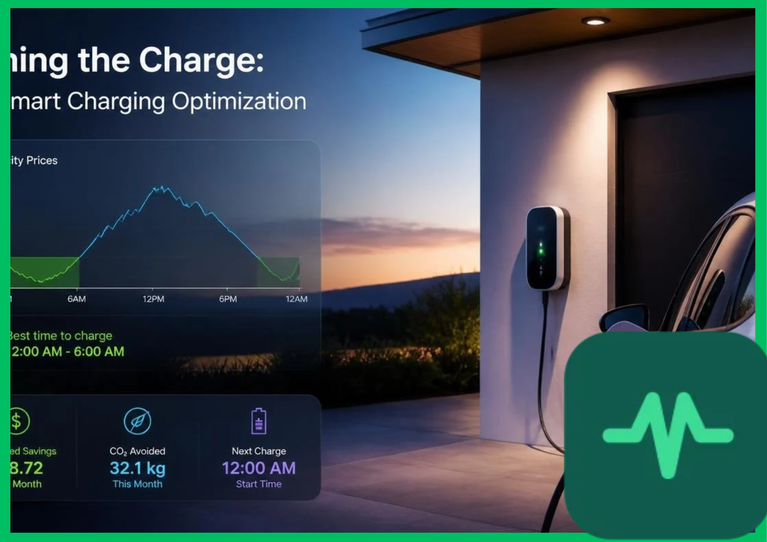
EV smart charging schedule optimization is an automated technology that connects your electric vehicle charger to smart grid signals, dynamic pricing tariffs, and renewable energy forecasts.
Instead of starting a high-speed charge the second you plug in, the smart charger pauses.
It communicates with your home network or utility provider, asking a simple question: When is the cleanest, cheapest electricity available tonight?
The system analyzes your driving schedule—knowing you need a full battery by 7:00 AM the next morning—and calculates the optimal window for energy delivery.
It might wait until 2:00 AM, when wind farms are spinning at full capacity and electricity demand across the city hits its lowest point.
Then, it quietly begins charging your vehicle, finishing just before your morning alarm rings.
You wake up to a full battery without ever having to adjust a manual timer.
The Science of Off-Peak Power and Grid Load Management
The environmental and financial benefits of smart charging are rooted in the physics of energy distribution.
Academic smart grid research shows that shifting electric vehicle charging to off-peak hours balances power network loads dramatically.
When cars charge overnight, they absorb surplus electricity generated by wind turbines and baseload power plants that would otherwise go to waste.
According to IEA clean transport roadmaps, widespread adoption of automated grid load management eliminates the need to build dozens of new fossil-fuel power plants to support the EV transition.
Furthermore, smart charging reduces strain on neighborhood transformers and local distribution lines.
Instead of thousands of homes pulling heavy currents simultaneously during the early evening peak, power consumption spreads out evenly across the quiet night hours.
According to ENERGY STAR efficiency benchmarks, smart chargers optimize power delivery while minimizing standby energy losses.
Saving Money While Protecting the Planet
Smart charging optimization does more than stabilize the regional power grid. It puts money back into your wallet.
Many energy markets use dynamic pricing models where electricity costs pennies per kilowatt-hour late at night, but spikes to high rates during evening peak hours.
If you charge your car blindly during peak hours, you pay top dollar for carbon-heavy energy.
When your smart charger delays your power draw until off-peak overnight hours, you buy electricity at its cheapest possible rate.
According to UNEP sustainable housing frameworks, automated charging schedules cut household vehicle fueling costs significantly while shrinking individual carbon footprints.
You sleep soundly, your car charges safely, and your utility bills drop.
It is a rare win-win scenario where personal savings align perfectly with global environmental stewardship.
Charging Toward a Sustainable Future
EV smart charging schedule optimization proves that technology can harmonize our daily routines with the needs of our planetary ecosystem.
We no longer have to accept that driving clean electric vehicles requires straining our power grids or consuming fossil-fuel electricity during peak hours.
By harnessing automated home EV charger timers, dynamic pricing tariffs, and smart grid intelligence, we transform our vehicles into flexible, cooperative energy assets.
We step away from brute-energy consumption, embracing an intelligent, responsive standard of living.
Through smart engineering, automated software coordination, and thoughtful daily habits, smart charging secures a clean, affordable, and sustainable future for our world.
Comments (0)
Login to leave a comment.
No comments yet. Be the first to share your thoughts!