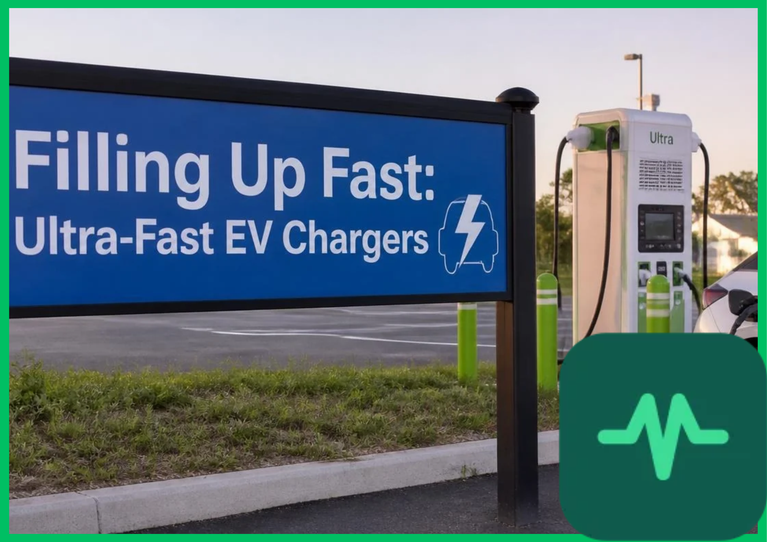
The battery gauge flashes amber at ten percent.
You plug in the heavy charging cable, walk inside to grab a hot cup of coffee, and return a few minutes later.
The dashboard indicator reads eighty percent.
You unplug, hop back into the driver's seat, and merge seamlessly back onto the open highway.
You feel a quiet wave of satisfaction.
For years, critics claimed that driving an electric vehicle on long journeys was impossible because recharging took too long.
We watched cars sit tethered to slow chargers for hours while drivers paced restlessly beside the asphalt.
That charging bottleneck kept millions of drivers anchored to gasoline engines, afraid to make the switch to clean electric transport.
We cannot build a clean transportation future if long-distance drivers have to wait hours at highway plazas just to replenish their energy.
What if highway charging stations could pump hundreds of kilowatts of power into a car battery in the time it takes to buy a beverage?
What if ultra-fast charging made road trips as seamless as filling a gas tank?
A quiet, brilliant power electronics revolution is transforming our highways across the globe.
According to global clean transport reports from the International Energy Agency (IEA), resource protection frameworks from the United Nations Environment Programme (UNEP), efficiency benchmarks from ENERGY STAR, and academic power electronics research, ultra-fast EV charging station infrastructure is changing our transit landscape.
By utilizing high-power direct current architecture, liquid-cooled cables, and localized battery buffer systems, we replenish car batteries in minutes without melting local electrical grids.
Here is how ultra-fast charging works, why megawatt-scale power systems change travel economics, and how filling up fast secures our sustainable future.
The Slow Charging Bottleneck of Early EVs
To understand why ultra-fast EV chargers matter so much, you have to look at the severe limits of early electric vehicle charging technology.
When modern electric cars first arrived on the market, most public chargers operated on standard alternating current or slow direct current levels.
Drivers plugged in and waited anywhere from four to eight hours for a full charge.
That speed worked fine for overnight home charging or workplace parking stalls.
It failed completely for long-distance highway travel.
People do not want to spend half their vacation sitting parked at a roadside charging post.
Skeptics argued that electrical grids could never supply the massive surges of power required to charge hundreds of cars in minutes.
Power electronics engineers and smart grid researchers proved those skeptics wrong.
You do not need to rewrite the laws of physics if you engineer smarter power hardware and buffer energy locally.
What Is an Ultra-Fast EV Charger?
An ultra-fast EV charger is a high-power direct current charging station capable of delivering electrical output ranging from 150 kilowatts to 350 kilowatts or higher straight into an electric vehicle battery pack, reducing typical highway charging stops down to ten or fifteen minutes.
Instead of a standard wall box trickling current into a car, an ultra-fast station acts as a localized power powerhouse:
- High-Voltage Architecture: The station operates at 800 volts or higher, pushing massive electrical energy through vehicle circuits with minimal resistive heat loss.
- Liquid-Cooled Cables: Because pushing hundreds of amperes of current through a thin cable generates extreme heat, internal pumps circulate cooling fluid directly through the charging cord to keep it light and safe to touch.
- Smart Power Sharing: Advanced switching cabinets distribute electricity dynamically among multiple charging stalls, sending maximum power to cars that need it most.
You plug in, walk away for a few minutes, and return to a fully replenished battery.
The Science of Power Electronics and Thermal Management
How can a charging cable transfer enough electrical energy to power dozens of homes simultaneously straight into a single automobile without melting down?
It comes down to semiconductor physics and liquid thermal management.
Academic power electronics research shows that modern ultra-fast chargers rely on silicon-carbide semiconductors that switch electrical states with astonishing speed and minimal energy loss.
When high-power direct current flows into a lithium-ion battery, the car's internal thermal management system circulates chilled coolant through the battery cells to prevent overheating.
Furthermore, ENERGY STAR and international electrical efficiency evaluations prove that advanced power conversion systems maintain overall efficiencies exceeding 95%, ensuring that energy flows smoothly from the grid into the car without wasting power as heat.
Charging becomes fast, safe, and efficient.
Environmental Integrity and Local Grid Support
The environmental benefits of ultra-fast EV charging station infrastructure extend far beyond making road trips convenient or convincing skeptical drivers to buy electric cars.
They provide a vital catalyst to accelerate the global transition away from internal combustion engines.
According to UNEP resource governance frameworks, passenger cars powered by clean electricity eliminate localized urban air pollution and slash greenhouse gas emissions across national transportation corridors.
When ultra-fast chargers sit alongside highways powered by regional wind and solar farms, every journey becomes truly zero-emission.
To prevent highway chargers from overloading local rural power grids during peak traffic hours, modern stations integrate localized battery energy storage buffers that trickle-charge slowly from the grid all day, then discharge massive bursts of stored energy into vehicles when fast-charging demand spikes.
According to IEA clean transport roadmaps, scaling up ultra-fast charging networks is an essential pillar to achieve global net-zero emissions targets.
When highway refueling matches the speed of gasoline while running entirely on clean electricity, sustainable mobility wins the open road.
Overcoming Grid Capacity and Real-Estate Realties
Scaling ultra-fast EV charging station infrastructure from pioneering highway corridors into universal global coverage involves navigating real-world electrical grid hurdles.
Connecting 350-kilowatt chargers to rural or remote highway intersections requires massive electrical capacity upgrades and high-voltage substation connections.
Utility companies, charging network operators, and electrical engineers are solving these challenges by pairing ultra-fast chargers with stationary battery banks and local solar canopies, smoothing out electrical demand and reducing the need for expensive grid reinforcement.
As charging hardware becomes more modular and grid integration improves, ultra-fast chargers are transitioning successfully from rare highway novelties into standard transportation infrastructure worldwide.
Filling Up Fast Toward a Sustainable Future
Ultra-fast electric vehicle chargers prove that human engineering can eliminate the final practical barriers standing in the way of global clean transportation.
We no longer have to accept that driving electric on long journeys requires sitting parked for hours while waiting for batteries to replenish.
By combining high-voltage direct current power, liquid-cooled cables, and smart battery buffers, modern charging stations fill up car batteries in minutes.
We step away from range anxiety, embracing a fast, convenient, and enduring standard of highway travel.
Through brilliant power electronics, rigorous academic research, and a deep respect for our planetary climate, filling up fast secures a clean, boundless, and sustainable future for every traveler on Earth.
Comments (0)
Login to leave a comment.
No comments yet. Be the first to share your thoughts!