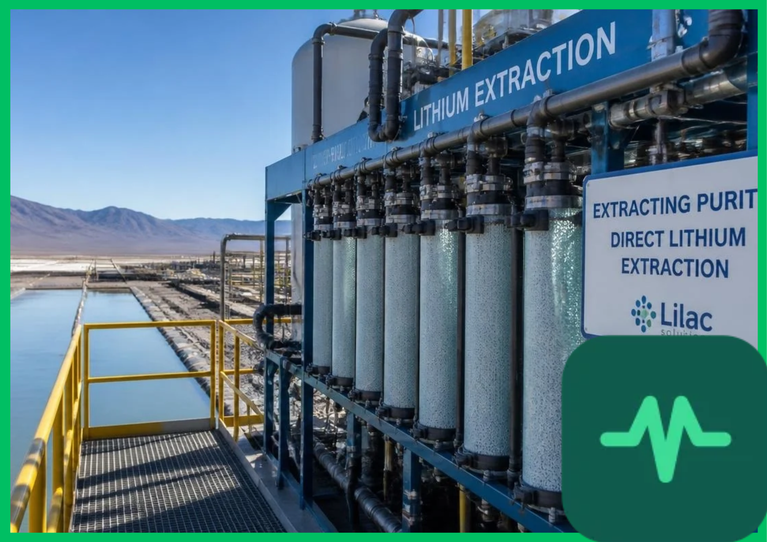
You look out across rows of massive evaporation pools stretching toward the horizon.
For decades, getting lithium out of salt flats meant flooding vast basins with brine and waiting twelve to eighteen months under the hot sun for water to evaporate.
That old method took forever.
It wasted millions of liters of precious water in fragile arid regions, and it left behind huge chemical sludge scars on the landscape.
As millions of electric vehicles roll off assembly lines every year, the global demand for battery minerals skyrockets.
We cannot build a clean energy future while destroying local water tables and waiting over a year to harvest a single batch of battery material.
What if we could extract pure lithium from underground brine in hours instead of years?
What if advanced filtration could capture lithium cleanly without wasting water or carving up the earth?
A quiet, brilliant chemical engineering revolution is transforming mineral extraction across the globe.
According to global clean energy reports from the International Energy Agency (IEA), resource protection frameworks from the United Nations Environment Programme (UNEP), efficiency benchmarks from ENERGY STAR, and academic hydro-metallurgical research, direct lithium extraction from geothermal brine is changing our mineral supply chains.
By utilizing selective sorbents, advanced membranes, and closed-loop reinjection systems, we extract battery-grade lithium in hours while returning clean water back underground.
Patsnap
Here is how direct lithium extraction works, why geothermal brine processing changes mining economics, and how extracting purity secures our sustainable future.
The Slow, Thirsty Legacy of Evaporation Ponds
To understand why direct lithium extraction matters so much, you have to look at the severe limits of traditional brine mining.
Traditional lithium mining relies on massive solar evaporation ponds.
Companies pump mineral-rich underground brine into shallow basins covering thousands of hectares.
The sun heats the liquid slowly over many months, precipitating out salts of potassium and sodium until concentrated lithium remains.
That process is deeply inefficient.
It loses up to fifty percent of the total lithium trapped in the brine during the lengthy evaporation cycle.
Worse still, it evaporates millions of liters of pristine regional groundwater in water-stressed desert regions, threatening local agriculture and indigenous communities.
Skeptics once argued that separating lithium from complex underground brines without solar evaporation was chemically impossible or economically unviable.
Chemical engineers and materials scientists proved those skeptics wrong.
You do not need an ocean of sun-baked mud to capture lithium if you use intelligent molecular filters.
What Is Direct Lithium Extraction?
Direct lithium extraction is an advanced industrial separation technology that recovers lithium ions selectively from raw underground brines—including geothermal brines and subsurface mineral waters—in a matter of hours using specialized solid sorbents, ion-exchange resins, or membranes, without requiring massive multi-year evaporation ponds.
Patsnap
Instead of baking brine under the sun, the facility operates like a high-tech water treatment plant:
- Brine Intake: Hot mineral-rich brine is pumped from deep underground wells straight into enclosed industrial processing units.
- Selective Capture: Specialized chemical sorbents or ceramic frameworks grab lithium ions out of the liquid while letting competing elements like sodium, potassium, and calcium pass right through.
- Immediate Elution: A mild water wash strips the captured lithium off the sorbent material, producing a concentrated lithium chloride solution in minutes.
- Underground Reinjection: The stripped, leftover brine is pumped safely back down into the exact same deep geological formation through reinjection wells, preserving local water tables.
Patsnap
You get clean, concentrated lithium solution instantly while keeping the local environment completely undisturbed.
The Science of Ion Selectivity and Geothermal Co-Production
How can a chemical filter pick out a single target mineral from a chaotic soup of competing salts that are hundreds of times more concentrated?
It comes down to atomic-scale ion selectivity and thermal fluid integration.
Academic research shows that modern direct lithium extraction systems use engineered titanium-manganese oxide sorbents or electro-driven intercalation electrodes that match the exact ionic radius of lithium.
ResearchGate
When combined with geothermal power plants—which already bring super-hot mineral waters rushing to the surface to spin electricity turbines—lithium extraction becomes a natural co-product.
Patsnap
The hot brine passes through the power station first, generating zero-emission electricity, and flows immediately through the extraction unit before getting reinjected back into the earth.
Furthermore, ENERGY STAR and international industrial efficiency evaluations prove that closed-loop direct extraction systems recycle over 95% of the water they use, dropping environmental footprints to a fraction of traditional mining.
Clean energy generates clean minerals. Efficiency protects our resources.
Environmental Integrity and Water Conservation
The environmental benefits of direct lithium extraction extend far beyond accelerating mineral production or eliminating ugly evaporation mud flats.
They provide an essential safeguard for global water security and ecosystem protection.
According to UNEP resource governance frameworks, protecting local aquifers from groundwater depletion prevents irreversible ecological damage in fragile desert and volcanic regions.
When mining operations return spent brine safely underground instead of evaporating millions of tons of water into thin air, the hydrological balance remains unbroken.
According to IEA clean energy roadmaps, scaling up direct extraction technology is an absolute pillar to supply the millions of tons of battery minerals needed for global transport electrification without triggering a localized water crisis.
When mineral sourcing protects nature, our green transition remains truly green.
Overcoming Scaling, Scaling Chemistry, and Brine Complexity
Scaling direct lithium extraction from pioneering pilot facilities into universal global industrial production involves navigating real-world chemical engineering hurdles.
Every underground brine deposit possesses a unique chemical fingerprint, containing different temperatures, acidity levels, silica concentrations, and competing mineral salts that can foul filters or corrode equipment.
Patsnap
Chemical engineers, geologists, and plant designers solve these challenges by installing customized pre-treatment filtration stages, utilizing corrosion-resistant titanium alloy piping, and building modular extraction units tailored to the specific chemistry of each local reservoir.
Patsnap
As commercial plants expand across North and South America, Europe, and Asia, direct extraction is transitioning successfully from specialized oilfield trials into standard global mining infrastructure.
Extracting Purity Toward a Sustainable Future
Direct lithium extraction proves that human ingenuity can revolutionize heavy industry, replacing crude environmental disruption with surgical molecular precision.
We no longer have to accept that building electric car batteries requires wasting millions of liters of water in fragile desert basins.
By capturing lithium selectively from underground brines in hours and returning clean water to the earth, we secure the minerals of our clean future responsibly.
We step away from extractive waste, embracing a clean, efficient, and enduring standard of resource stewardship.
Through brilliant chemical engineering, rigorous academic research, and a deep respect for our planetary water supply, extracting purity secures a clean, prosperous, and sustainable future for every community on Earth.
Comments (0)
Login to leave a comment.
No comments yet. Be the first to share your thoughts!