You look at your electric vehicle plugged into the wall, charging up quietly with clean renewable energy.
You feel a deep sense of pride knowing your car produces zero tailpipe emissions. You are helping protect the air we breathe and the climate we share.
Then, a quiet, lingering question crosses your mind.
What happens to that powerful battery pack when the car finally reaches the end of its road?
For years, critics of electric vehicles pointed to a scary nightmare scenario.
They pictured millions of dead car batteries dumped into massive industrial landfills, leaking toxic heavy metals and acid into the soil and groundwater.
That thought breaks the heart of anyone who cares about building a truly sustainable green economy.
We cannot clean our transportation sector by creating a brand-new pollution disaster underground.
We cannot mine the earth forever for lithium, cobalt, and nickel without eventually running out.
Fortunately, a brilliant chemical revolution is unfolding in laboratories and recycling plants across the globe.
According to global clean transport reports from the International Energy Agency (IEA), resource circularity frameworks from the United Nations Environment Programme (UNEP), efficiency benchmarks from ENERGY STAR, and academic metallurgical research, EV battery recycling chemistry is changing everything.
By using advanced wet chemical baths to dissolve and separate valuable metals, we can recover up to 95% of the materials inside dead batteries and use them to build brand-new cells.
Here is how hydrometallurgical recycling works, why chemical dissolution saves our natural ecosystems, and how closed-loop manufacturing secures our sustainable future.
The Fear of the E-Waste Graveyard
To understand why chemical recycling matters so much, you have to look at the massive scale of the electric vehicle transition.
Millions of electric cars roll off manufacturing assembly lines every year.
Inside each car sits a heavy, complex battery pack packed with precious minerals.
Extracting those raw elements from natural earth requires harsh industrial mining operations that destroy landscapes and consume massive volumes of water.
If we simply throw those batteries away when they wear out, we waste finite earthly resources and trigger a toxic waste crisis.
Early environmental critics warned that electric vehicles would trade smokestack pollution for battery waste.
Scientists and chemical engineers refused to accept that dead-end scenario.
They realized that a spent battery is not garbage. It is an above-grade mineral deposit waiting to be unlocked.
We needed a chemical process precise enough to separate individual metal atoms without destroying them.
What Is EV Battery Recycling Chemistry?
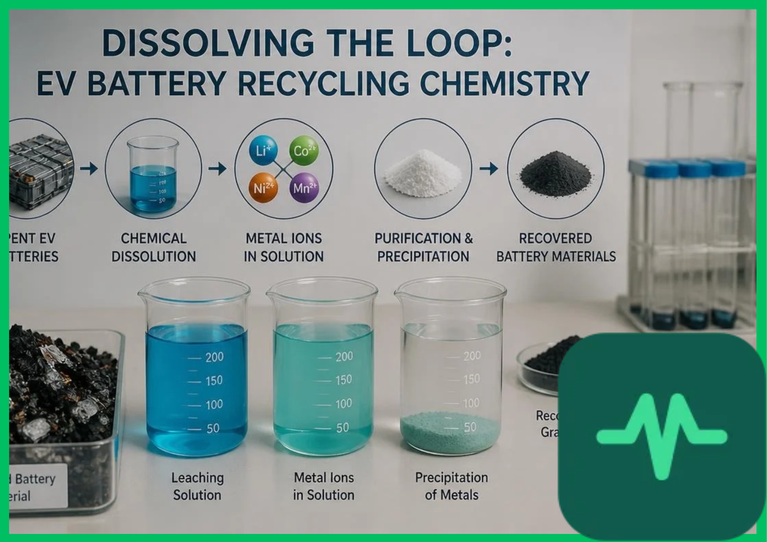
EV battery recycling chemistry—known formally as hydrometallurgical processing—uses liquid chemical baths, mild acids, and precise solvent extraction techniques to dissolve the contents of a dead battery pack into purified liquid solutions.
Instead of just smashing batteries into a coarse metallic powder or melting them down in high-heat furnaces, hydrometallurgical recycling treats battery cells like a molecular puzzle.
Workers discharge the spent battery modules safely, crush them mechanically into a fine material known as black mass, and submerge that mass into specialized acid solutions.
The acid dissolves the valuable lithium, cobalt, nickel, and manganese into liquid form.
Chemical technicians then adjust the pH levels and use specific organic solvents to extract each metal individually.
The result is pure, crystal-clear liquid salts of lithium, cobalt, and nickel that match the exact chemical purity of newly mined virgin ores.
You can use those recovered chemicals to manufacture brand-new battery cells over and over again without any loss in performance.
The Science of Acid Leaching and Solvent Extraction
How do industrial recycling facilities separate four or five different valuable metals from a murky black liquid mixture?
It comes down to precision chemistry and differential solubility.
Academic metallurgical research shows that adjusting the temperature, acidity, and chemical binding agents in the leaching bath causes specific metals to precipitate out of the liquid at different times.
Cobalt drops out first. Nickel follows next. Lithium is carefully captured in the final purification stages.
Unlike pyrometallurgical smelting—which burns away valuable lithium in high-temperature furnaces to recover only basic nickel and cobalt—hydrometallurgical chemistry recovers nearly 95% of all critical battery elements, including delicate lithium.
According to ENERGY STAR and international industrial efficiency evaluations, wet chemical recycling consumes significantly less energy than mining raw ore from deep rock deposits, because the metals are already refined and concentrated inside the battery waste stream.
Environmental Protection and Supply Chain Independence
The environmental benefits of advanced battery recycling extend far beyond keeping landfills clean.
They provide vital geopolitical and ecological stability for the entire clean energy transition.
As global demand for electric vehicles skyrockets, demand for lithium and cobalt threatens to outpace natural mining capacity.
According to UNEP resource circularity frameworks, establishing closed-loop recycling infrastructure reduces our reliance on destructive new mining operations, protecting fragile natural habitats across the globe.
According to IEA clean transport roadmaps, recycling domestic battery waste creates secure regional supplies of critical minerals, insulating vehicle manufacturers from international trade bottlenecks and wild commodity price swings.
When nations recycle their own batteries locally, they build an independent, self-sustaining industrial loop.
Overcoming Collection and Sorting Realities
If hydrometallurgical recycling offers such clear environmental and economic benefits, why aren't 100% of spent EV batteries being recycled today?
The bottleneck is not chemical technology; the bottleneck is collection logistics and battery design standardization.
Automotive battery packs come in hundreds of different shapes, sizes, and chemical formulations.
Disassembling thousands of unique battery packs safely requires specialized robotic sorting lines and careful handling protocols.
As global policy frameworks and manufacturer standards move toward unified battery designs and mandatory recycling targets, recycling facilities are scaling up rapidly across multiple continents.
When car makers design battery packs with easy disassembly in mind, chemical recycling plants process them faster, cleaner, and cheaper than ever before.
Dissolving the Loop Toward a Sustainable Future
EV battery recycling chemistry proves that human ingenuity can solve the environmental challenges created by our own technological progress.
We no longer have to accept that driving electric cars requires permanent resource extraction and toxic waste accumulation.
By dissolving spent battery cells in precise chemical baths, recovering pure lithium and cobalt, and feeding those elements back into new manufacturing lines, we close the loop on modern transport.
We step away from a linear throwaway culture, embracing a smart, circular, and regenerative standard of living.
Through brilliant chemical engineering, advanced metallurgy, and deep respect for our planetary ecosystem, dissolving the loop secures a clean, thriving, and sustainable future for our world.
Comments (0)
Login to leave a comment.
No comments yet. Be the first to share your thoughts!