Every single item around you wears a coat of plastic.
Crisp bags, milk jugs, shampoo bottles, and shrink-wrapped boxes line the shelves.
You buy your groceries, bring them home, and unpack your bags.
Within minutes, your kitchen trash can fills up with plastic packaging.
You carry that plastic out to your recycling bin, feeling good that you are doing your part to protect the planet.
Then, a harsh truth hits you.
Most of the plastic you throw into that blue bin never actually gets recycled into something new.
Traditional mechanical recycling has a dirty secret. Every time plastic gets melted down and reshaped, its polymer chains break down a little bit more.
After two or three cycles, the plastic becomes brittle, weak, and useless. It ends up in a landfill or gets burned in an incinerator.
We cannot solve our global waste crisis by pretending mechanical sorting is enough.
We need a completely different way to handle plastic.
A quiet, brilliant molecular revolution is transforming waste management.
According to global resource reports from the International Energy Agency (IEA), circular economy frameworks from the United Nations Environment Programme (UNEP), efficiency benchmarks from ENERGY STAR, and academic polymer research, chemical plastic recycling technology is changing everything.
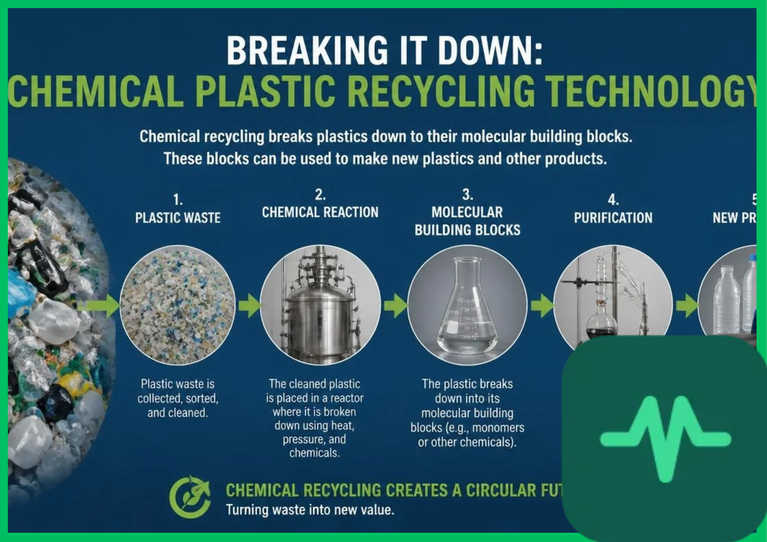
By melting plastic back down to its raw molecular building blocks, we can remake it infinitely without losing quality.
Here is how chemical recycling works, why breaking down polymers saves our oceans, and how advanced molecular processing secures our sustainable future.
The Broken Promise of Traditional Plastic Recycling
To understand why chemical recycling is so revolutionary, you have to look at why traditional mechanical recycling fails so many plastics.
When you toss a plastic bottle into a recycling bin, workers or automated machines sort it by polymer type.
They wash it, shred it into tiny flakes, melt those flakes down, and mold them into plastic pellets.
Manufacturers use those pellets to make new products, like park benches or polyester clothing.
That mechanical process works fine for rigid drink bottles made of clean polyethylene terephthalate.
It fails completely for almost everything else.
Flexible food packaging, multi-layer pouches, greasy takeout containers, and mixed-color polymers clog mechanical sorting plants instantly.
If a plastic wrapper contains a thin layer of aluminum foil glued to plastic film, mechanical recyclers cannot separate them.
The whole batch gets rejected and sent to a landfill.
Furthermore, every time polymer chains go through a high-heat mechanical extruder, the heat chops the long molecular strings into shorter pieces.
Plastic degrades. It loses its strength.
After a few rounds, it is garbage.
We needed a technology that could hit the reset button on plastic at the molecular level.
What Is Chemical Plastic Recycling Technology?
Chemical plastic recycling technology—often called advanced recycling or feedstock recycling—does something entirely different from mechanical shredding.
Instead of just melting plastic and molding it into a lower-grade shape, chemical recycling uses heat, pressure, catalysts, or solvents to break mixed plastic waste down into its original chemical building blocks.
Those building blocks are monomers and basic hydrocarbons.
They are the exact same raw chemical substances that fossil fuels provide.
Once plastic waste is reduced back to those pure liquid or gas hydrocarbons, refineries clean them thoroughly.
All dyes, food residues, labels, and chemical additives are filtered out completely.
The resulting clean liquid feedstock is fed back into petrochemical steam crackers, where it is built into brand-new virgin-quality plastic.
You can recycle that plastic an infinite number of times without any loss in material strength.
The Science of Pyrolysis and Dissolution
How do industrial facilities turn old shampoo bottles and crisp bags back into pure chemical building blocks?
The process relies on a few distinct scientific methods depending on the type of plastic:
- Pyrolysis: This thermal process heats mixed plastic waste in an oxygen-free chamber to temperatures between 400°C and 600°C (approx. 750°F to 1,100°F). The heat cracks the long polymer chains apart, turning solid plastic waste into a synthetic crude oil.
- Gasification: This method exposes plastic waste to high heat and controlled oxygen or steam, turning the material into a mixture of carbon monoxide and hydrogen—known as synthesis gas—which chemists use to manufacture fresh methanol and ammonia.
- Solvent Dissolution: This process uses specific liquid solvents to dissolve targeted plastics out of complex, multi-layer packaging, leaving additives behind so the pure polymer can be recovered cleanly.
Academic polymer research shows that these chemical pathways bypass the physical contamination limits that shut down traditional mechanical sorting facilities.
Dirty, mixed, and colored plastic waste that was once destined for landfills suddenly becomes a valuable chemical resource.
Closing the Loop on the Circular Economy
The environmental benefits of chemical recycling go far beyond cleaning up neighborhood streets and beaches.
They touch the core of global climate governance.
According to UNEP circular economy frameworks, keeping existing plastic molecules in active industrial circulation reduces our reliance on extracting fresh crude oil from the earth.
When we turn old plastic bags back into virgin-quality resin through pyrolysis, we avoid the heavy carbon emissions generated by drilling, pumping, and refining new fossil fuels.
According to IEA industrial efficiency assessments, modern chemical recycling plants are scaling up rapidly, integrating renewable electricity to power their thermal reactors and cutting their own operational carbon footprints.
ENERGY STAR evaluations highlight that advanced sorting and catalytic processing facilities maintain high energy recovery efficiency, ensuring that the process consumes less power than the raw extraction and synthesis of brand-new materials from scratch.
Overcoming Industrial and Economic Hurdles
Like any emerging technology, chemical plastic recycling faces real-world growing pains.
Building advanced pyrolysis and gasification plants requires significant financial investment.
Critics also point out that chemical facilities must run on clean energy sources to avoid trading one pollution problem for another.
Scientists and industrial engineers work constantly to optimize catalysts that lower required operating temperatures and reduce energy consumption.
As global policy frameworks and consumer demand push manufacturers toward circular production, chemical recycling scales up to meet the challenge, transforming mountains of unrecyclable trash into a clean, repeating resource loop.
Breaking Down Waste Toward a Sustainable Future
Chemical plastic recycling technology proves that human ingenuity can untangle our most stubborn environmental pollution challenges.
We no longer have to accept that billions of tons of flexible packaging, mixed plastics, and everyday waste must end up buried in landfills or floating in our oceans.
By melting polymers back down to their raw molecular building blocks, purifying them completely, and remaking virgin-quality resin, we rewrite the rules of modern manufacturing.
We step away from a linear throwaway culture, embracing a smart, circular, and regenerative standard of living.
Through brilliant chemical engineering, advanced molecular science, and deep respect for our planetary ecosystem, breaking down plastic waste secures a clean, thriving future for our world.


Comments (0)
Login to leave a comment.
No comments yet. Be the first to share your thoughts!