
 to
 [
 to
 ]), often oxidizing lithium into slag rather than recovering battery-grade lithium compounds directly. Hydrometallurgical lithium-ion battery recycling black mass leaching dissolves ground electrode active powders in aqueous lixiviants at moderate temperatures (
 to
 [
 to
 ]), enabling selective separation and high-purity recovery of critical metals for cathode active material synthesis. Evaluating black mass leaching, solvent extraction recovery, closed-loop metal purity, and pyrometallurgical smelting trade-offs is essential for analyzing hydrometallurgical battery recycling physics.
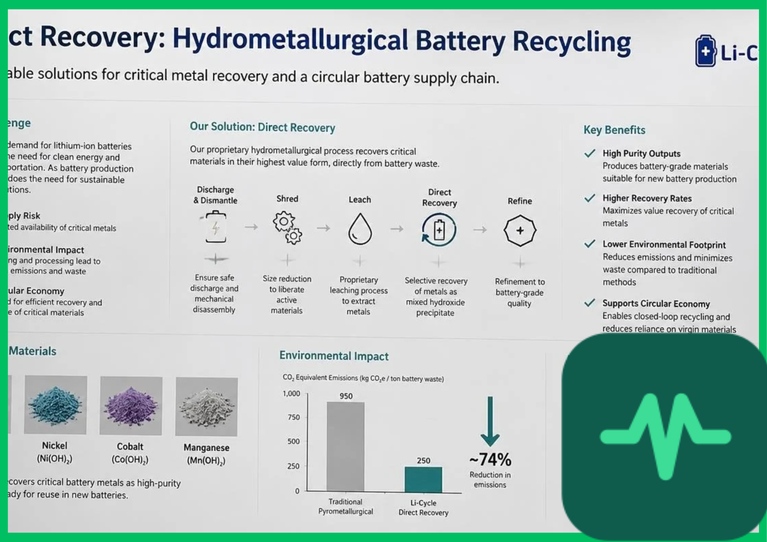
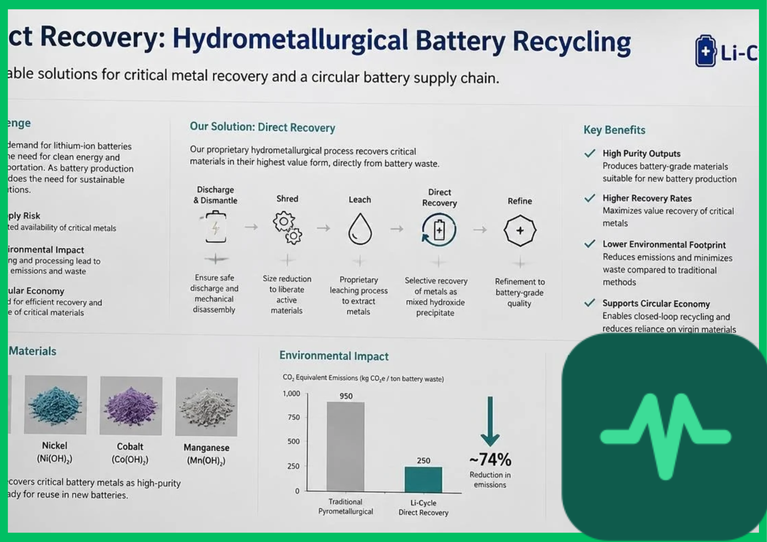
Black Mass Characterization and Leaching Kinetics
Mechanical pretreatment—discharging, dismantling, shredding or granulating, sieving, magnetic separation, and density/air classification—converts spent or scrap lithium-ion cells into "black mass," a fine dark powder containing active cathode materials (such as nickel-manganese-cobalt oxides,  or
 ; nickel-cobalt-aluminum oxides,
 ; or lithium iron phosphate,
 or
 ), graphite anode particles, residual aluminum and copper foils, binder polymers such as polyvinylidene fluoride (
 ), and trace electrolyte salts or fluorinated compounds.
Leaching kinetics transfer solid transition metals and lithium from layered or olivine oxide crystal lattices into an aqueous pregnant leach solution ( ). In acidic leaching—using sulfuric acid (
 ), hydrochloric acid (
 ), or organic acids—higher oxidation-state cations such as
 or
 dissolve slowly unless reduced to more soluble lower valence states (
 ,
 ) using a reducing agent such as hydrogen peroxide (
 ), sodium metabisulfite (
 ), or glucose/ferrous reductants:

Leaching extraction efficiency depends on acid molarity, solid-to-liquid ratio ( or
 ), particle size distribution, agitation mass transfer, temperature (
 to
 [
 to
 ]), and oxidation-reduction potential (
 ). Excessive peroxide at elevated temperature decomposes thermally into water and oxygen without reducing metal ions, requiring careful reagent dosing.
Impurity Removal and Solvent Extraction Recovery
Raw pregnant leach solutions carry dissolved impurities—including iron ( ), aluminum (
 ), copper (
 ), calcium, sodium, and residual fluorine or phosphorus—alongside target metals (
 ,
 ,
 ,
 ). Before selective recovery, operators adjust solution
 using alkaline reagents such as sodium hydroxide (
 ), calcium carbonate (
 ), or lithium hydroxide to precipitate
 ,
 , and copper phases while minimizing co-precipitation losses of nickel and cobalt.
Following impurity filtration, solvent extraction recovery separates individual target metal ions using an immiscible organic phase—typically a kerosene or hydrocarbon diluent containing selective chelating or organophosphorus extractants (such as  for manganese/impurities, or phosphinic/phosphonic acid extractants for cobalt and nickel). Metal extraction equilibrium depends on aqueous
 , extractant concentration, and phase ratio (
 ), governed by cation-exchange equilibria:

where overbars denote species in the organic phase. Multi-stage counter-current mixer-settler or centrifugal contactor cascades load target cations selectively in the extraction stage, scrub minor co-extracted ions, strip target metals into a concentrated aqueous strip liquor using acidic solutions, and regenerate the organic extractant for continuous reuse. Lithium typically remains in the raffinate stream after transition-metal removal and is recovered via precipitation or crystallization as lithium carbonate ( ) or lithium hydroxide monohydrate (
 ).
Technical Data Specifications of Hydrometallurgical Battery Recycling
| Recycling Process Parameter | Hydrometallurgical Process Standard |
|---|---|
| Leaching Temperature Span |  to  (  to  ) atmospheric/pressurized |
| Primary Leaching Media |  + reductant (  / bisulfite) or  /organic |
| Selective Separation Route |  impurity precipitation + solvent extraction / ion exchange |
| Target Recovered Outputs |  ,  ,  sulfates/salts,  /  , graphite |
| Process Energy & Power Basis | Lower thermal duty than smelting; 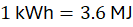 ;  |
| Primary Effluent / Waste Stream | Neutralized salt brines/effluents, filter cakes, off-gas scrubbing |
| Key Quality Target | Battery-grade precursor purity for cathode active material |
Closed-Loop Metal Purity and Pyrometallurgical Smelting Trade-Offs
Achieving closed-loop metal purity requires controlling trace impurities—such as iron, copper, sodium, sulfur, and halogens—down to parts-per-million thresholds required by cathode active material ( ) precursor producers. Even minor trace contaminants in nickel, cobalt, or lithium salts can disrupt precursor co-precipitation morphology, alter crystal stoichiometry during calcination, increase lithium-nickel cation mixing, or degrade cycle life and impedance in finished cells.
Comparing hydrometallurgy against pyrometallurgical smelting trade-offs highlights distinct operational profiles:
- Thermal & Energy Profile: Pyrometallurgy relies on high-temperature smelting (
 to
 [
 to
 ]) and requires off-gas scrubbing for fluorinated/organics decomposition products, whereas hydrometallurgy operates at low-to-moderate temperatures (
 [
 ]) but generates aqueous salt streams and requires reagent supply and wastewater treatment.
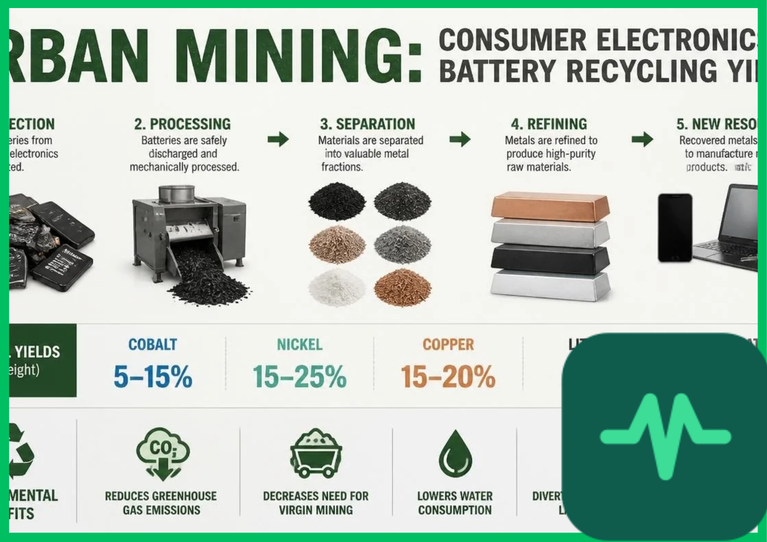
- Elemental Recovery Breadth: Smelting typically recovers an alloy of nickel, cobalt, and copper while losing lithium to slag unless a secondary hydrometallurgical slag-leaching step is added; hydrometallurgy can recover lithium alongside nickel, cobalt, and manganese when flowsheets are tuned for each chemistry.
- Feedstock Tolerance: Smelting tolerates mixed or un-sorted scrap formats robustly, whereas hydrometallurgy benefits from clean sorting and effective impurity removal—especially as lower-margin chemistries like
 scale alongside high-nickel
 cells.
Reagent Balances, Effluent Management, and Circular Scaling
Scaling hydrometallurgical battery recycling to industrial throughput requires closing reagent and water loops while controlling operating costs. Acid consumption, neutralizing base demand, reductant usage, and solvent losses form major variable cost components alongside black mass feedstock pricing.
Treating and recycling process water, crystallizing or managing sodium/sulfate salt streams responsibly, and matching plant capacity to reliable black mass supply chains determine commercial resilience. As battery chemistries evolve and cell designs shift toward easier disassembly and direct cathode recycling routes, hydrometallurgical processing remains a core pillar for converting manufacturing scrap and end-of-life packs into high-purity battery raw materials.
Comments (0)
Login to leave a comment.
No comments yet. Be the first to share your thoughts!