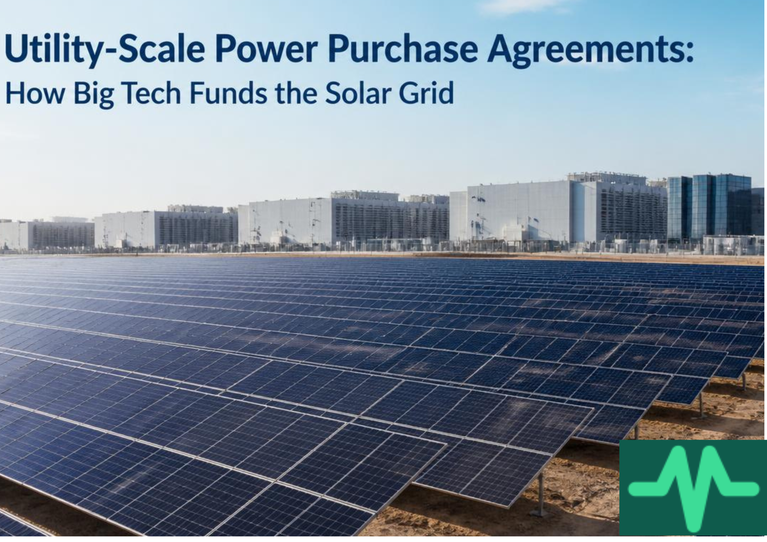
Big tech companies have promised to hit strict climate goals. They cannot just plug into a dirty power grid and call it a day. So they had to find another way. Power purchase agreements gave them exactly that path forward.
In this guide, we will explore how power purchase agreements work. We will look at why tech giants love them so much. We will also look at a clever twist called the virtual PPA. By the end, you will understand why these contracts are quietly funding a massive share of new solar power around the world.
Why AI Created a Power Problem
Let's start with the root issue. Training AI models takes enormous computing power. That computing power needs enormous electricity. A single data center can draw as much power as a medium-sized city, running nonstop, day and night.
This demand puts real strain on local power grids. It also puts pressure on tech companies themselves. Most have made public promises to reach net-zero emissions. Simply drawing power from a coal or gas-heavy grid would break that promise instantly.
This is exactly why power purchase agreements became so important. Tech companies needed a reliable way to secure clean electricity, at massive scale, without waiting years for public grids to catch up.
What Exactly Is a Power Purchase Agreement?
So what are power purchase agreements, in simple terms? They are long-term contracts. A solar or wind developer agrees to build a power project. A big buyer, often a tech company, agrees to purchase all the electricity it makes.
These deals usually last ten to fifteen years. The price gets locked in from the very start. This means both sides know exactly what to expect for over a decade. That kind of certainty is rare in the energy world, and it matters enormously.
Power purchase agreements create a genuine win for both sides involved. The tech company gets stable, predictable electricity costs. The developer gets a guaranteed buyer, which makes the whole project far less risky to build.
Why Banks Love These Deals Too
Here is a detail that often gets overlooked. Power purchase agreements do more than help two companies. They also make banks much more willing to lend money for new solar and wind projects.
Building a massive solar farm costs a huge amount of money upfront. Banks want assurance that the project will actually make money once it is built. A signed contract with a major tech company provides exactly that assurance.
Without power purchase agreements, many of these massive solar projects might never get built at all. Banks would see too much risk. With a guaranteed buyer locked in for over a decade, that risk mostly disappears, making construction loans much easier to secure.
The Clever Twist: Virtual Power Purchase Agreements
Sometimes, a data center sits far away from any solar farm. Sometimes, local rules make a direct power connection impossible. This is where a smart workaround comes in, called a virtual power purchase agreement, or VPPA.
Under a virtual PPA, the solar farm still sells its power to the local grid, just like normal. The tech company does not receive that electricity directly. Instead, a financial deal runs alongside it. If market prices go above the agreed rate, the developer pays the tech company. If prices fall below it, the tech company pays the developer instead.
This clever structure lets companies claim credit for supporting clean energy, even if their data center sits far away from the actual solar panels. Virtual power purchase agreements have become a genuinely important tool for companies trying to hit ambitious climate goals across many different regions at once.
Who Is Actually Signing These Deals
Some of the biggest names in tech are leading this trend. Microsoft, Amazon, Google, and Meta all rank among the largest buyers of clean energy through power purchase agreements. Together, these companies are funding an enormous share of new solar and wind construction worldwide.
This matters because these are not small commitments. Some of these deals involve buying power from entire massive solar farms, all at once, for over a decade. This level of demand has become one of the biggest driving forces behind new clean energy construction today.
In fact, power purchase agreements signed by large tech companies now account for more than half of recent utility-scale solar financing. That is a remarkable shift. Corporate demand, not government policy alone, is now steering much of the clean energy buildout happening right now.
Why This Feels Like a Genuine Shift
For years, clean energy growth depended heavily on government subsidies and public policy support. Power purchase agreements represent something different. They show that private companies can drive real, large-scale investment on their own, simply because it makes good business sense.
This shift feels meaningful. It suggests that clean energy is not just a policy goal anymore. It has become a genuine business strategy, chosen by some of the most powerful companies in the world because it protects them from unpredictable energy costs.
Power purchase agreements also offer a hopeful signal for the future. As more industries face growing power demands, similar deals could help fund even more clean energy projects, well beyond just tech companies and data centers.
What This Means for the Broader Grid
Beyond just helping tech companies meet their goals, power purchase agreements are quietly reshaping the entire energy grid. Every new solar farm built through these deals adds real clean capacity to the broader system, benefiting everyday electricity users too, not just the company that signed the contract.
This ripple effect matters. As more solar and wind power gets added to regional grids, overall reliance on fossil fuels tends to shrink over time. Power purchase agreements, even when signed privately between two companies, end up creating a genuinely public benefit for the whole community connected to that grid.
Common Questions About Power Purchase Agreements
Why do tech companies prefer power purchase agreements over buying regular electricity? These agreements offer fixed, predictable pricing for years, protecting companies from unpredictable energy market swings while helping them meet clean energy goals.
What is the difference between a regular PPA and a virtual PPA? A regular PPA involves receiving actual electricity from a nearby project. A virtual PPA is a financial arrangement, used when direct power delivery is not possible.
Do power purchase agreements really help build new solar farms? Yes. These contracts give developers guaranteed revenue, which makes it far easier to secure bank loans needed to build large-scale solar and wind projects.
Which companies sign the most power purchase agreements? Major tech firms like Microsoft, Amazon, Google, and Meta are currently among the largest corporate buyers of clean energy through these deals.
Real Risks Worth Understanding
It would be unfair to pretend these deals are without any downsides. Locking in a fixed price for fifteen years can backfire if energy prices drop sharply during that time. A company could end up paying more than the going market rate for years at a stretch.
There is also a risk tied to project delays. Building a massive solar or wind farm takes time, and unexpected delays can push back when a buyer actually starts receiving power or savings from the deal. Weather, permitting issues, and supply chain problems can all slow construction down.
Despite these risks, most large buyers still view long-term contracts as worthwhile. The predictability they offer usually outweighs the potential downside of a price shift. For companies managing massive, ongoing energy needs, knowing your costs years in advance often matters more than chasing the absolute lowest price in any given month.
Final Thoughts
Power purchase agreements have quietly become one of the most powerful tools driving clean energy growth today. What started as a way for tech companies to meet their own climate goals has turned into a genuine engine funding massive new solar and wind projects worldwide.
This shift matters far beyond corporate boardrooms. Every new solar farm built through power purchase agreements adds real, lasting clean capacity to the grid, benefiting entire communities, not just the companies signing the contracts.
As AI and data center demand keeps growing, expect power purchase agreements to keep playing a central role in how new clean energy gets built and funded. This quiet financial tool is proving that private business decisions can genuinely accelerate the clean energy transition, one signed contract at a time.


Comments (0)
Login to leave a comment.
No comments yet. Be the first to share your thoughts!