The concept sounded wonderful at first. Companies could offset their pollution by funding good projects elsewhere. They could plant forests. They could protect wild ecosystems. They could capture harmful methane gas. It felt like a clever way to fight climate change using the power of corporate money.
Then the cracks started showing. Investigations revealed something painful. Many of these carbon credits were not real. Forests that were supposedly protected did not actually exist, or were never really at risk in the first place. This discovery shook voluntary carbon markets to their core, leaving companies and consumers feeling betrayed and unsure who to trust anymore.
In this guide, we will explore how voluntary carbon markets are fighting back. We will look at satellites tracking forests from space. We will look at blockchain technology locking in honesty. By the end, you will understand why this quiet, technical rebuilding effort feels like such an important, hopeful shift.
Why Trust Collapsed in the First Place
Let's start with the painful part of this story. For years, voluntary carbon markets relied on a shaky, old-fashioned system. A consultant would visit a forest once every few years. They would walk around with a clipboard, counting trees by eye and estimating how much carbon the forest held.
This method sounds almost quaint now, but it caused real damage. Estimates were often wrong. Sometimes they were wildly wrong. Worse, this slow, manual process left wide open doors for fraud. Some projects sold carbon credits for forests that were never truly at risk of being cut down. Others sold the exact same carbon credits more than once.
When journalists exposed these problems, the fallout was swift and painful. Companies that had proudly claimed "carbon neutral" status suddenly faced accusations of greenwashing. Nobody wanted to be caught defending a broken, dishonest system. Corporate buyers pulled back fast, and voluntary carbon markets saw their value crash almost overnight.
The Emotional Cost of Broken Promises
There is something deeply frustrating about discovering a good idea was quietly failing behind the scenes. Many people genuinely believed in voluntary carbon markets. They wanted to believe that buying a carbon credit truly meant a tree stayed standing, or that real emissions were truly being avoided somewhere in the world.
Learning that this trust was misplaced felt like a quiet betrayal. It damaged not just individual companies, but the broader idea that markets could genuinely help solve climate change. This emotional wound ran deep, and rebuilding it required more than just apologies or promises. It required real, undeniable proof.
This is exactly where technology stepped in, offering a path back toward genuine trust.
Satellites Watching Forests From Space
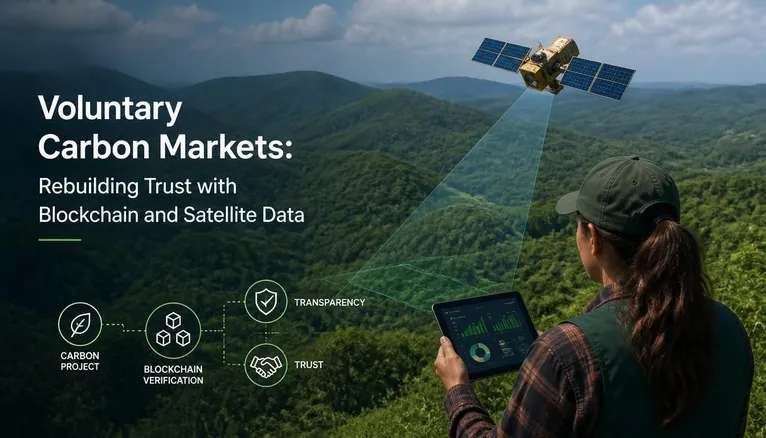
One of the most exciting fixes reshaping voluntary carbon markets involves something almost unbelievable: satellites watching forests from outer space. This technology is called Digital Measurement, Reporting, and Verification, or dMRV for short.
Instead of relying on a human walking through a forest once every few years, dMRV uses specialized satellites equipped with LiDAR and radar sensors. These satellites constantly scan forestry projects from above, measuring tree height, canopy thickness, and total biomass down to the meter.
This feels like a genuine leap forward for voluntary carbon markets. No more guessing. No more relying on outdated clipboard estimates. Instead, machine-learning models process this constant stream of data, calculating in real time exactly how much carbon a forest is absorbing.
This shift brings real relief to anyone who felt burned by past scandals. Satellites do not lie. They do not have financial incentives to inflate numbers. This objective, constant monitoring gives voluntary carbon markets a level of honesty that simply did not exist before.
Blockchain: Locking In Honesty
Satellite data alone was not enough to fully fix voluntary carbon markets. Even accurate data can be manipulated if it sits on an unreliable ledger. This is where blockchain technology enters the story, offering something genuinely powerful: permanent, tamper-proof record keeping.
Once satellite data confirms that a forest has successfully absorbed one metric ton of carbon dioxide, that achievement gets recorded as a unique digital token on a public blockchain. This token carries direct links back to the exact satellite readings that proved its existence. Nothing about it can be secretly altered or duplicated.
When a company buys this token to offset their emissions, something important happens. The token gets permanently retired, sent to what is called a "burn address." This action ensures it can never be resold or counted twice. For voluntary carbon markets, this single innovation solves one of the most damaging problems from the past: double counting the same carbon credit multiple times.
Why This Technology Feels Like Real Redemption
There is something genuinely hopeful about watching an industry try to heal itself. Voluntary carbon markets are not disappearing after their scandals. Instead, they are rebuilding themselves from the ground up, using tools designed specifically to prevent the same mistakes from happening again.
This effort matters deeply for the planet. Forests and ecosystems still desperately need funding to survive. Corporate capital, when used honestly, can make a real difference in protecting these vital carbon sinks. Losing that funding entirely because of past dishonesty would have been a genuine tragedy for global conservation efforts.
By combining satellite verification with blockchain transparency, voluntary carbon markets are offering something rare: a second chance built on real accountability. This feels less like a marketing fix and more like a genuine structural repair, addressing the root causes of past failures rather than simply papering over them.
Who Is Buying Into This New System
Interest in reformed voluntary carbon markets is growing steadily among major corporate buyers. Multinational tech companies are among the most active participants, often facing intense public pressure to prove their climate commitments are real, not just marketing slogans.
Aviation companies are watching closely too. Air travel remains difficult to fully decarbonize with current technology, making credible offsets especially important for airlines trying to demonstrate genuine environmental responsibility. Consumer product companies are joining as well, hoping to reassure increasingly skeptical customers that their sustainability claims can withstand real scrutiny.
This growing interest signals something important. Despite past scandals, many companies still believe voluntary carbon markets can work, as long as the underlying verification system finally earns back genuine, well-deserved trust.
The Road Ahead Is Not Without Challenges
It would be unfair to pretend this fix is perfect or complete. Voluntary carbon markets still face real challenges moving forward. Satellite technology, while impressive, cannot capture every nuance of a complex ecosystem. Machine-learning models require constant refinement to stay accurate across different types of forests and climates.
Blockchain systems, while transparent, still depend on the accuracy of the data feeding into them. If satellite readings are flawed, even a perfectly transparent blockchain record will simply preserve that flawed information permanently. This means human oversight and careful calibration remain essential, even as automation increases across voluntary carbon markets.
Despite these lingering challenges, the overall direction feels genuinely positive. Each improvement builds on the last, slowly closing the gaps that once allowed fraud and exaggeration to flourish unchecked.
Why This Matters Beyond Corporate Reputation
It is easy to view voluntary carbon markets purely through a corporate lens, focused on public relations and shareholder pressure. But there is something bigger happening here too. Real forests, real ecosystems, and real communities depend on this funding continuing responsibly.
When voluntary carbon markets function honestly, money flows toward genuine conservation efforts, protecting biodiversity and supporting local communities who depend on these ecosystems. When trust collapses, that funding disappears, often leaving vulnerable environments and communities worse off than before.
This is why rebuilding trust in voluntary carbon markets carries weight far beyond corporate boardrooms. It touches real forests, real wildlife, and real people whose livelihoods depend on these protected lands continuing to exist.
Common Questions About Voluntary Carbon Markets
Why did voluntary carbon markets lose trust in the first place? Investigations revealed that many carbon credits were based on inaccurate or fraudulent claims, including forests that were never truly at risk or credits that were sold multiple times.
How does satellite technology improve voluntary carbon markets? Satellites provide continuous, objective monitoring of forests and ecosystems, replacing outdated manual estimates with real-time, verifiable data.
What role does blockchain play in voluntary carbon markets? Blockchain creates a permanent, tamper-proof record of each carbon credit, preventing fraud and stopping the same credit from being sold more than once.
Are voluntary carbon markets fully fixed now? Not completely. Challenges remain around data accuracy and system calibration, but the combination of satellite tracking and blockchain represents major progress toward genuine accountability.
The Role of Independent Standards and Oversight
Technology alone cannot fully restore confidence in voluntary carbon markets. Independent standards organizations play a critical role too, setting the rules that determine what counts as a legitimate carbon credit in the first place.
These standard-setting bodies are increasingly adopting dMRV requirements themselves, essentially mandating satellite verification and blockchain tracking for any project seeking their approval. This creates a stronger, more unified system across voluntary carbon markets, rather than leaving verification methods scattered and inconsistent between different registries.
Government regulators are paying closer attention as well. Some countries are exploring formal oversight of voluntary carbon markets, hoping to prevent future scandals through clearer legal accountability. While voluntary markets remain largely separate from mandatory compliance markets, this growing regulatory interest suggests that governments see real value in ensuring these systems operate honestly, given their potential to meaningfully support global climate goals.
This combination of private technology and public oversight feels like a genuinely balanced approach. Neither element alone could fully restore trust in voluntary carbon markets. Together, they offer a more complete, resilient framework capable of withstanding future scrutiny.
Lessons for Other Environmental Markets
The turnaround happening within voluntary carbon markets offers valuable lessons for other environmental initiatives too. Biodiversity credits, water conservation programs, and other emerging environmental markets are watching closely, hoping to avoid the same painful trust collapse.
Many of these newer markets are adopting similar verification approaches from the start, incorporating satellite monitoring and blockchain record-keeping before scandals ever have a chance to take root. In this sense, voluntary carbon markets are serving as an important, if painful, case study for the broader world of environmental finance.
This ripple effect matters. If voluntary carbon markets can successfully demonstrate that technology-driven accountability works, it could accelerate trust-building across an entire ecosystem of environmental financial tools, each one learning from the hard lessons this particular market was forced to confront first.
Final Thoughts
Voluntary carbon markets are proving that broken trust can, with real effort, be rebuilt. What once felt like an industry defined by scandal and disappointment is slowly transforming into something grounded in honest, verifiable data.
Satellites watching from space. Blockchain locking every transaction in place. Together, these tools are giving voluntary carbon markets a genuine second chance, one built on transparency rather than blind faith.
This matters for more than just corporate reputations. Real forests, real ecosystems, and real communities depend on this funding continuing honestly and reliably. As voluntary carbon markets continue healing from past mistakes, they offer something genuinely hopeful: proof that even a broken system can be repaired, piece by piece, with the right tools and enough honest effort.
In the end, voluntary carbon markets remind us that trust, once lost, is never truly gone forever. It can be earned back, carefully and deliberately, through real accountability instead of empty promises.
Comments (0)
Login to leave a comment.
No comments yet. Be the first to share your thoughts!