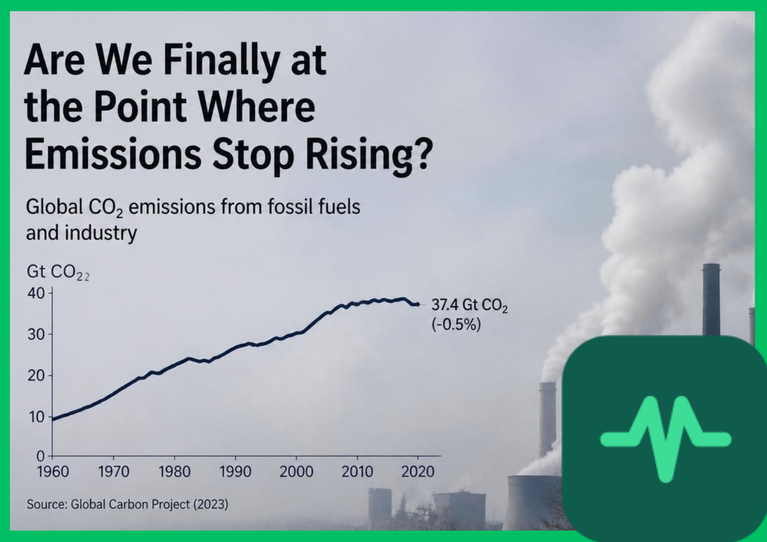
Analysts now believe that trend may finally be close to reversing. Let's look at what this actually means, without overselling it.
What "peaking" actually means
Peaking doesn't mean emissions suddenly drop to zero. It means they stop rising and start heading down instead, even if only slightly at first.
Think of it like a ball thrown into the air. It rises, slows down, briefly hangs at its highest point, then starts falling. Global emissions may be nearing that exact turning point right now.
Why this moment is happening now
New energy demand keeps growing every year, driven by population growth, economic development, and new technology like data centers. For most of history, this new demand was met mostly by fossil fuels.
Recently, renewable energy has grown fast enough to cover almost all new demand on its own. If this pattern holds, and older fossil fuel plants keep retiring as planned, total emissions could finally stop climbing.
Why this took so long to happen
Building enough renewable energy to outpace rising demand took years of steady investment and falling costs. Early renewable energy was too expensive and too limited to make a dent in overall demand growth.
Only recently has renewable capacity grown large enough, and cheap enough, to genuinely compete with, and now exceed, new demand from fossil fuel sources.
Why economic growth plays a role too
Slower economic growth in some regions has also played a part. When economies grow more slowly, energy demand grows more slowly too, making it easier for renewable energy to keep pace.
This isn't necessarily a positive reason for reaching this milestone, but it's an honest part of the full picture worth mentioning rather than ignoring.
Why scheduled fossil fuel retirements matter here
Many older coal and gas power plants are reaching the end of their planned operating life around the world. As these plants shut down on schedule, their emissions disappear from the total count.
Combined with new demand being met by renewables, these retirements add real downward pressure on the overall emissions trend, pushing toward this potential turning point.
Why this milestone matters so much
Every year emissions kept rising made the climate challenge harder to solve. Reaching a genuine peak, then starting a real decline, would mark a real shift in direction after decades moving the wrong way.
This wouldn't mean the climate challenge is solved. It would mean the world has finally stopped making the problem worse each year, which is a real, meaningful first step before things can start genuinely improving.
The honest uncertainty still worth acknowledging
This remains a probable outcome, not a guaranteed one. Unexpected economic growth, policy changes, or shifts in energy investment could still push emissions higher again before a real, lasting peak takes hold.
Experts are cautiously optimistic, not certain. That distinction matters for setting realistic expectations rather than assuming this milestone is already locked in.
Why regional differences still matter
This global trend doesn't mean every region moves the same way at the same time. Some countries may see emissions falling already, while others continue rising for a while longer before their own turning point arrives.
The global total combines all these different regional stories into one overall number, which can make individual, local trends harder to see clearly within that bigger picture.
What happens after a peak, honestly
Reaching a peak is just the beginning of a much longer decline needed to seriously address climate change. A slow, gradual decline still leaves a large amount of ongoing emissions each year.
The pace of decline after any peak matters just as much as the peak itself. A slow decline delays progress considerably compared to a fast, steep one.
Why this news deserves cautious optimism
It's genuinely encouraging to see analysts discuss a peak as a real possibility rather than a distant, unlikely dream. This reflects real, measurable progress in renewable energy deployment over recent years.
At the same time, celebrating too early risks reducing the urgency needed to keep pushing for faster, deeper cuts once a peak is actually reached and confirmed.
The bottom line
Global emissions may be nearing their highest point ever, thanks to renewable energy finally growing fast enough to cover new demand, combined with older fossil fuel plants retiring on schedule.
This would be a real, meaningful milestone after decades of steady increases. It's not a finish line, just an important turning point, one worth watching closely as new data continues to come in over the following months and years.


Comments (0)
Login to leave a comment.
No comments yet. Be the first to share your thoughts!