You feel the warm sun on your face. You breathe in deeply.
For generations, humanity treated the atmosphere like an infinite, free dumping ground.
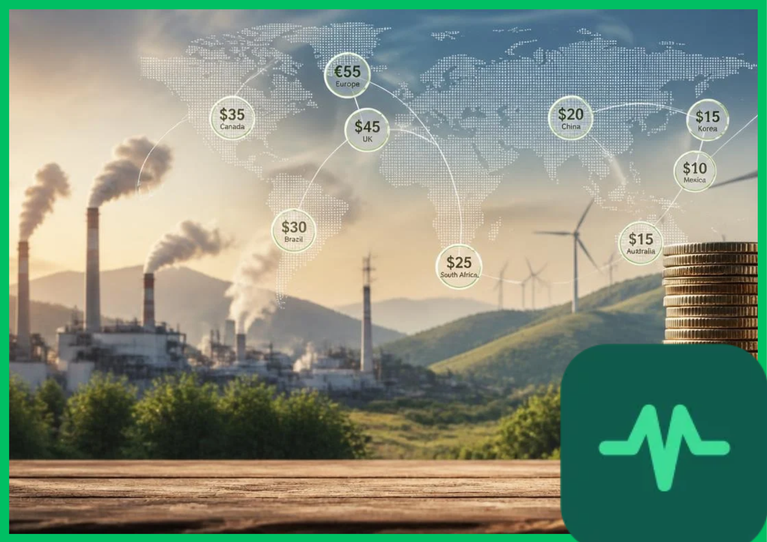
Factories billowed thick black smoke. Power plants burned endless tons of coal. Cargo ships crossed oceans spewing exhaust.
Polluting the air cost industrial businesses exactly zero dollars.
That broken economic logic fueled our global climate crisis. When destroying our shared environment remains free, corporations keep polluting without a second thought.
What if the rules of global commerce changed? What if dumping carbon into the sky carried a real, unavoidable financial cost?
A quiet economic revolution is rewriting the rules of international business.
According to climate policy reports from the International Energy Agency (IEA), environmental governance frameworks from the United Nations Environment Programme (UNEP), energy efficiency metrics from ENERGY STAR, and academic economic research, global carbon pricing mechanisms are transforming climate action.
By making pollution expensive and clean innovation profitable, market forces are driving heavy industries toward a sustainable future.
Here is how carbon pricing works, why cap-and-trade systems change corporate behavior, and how putting a price on carbon protects our atmosphere.
The Hidden Cost of Free Pollution
To understand why carbon pricing is essential, you have to look at how traditional economics failed our planet.
For decades, burning fossil fuels carried a hidden cost that never appeared on any corporate balance sheet.
That hidden cost was paid by society. It showed up as melting glaciers, rising sea levels, severe droughts, destructive storms, and millions of people suffering from air pollution-related illnesses.
Economists call this a negative externality.
It means a business reaps 100% of the financial profit from burning cheap coal or gas, while the rest of humanity absorbs the devastating environmental damage.
As long as carbon pollution stayed free, polluting companies had zero financial incentive to clean up their operations.
Building clean energy factories, retrofitting steel mills, or developing zero-emission transport systems required heavy upfront capital.
Why spend money on sustainability when burning dirty fossil fuels cost nothing?
To fix the market, we had to change the math. We had to attach a real financial price tag to every single ton of carbon dioxide released into the air.
What Is Carbon Pricing?
Carbon pricing is an economic tool designed to internalize that external damage.
Instead of relying solely on messy government bans or voluntary corporate promises, carbon pricing uses the powerful engine of global markets to drive change.
When polluting carries a direct financial penalty, corporate boardrooms listen immediately.
There are two primary economic models used across the globe:
- Carbon Taxes: Governments set a direct, fixed tax on every metric ton of greenhouse gas emitted by fossil fuels or industrial processes. If a factory burns coal, it pays a direct fee based on its total emissions.
- Cap-and-Trade Systems: Governing bodies establish a strict legal limit—a cap—on total allowable carbon emissions across an economy. They issue a declining number of pollution permits. Companies must buy or trade those permits on open markets. As the cap drops year by year, permits become scarce and expensive, forcing companies to cut emissions or face crippling financial losses.
Both systems achieve the exact same core objective. They make pollution expensive and reward businesses that innovate.
How Markets Drive Corporate Innovation
The true power of global carbon pricing lies in how it unleashes human creativity.
When a carbon tax or an emissions cap raises the operating cost of burning fossil fuels, corporate accountants run the numbers.
They quickly realize that paying heavy carbon penalties year after year eats away at profits.
Suddenly, investing in energy efficiency, installing solar panels, upgrading to electric fleets, or redesigning industrial chemical processes becomes the smartest financial decision a company can make.
Academic economic studies and IEA policy assessments show that carbon pricing triggers immediate behavioral shifts across heavy industries.
Steel manufacturers, cement producers, and energy utilities accelerate their transition to clean technology because pollution is no longer the cheapest option.
Market competition takes over. Companies race to out-innovate each other, driving down the cost of clean technology through sheer commercial demand.
Preventing Carbon Leakage and Ensuring Global Fairness
Implementing carbon pricing on a global scale requires careful coordination.
If one nation imposes a strict carbon price on its domestic industries while neighboring regions do nothing, polluting factories might simply pack up and move across the border to evade the rules.
Economists call this risk carbon leakage.
To prevent leakage and ensure fairness, international policy frameworks emphasize cross-border carbon regulations and international emissions trading systems.
UNEP governance guidelines highlight that universal carbon standards level the playing field.
When major trading blocks apply equivalent carbon border adjustments, imported goods produced under dirty, unregulated conditions face equal tariffs at the port.
This mechanism protects domestic clean industries from unfair competition and encourages exporting nations to adopt their own robust carbon pricing policies.
It creates a unified global standard where pollution has nowhere to hide.
Rewarding Sustainability Through Economics
Putting a price on carbon proves that economics can be a powerful ally in the fight against climate change.
We no longer have to rely solely on moral appeals or corporate charity to protect our environment.
By aligning financial profit with ecological survival, we harness the unstoppable engine of global markets.
Polluting becomes the most expensive choice a business can make. Innovation, efficiency, and sustainability become the ultimate competitive advantages.
Through smart market design, international carbon pricing, and unwavering economic resolve, we shift our global economy away from fossil fuels, securing a breathable, thriving future for our planet.

Comments (0)
Login to leave a comment.
No comments yet. Be the first to share your thoughts!