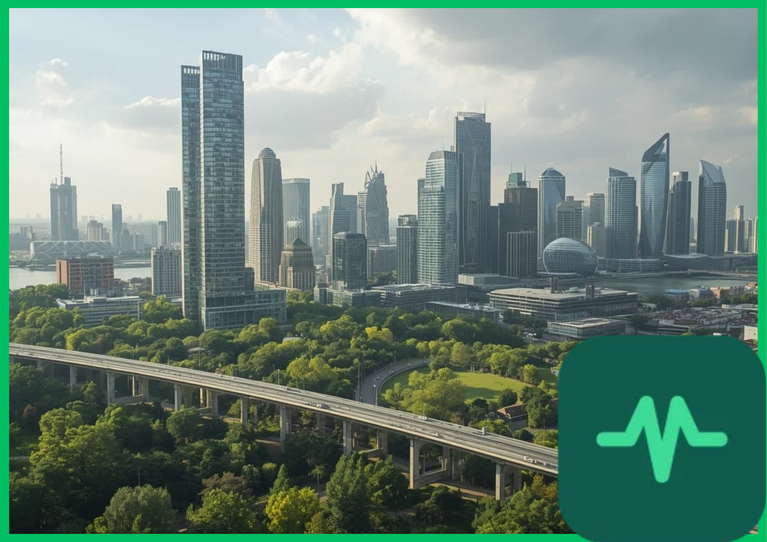
The air feels thick and heavy. A long line of cars crawls slowly past, spewing exhaust fumes and blowing hot air from their engines.
The roar of traffic fills your ears.
Concrete buildings tower over you on both sides, soaking up the summer heat and radiating it right back down onto the pavement.
You feel trapped in a gray concrete box.
For over a century, urban planners designed cities around a single, destructive idea.
Cars came first. People came second.
Cities grew into sprawling mazes of asphalt highways, smog-filled air, and endless parking lots.
That concrete sprawl gobbled up natural land, destroyed local ecosystems, and pumped staggering volumes of carbon emissions into our shared atmosphere.
We cannot build a sustainable future while living in cities that suffocate the earth and exhaust our spirits.
What if our cities felt more like living forests?
What if urban spaces cleaned our air, cooled our streets, and welcomed people instead of cars?
A quiet, brilliant architectural revolution is transforming municipal landscapes across the globe.
According to global urban reports from the International Energy Agency (IEA), resource protection frameworks from the United Nations Environment Programme (UNEP), efficiency benchmarks from ENERGY STAR, and academic urban planning research, sustainable urban planning guidelines are changing our human habitats.
By designing climate-resilient cities with green municipal infrastructure, efficient public transit, and smart zoning, we turn gray concrete jungles into thriving ecological sanctuaries.
Here is how sustainable urban design works, why eco-city principles change municipal economics, and how building greener cities secures our sustainable future.
The Concrete Trap of Traditional City Planning
To understand why sustainable urban design matters so much, you have to look at the physical layout of twentieth-century cities.
For generations, city planners separated homes, offices, and grocery stores by miles of asphalt.
If you wanted to buy a loaf of bread or go to work, you had no choice.
You had to climb into a gasoline car and drive down a clogged highway.
That car-dependent sprawl created the urban heat island effect.
Dark asphalt roads and concrete buildings absorbed solar radiation all day long, turning cities into baking ovens that required massive amounts of air conditioning power to stay livable.
Skeptics once argued that dense, car-free urban centers were impossible to manage and that asphalt sprawl was the inevitable price of human progress.
Physics, climate reality, and human health proved the skeptics wrong.
When cities prioritize cars over people, everyone suffers from bad health, high stress, and polluted air.
Smart planners realized that cities must be designed for human beings, not machines.
What Is Sustainable Urban Design?
Sustainable urban design is an architectural and municipal planning discipline that prioritizes low-carbon development, climate resilience, green infrastructure, and human-scale mobility over car-dependent sprawl.
Instead of spreading homes and businesses across vast distances, sustainable city design focuses on compact, connected communities.
You can walk or ride a bicycle to your local grocery store, park, and workplace in fifteen minutes or less.
Streets are lined with shade trees and bioswales that absorb rainwater naturally, preventing urban flooding.
Rooftops are covered in gardens or solar arrays, turning barren concrete structures into productive energy generators and wildlife habitats.
Public transit networks move millions of residents quietly and efficiently across clean electrical lines, replacing endless lines of private cars with fast, accessible trains and electric buses.
The Science of Urban Canopies and Thermal Comfort
How do green roofs, shade trees, and smart zoning cool down an entire city during a scorching summer heatwave?
It comes down to natural thermodynamics and evapotranspiration.
Academic urban planning research shows that mature shade trees and green roofs lower local ambient urban temperatures by 2°C to 5°C or roughly 4°F to 9°F compared to traditional asphalt-heavy districts.
Plants absorb solar radiation and release moisture through their leaves, cooling the surrounding air naturally.
Furthermore, bioswales and permeable paving materials let rainwater soak deep into the soil instead of rushing into overloaded storm drains.
According to ENERGY STAR and international municipal efficiency evaluations, energy-efficient buildings integrated into smart urban zones reduce annual heating and cooling energy consumption by up to 30% through shared thermal mass and optimized wind shielding.
Cities become self-cooling ecosystems.
Environmental Integrity and Human Well-Being
The benefits of sustainable urban planning extend far beyond cooling streets or saving municipal energy.
They transform human health and community well-being.
According to UNEP resource governance frameworks, designing cities around walking, cycling, and clean public transit eliminates toxic air pollutants that cause respiratory illness in urban populations.
When children grow up walking down quiet, tree-lined streets instead of breathing highway exhaust, public health outcomes improve dramatically.
According to IEA clean energy roadmaps, compact, efficient urban design is an essential pillar to cut global building and transport emissions by half over the coming decades.
When municipal infrastructure supports clean living, sustainable choices become the easiest choices for every resident.
Overcoming Retrofitting Realties
Transforming existing cities or planning new eco-districts involves navigating real-world municipal hurdles.
Many established cities were built around cars, making it challenging to rip up asphalt and replace highways with bike lanes and green parks.
Progressive municipalities overcome these hurdles through incremental, phased street redesigns, converting parking spaces into pocket parks and expanding pedestrian zones step by step.
As urban planners share successful case studies across international networks, green municipal design is expanding rapidly from experimental pilot projects into standard city codes across the globe.
Designing Our Cities Toward a Sustainable Future
Sustainable urban planning guidelines prove that human habitation can exist in harmony with the natural environment.
We no longer have to accept that living in a city means breathing smog, enduring deafening traffic noise, and baking on hot asphalt.
By designing compact, climate-resilient, and green urban spaces, we create cities that care for their residents.
We step away from car-dependent sprawl, embracing a smart, healthy, and enduring standard of community living.
Through brilliant urban architecture, ecological engineering, and a deep respect for our planetary climate, cities of tomorrow secure a clean, thriving, and sustainable home for every human being on Earth.


Comments (0)
Login to leave a comment.
No comments yet. Be the first to share your thoughts!