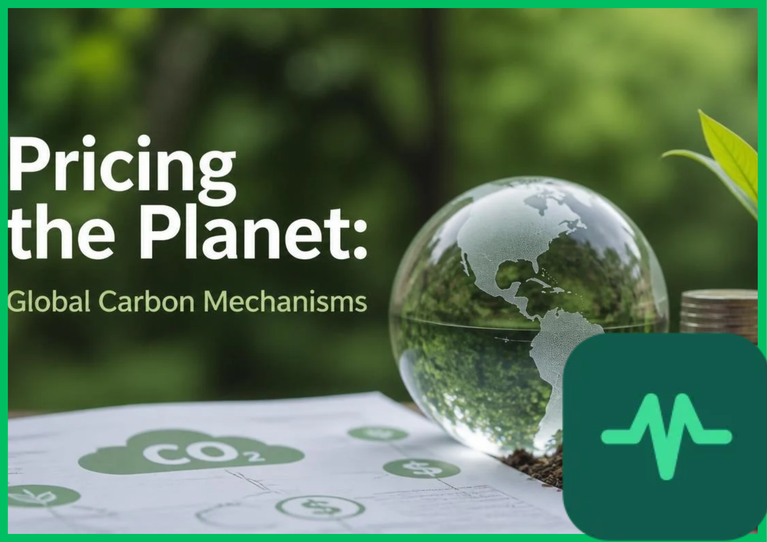
You take a deep breath of fresh air.
Then you look up at the heavy grey smoke pouring from a massive industrial smokestack on the horizon.
That smoke contains tons of invisible carbon dioxide, spreading outward into our shared sky, trapping heat, and destabilizing the climate we all depend on for survival.
For over a century, heavy industries enjoyed a hidden subsidy.
They could dump as much carbon pollution into the atmosphere as they wanted, completely free of charge.
Polluting our shared sky cost industrial polluters zero dollars.
The true cost was paid by farming families losing their crops to drought, coastal communities watching sea levels rise, and children breathing polluted city air.
That broken economic system rewarded companies for destroying the earth while penalizing businesses trying to clean up their operations.
We cannot build a sustainable global economy while pollution remains free.
What if dumping carbon into our atmosphere came with a direct financial price?
What if polluting companies had to pay for the environmental damage they caused, shifting market forces toward clean energy overnight?
A quiet, massive economic revolution is reshaping international trade and environmental policy across the globe.
According to global energy reports from the International Energy Agency (IEA), resource governance frameworks from the United Nations Environment Programme (UNEP), efficiency benchmarks from ENERGY STAR, and academic economic research, global carbon pricing mechanisms are changing how industry operates.
By placing a clear financial price on carbon emissions, we turn market forces into a powerful weapon against climate change.
Here is how carbon mechanisms work, why financial accountability changes heavy manufacturing, and how pricing pollution secures our sustainable future.
The Hidden Cost of Free Pollution
To understand why global carbon pricing matters so much, you have to look at the fundamental flaw of traditional market economics.
For generations, economists called pollution an externality.
That dry, technical term masked a harsh reality.
It meant that a factory could burn millions of tons of coal, release toxic greenhouse gases into the air, and dump the financial and environmental cleanup bills onto society.
The factory owner kept 100% of the profits. The public paid 100% of the ecological damage.
That distorted market made fossil fuels artificially cheap.
It gave dirty energy an unfair advantage over clean solar, wind, and efficiency technologies.
Skeptics once argued that forcing companies to pay for carbon emissions would destroy economic growth and ruin industrial competitiveness.
Economics and climate reality proved the skeptics wrong.
When you put a price tag on a scarce resource like a clean atmosphere, human ingenuity reacts instantly.
Businesses find creative ways to use less energy, upgrade their equipment, and cut their emissions to save money.
What Is a Global Carbon Pricing Mechanism?
A global carbon pricing mechanism is an economic policy framework that assigns a direct financial cost to greenhouse gas emissions, forcing heavy industries, power generators, and manufacturers to pay for every ton of carbon dioxide they release into the atmosphere.
There are two primary models driving this economic shift across international markets:
- Carbon Taxes: A direct government-set price on every ton of carbon emitted by burning fossil fuels, creating a predictable financial penalty that drives businesses to switch to clean energy.
- Cap-and-Trade Systems: A market-driven system where authorities set a legal limit on total regional emissions, issue limited pollution permits, and let companies buy and sell those permits on an open exchange.
If a steel mill invests in clean hydrogen furnaces and cuts its emissions below its legal limit, it can sell its leftover pollution permits to a dirtier factory down the road.
Pollution becomes a tradable commodity with a financial penalty, while clean innovation becomes a direct profit center.
The Science of Market Incentives and Industrial Decarbonization
How does putting a price tag on invisible gas molecules change the physical operations of massive industrial factories thousands of miles away?
It comes down to profit margins and capital allocation.
Academic economic research shows that when carbon prices cross specific financial thresholds, corporate executives rethink their entire business models.
Keeping an old, inefficient coal boiler running suddenly stops making financial sense.
The carbon penalties eat away at quarterly profits until investing in modern electric heat pumps, energy-efficient machinery, or renewable power becomes the cheapest option available.
According to ENERGY STAR and international industrial efficiency evaluations, businesses operating under carbon pricing frameworks audit their energy use twice as often and upgrade their equipment three times faster than companies in unregulated markets.
Financial accountability drives operational efficiency.
Environmental Integrity and Global Trade Harmonization
The benefits of carbon pricing mechanisms extend far beyond local factories or regional utility grids.
They protect global trade fairness and prevent carbon leakage.
In the past, if one country placed strict environmental rules on its factories, industrial polluters simply packed up their machinery and moved their operations to nations with zero pollution laws.
That loophole exported pollution without solving the global climate crisis.
Modern carbon border adjustment mechanisms close that escape hatch.
When goods cross international borders, importing countries levy a fee on products manufactured in high-emission jurisdictions, ensuring that foreign imports pay the exact same carbon price as domestic goods.
According to UNEP resource governance frameworks, border carbon alignment creates a level playing field, rewarding nations that invest in clean manufacturing.
According to IEA clean energy roadmaps, universal carbon pricing is the essential economic steering wheel required to accelerate the global transition away from fossil fuels.
Overcoming Political and Implementation Realties
Implementing global carbon pricing mechanisms involves navigating complex political and social questions.
Governments must design carbon pricing rules carefully to protect lower-income households from rising energy costs, returning carbon revenues directly to citizens as dividend payments or investing the funds into public clean transit and home energy upgrades.
As international markets harmonize their carbon accounting standards and trading registries, pricing pollution becomes a transparent, seamless part of global commerce.
When polluting the atmosphere costs more than cleaning it up, corporate boardrooms pivot toward sustainability overnight.
Pricing Our World Toward a Sustainable Future
Global carbon pricing mechanisms prove that market economics and environmental protection can work hand in hand.
We no longer have to accept that industrial progress requires destroying our shared atmosphere for free.
By placing a clear financial price on carbon pollution, we turn market incentives into a powerful engine for climate action.
We step away from free fossil-fuel waste, embracing a smart, accountable, and enduring standard of global commerce.
Through brilliant economic design, rigorous academic research, and a deep respect for our planetary climate, pricing the planet secures a clean, thriving, and sustainable future for our world.


Comments (0)
Login to leave a comment.
No comments yet. Be the first to share your thoughts!