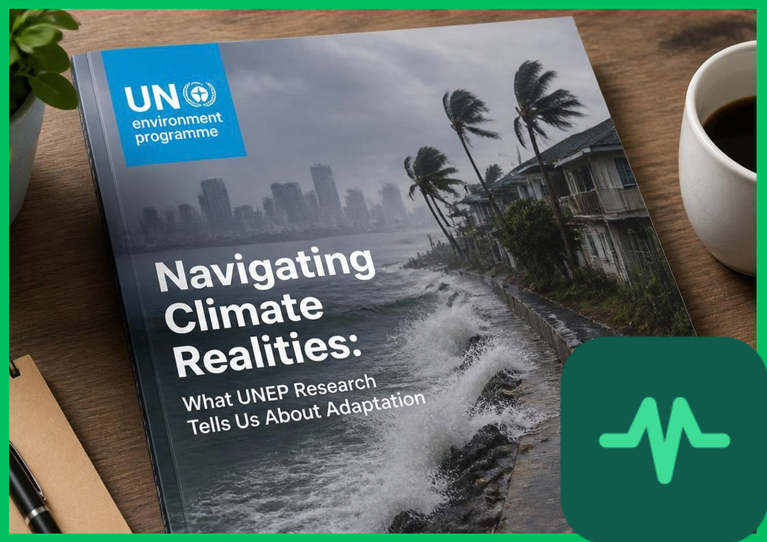
Climate change is no longer a distant future warning. It is our daily reality.
For decades, global climate conversations focused almost entirely on mitigation. This includes cutting greenhouse gas emissions to stop the planet from warming further.
While stopping emissions remains essential, it is only half the battle. The climate impacts we already locked in through past emissions are here today.
Recent scientific assessments released by the United Nations Environment Programme (UNEP) deliver a clear message: the world must scale up climate adaptation just as aggressively as emissions reduction.
Here is what global environmental research tells us about bridging the adaptation gap, protecting vulnerable communities, and building lasting planetary resilience.
The Reality of the Adaptation Gap
To understand why adaptation matters, you have to look at the mounting cost of inaction.
Global temperatures continue to rise, intensifying extreme weather events like prolonged droughts, severe flooding, and destructive wildfires.
These hazards disrupt food supplies, damage vital infrastructure, and displace millions of people.
According to UNEP findings, a yawning gap exists between the amount of adaptation planning needed and what is actually implemented on the ground.
This "adaptation gap" leaves economies and human lives exposed to escalating climate risks.
While governments draft national adaptation plans, financial investments lag far behind actual requirements. Protecting communities requires transforming how we build our cities, manage our water, and structure our global financial systems.
The Smart Economics of Investing Early
A common misconception is that climate adaptation is an expensive luxury item—something nice to have if extra funds are left over.
Research proves the exact opposite. Adaptation is a high-return investment.
Studies highlighted in environmental assessments demonstrate clear economic logic: every unit of currency spent on proactive adaptation saves multiples in future disaster recovery costs.
For instance, investing in robust coastal protection infrastructure avoids vast amounts of storm damage.
Implementing urban nature-based solutions—like expanding urban green spaces, planting shade trees, and restoring wetlands—reduces ambient urban temperatures by over 1 degree Celsius (nearly 2 degrees Fahrenheit), cutting heat stress during scorching summer months.
Waiting for disasters to strike and paying for recovery afterward is a losing economic strategy. Proactive adaptation protects both human lives and financial stability.
Integrating Resilience Into Everyday Decisions
Closing the adaptation gap requires more than government grants. It requires embedding climate resilience into everyday decision-making across both public and private sectors.
When urban planners design new neighborhoods, they must account for shifting precipitation patterns and flood risks.
When agricultural sectors face unpredictable rainfall, transitioning to drought-resistant crop varieties and efficient drip-irrigation systems secures food security.
Financial institutions and private investors must evaluate long-term climate vulnerability when funding real estate, supply chains, and industrial infrastructure.
Resilience cannot be treated as an isolated environmental project. It must become the standard operating framework for modern society.
Action Over Empty Promises
The path forward demands genuine commitment.
As UNEP assessments emphasize, climate resilience cannot run on empty political promises or slow bureaucratic approvals.
By mobilizing long-term adaptation finance, scaling up technological solutions, and protecting natural ecosystems, we can soften the blows of a warming planet.
We cannot undo every change overnight, but through smart, proactive adaptation, we can build resilient communities capable of weathering any storm.

Comments (0)
Login to leave a comment.
No comments yet. Be the first to share your thoughts!