You wheel out heavy bins packed tight with plastic packaging, discarded containers, broken gadgets, and unwanted wrapping.
You watch the truck hoist those bins into its dark belly.
Everything vanishes from sight. You assume it disappears forever, swallowed by some distant landfill or buried deep underground.
We grew up inside a linear economy.
For generations, human society operated on a simple, destructive three-step rule: take resources from the earth, make products in massive factories, and throw everything away when it breaks or loses its novelty.
That "take-make-waste" model treats our finite planet like an endless trash can.
Landfills overflow. Oceans choke on plastic debris. Valuable minerals, metals, and chemicals are dug up, used once, and buried permanently in the dirt.
We cannot keep throwing our world away.
A quiet legal and industrial shift is sweeping across international supply chains.
According to resource governance reports from the United Nations Environment Programme (UNEP), efficiency benchmarks from ENERGY STAR, industrial material studies from the International Energy Agency (IEA), and academic lifecycle research, circular economy policies are rewriting the rules of manufacturing.
By enforcing extended producer responsibility, international e-waste regulations, and sustainable material mandates, governments and industries are closing the loop.
Here is how circular economy policies work, why extended producer responsibility changes corporate boardrooms, and how eliminating waste protects our shared environment.
The Fatal Flaw of the Linear Economy
To understand why circular policies are essential, you have to look closely at the linear trap.
For over a century, manufacturing was designed for a one-way street.
Companies designed products to be cheap to produce and easy to sell. They spent zero time thinking about what happens to a product ten years down the road when it stops working.
If a plastic appliance breaks, fixing it costs more than buying a new one.
That design flaw forces consumers into a constant cycle of purchasing, discarding, and replacing.
Extracting virgin aluminum, refining raw lithium, and smelting raw iron ore takes massive amounts of industrial energy and releases gigatons of carbon pollution into the atmosphere.
Once those products reach the end of their brief lives, they are tossed out.
Academic lifecycle studies show that humanity generates tens of millions of metric tons of solid waste every single year, squandering precious natural resources.
Waiting for voluntary corporate charity to fix this crisis failed.
We needed binding legal frameworks to change the math of manufacturing.
What Is a Circular Economy Policy?
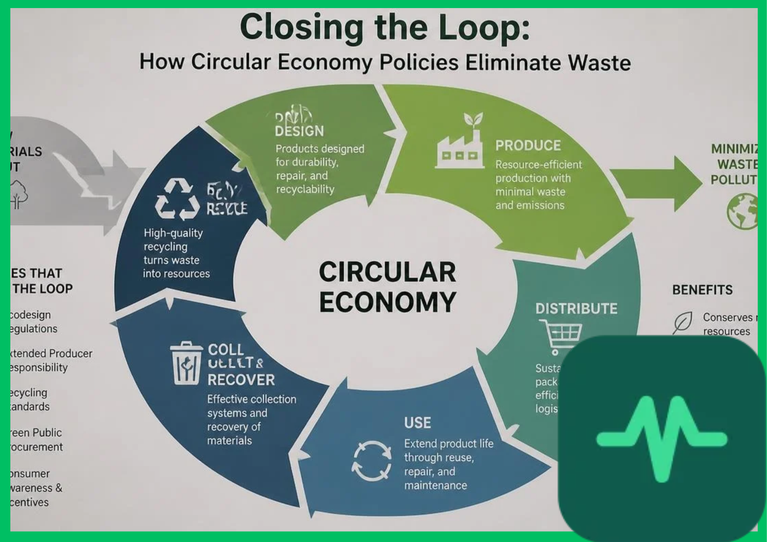
A circular economy policy replaces the linear take-make-waste model with a regenerative loop.
Instead of letting companies profit from endless extraction while society pays to clean up the trash, circular policies place responsibility directly back on the creators.
These policies use legal mandates to force manufacturers to think about a product's entire lifecycle before it ever leaves the factory floor.
There are three foundational pillars driving this global shift:
- Extended Producer Responsibility (EPR): Laws that legally require manufacturers to take back their products when they wear out and pay for their safe recycling or refurbishing.
- Sustainable Material Mandates: Regulations that restrict toxic chemicals, mandate minimum percentages of recycled content in new products, and ban single-use waste designs.
- International E-Waste Regulations: Global standards that halt the illegal dumping of electronic trash across borders, forcing proper recovery of valuable rare earth metals.
When laws demand that companies manage their own waste, product design changes overnight.
How Extended Producer Responsibility Changes Design
Extended producer responsibility is the sharpest tool in the circular policy toolbox.
Imagine you are a manufacturer of refrigerators, smartphones, or power tools.
Under an EPR framework, your company is legally accountable for collecting and recycling your products at the end of their lives.
If you build appliances out of toxic plastics welded together with cheap glue, your recycling costs will skyrocket.
Corporate accountants and engineers run the numbers. They realize that poor design equals expensive waste management penalties.
Suddenly, corporate priorities shift.
Engineers start designing products to be modular, durable, and easy to disassemble. They use snap-fit casings instead of toxic adhesives. They choose aluminum and steel that can be melted down and repurposed endlessly.
Academic industrial research shows that EPR policies drive immediate innovation, turning waste management from an external societal burden into an internal design priority.
Closing the Loop on Global Materials
Circular economy policies do more than manage trash. They secure our industrial future.
The earth holds a finite amount of copper, lithium, cobalt, and rare earth elements.
Mining virgin ores becomes harder, more expensive, and more ecologically destructive every decade.
When international e-waste regulations and sustainable material mandates force recycling facilities to scale up, we unlock an urban mine.
Reclaiming gold, copper, and precious metals from old electronics requires a fraction of the energy needed to mine raw ore from the earth.
According to IEA material tracking reports, closing the loop slashes industrial carbon emissions drastically while shielding global supply chains from geopolitical resource shocks.
Waste ceases to exist. Every discarded item becomes the raw material for tomorrow's manufacturing run.
Building a Regenerative Future
Circular economy policies prove that human governance can fix broken industrial systems.
We no longer have to accept a world buried under mountains of plastic and electronic trash.
By enforcing extended producer responsibility, establishing international e-waste regulations, and demanding sustainable material mandates, we transition from a wasteful linear society to a regenerative circular economy.
We stop stealing endlessly from the earth. We honor the resources we already share.
Through smart policy design, industrial innovation, and unwavering human purpose, we close the loop and secure a clean, thriving future for our global community.

Comments (0)
Login to leave a comment.
No comments yet. Be the first to share your thoughts!