
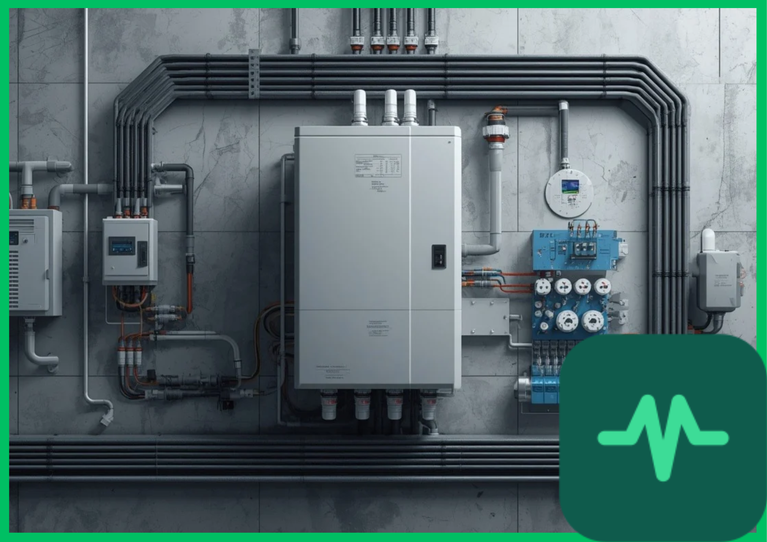
Automatic Transfer Switch (ATS) Topologies and Electromechanical Actuation
The foundational electrical engineering principle governing backup power transfer is the reliable physical separation and reconnection of electrical load circuits between two independent power sources: the public utility grid and the residential battery energy storage system. Residential backup architectures utilize either whole-home automatic transfer switches (ATS) or critical load sub-panels managed by dedicated grid-forming inverters.
An automatic transfer switch comprises high-speed electromechanical contactors or motorized circuit breakers governed by microprocessor-based controllers that monitor incoming line voltage ( to
 AC) and frequency (
 or
 ). When utility voltage drops below calibrated operational thresholds (typically
 of nominal voltage for more than
 ), the ATS control unit triggers a mechanical switching sequence:
- Utility Disconnection: The primary utility-side contactor opens via high-speed spring-loaded actuators, physically severing the connection to the municipal distribution network.
- Mechanical Interlocking: A strict mechanical and electrical interlock prevents the utility contactor and the inverter-side contactor from closing simultaneously, eliminating the possibility of a short circuit or backfeed.
- Inverter Connection: The backup contactor closes, routing electrical power generated by the residential battery storage system and hybrid inverter directly into the household electrical distribution busbar.
Modern solid-state transfer switches and hybrid inverter internal relays achieve total switchover response times ranging from  to
 (
 ), ensuring uninterrupted power delivery to sensitive electronic loads without triggering computer reboots or digital clock resets.
Microgrid Islanding Protocols and Grid Synchronization Lag
Executing safe backup power transfer requires strict compliance with international anti-islanding standards, specifically IEEE 1547 and UL 1741. Islanding occurs when a distributed energy resource continues energizing a localized section of the electrical grid after the primary utility source has failed. Uncontrolled islanding poses severe electrocution hazards to utility line technicians repairing downed distribution wires and risks equipment damage from out-of-phase auto-reclosing transients.
Transfer switch controllers and hybrid inverters deploy active and passive anti-islanding algorithms to detect the loss of mains (LoM):
- Passive Over/Under Voltage and Frequency Protection: Continuously monitors line voltage and frequency variations, tripping the transfer switch immediately if parameters drift outside rigid safety windows (e.g., voltage dropping below
 or frequency shifting beyond
 ).
- Active Frequency Shifting: Injects microscopic reactive current perturbations into the grid connection. When the utility grid is present, its massive rotational inertia stabilizes the frequency. When the grid disconnects, the perturbation causes an immediate frequency drift that the inverter detects within milliseconds.
Once islanding is confirmed, the system enters microgrid mode, utilizing synchronization algorithms to match the voltage magnitude, phase angle, and frequency of the residential storage inverter precisely with household loads before closing the backup contactor.
Technical Data Specifications of Residential Transfer Switch Parameters
| Transfer Switch & Islanding Parameter | Engineering Specification Standard |
|---|---|
| Switchover Response Time |  to  (  ) |
| Nominal Residential Operating Voltage |  to  AC line voltage |
| Grid Frequency Operating Band |  or  (  tolerance) |
| Anti-Islanding Disconnection Time |  per IEEE 1547 standards |
| Surge Withstand Voltage Rating |  transient impulse withstand capability |
| Contactor Mechanical Durability |  full load switching cycles |
| Continuous Ampacity Rating |  to  whole-home electrical service |
Surge Protection Limits and Transient Overvoltage Suppression
Residential backup transfer switches and hybrid inverter inputs are highly vulnerable to transient overvoltages induced by lightning strikes, grid switching surges, and transformer load re-energization. When high-voltage transients propagate along overhead utility lines, unsuppressed voltage spikes exceeding  can breach solid-state semiconductor junctions within the inverter and destroy ATS control microprocessors.
To protect internal circuitry, transfer switch assemblies integrate multi-stage transient voltage surge suppression (TVSS) networks. Metal Oxide Varistors (MOVs) and Gas Discharge Tubes (GDTs) are positioned across incoming utility lines and inverter terminals. Under normal operating voltages, MOV impedance remains exceptionally high. When a high-voltage transient spike hits the circuit, MOV resistance collapses instantaneously within nanoseconds, shunting transient surge energy safely to the grounding busbar.
Transfer switch engineering standards require dielectric insulation withstand capabilities exceeding  AC for one minute and transient impulse withstand ratings up to
 , ensuring robust protection against severe environmental electrical disturbances.
Seamless Backup Switching and Inverter Synchronization Realities
Achieving seamless, zero-millisecond backup power transfer requires sophisticated grid-forming inverter technology. Traditional grid-following inverters rely entirely on an external utility voltage reference to synchronize their output sine waves. When the utility grid fails, a grid-following inverter shuts down instantly for safety compliance.
In contrast, residential storage systems equipped with grid-forming inverters act as autonomous voltage sources, maintaining an internal voltage vector reference independently. When a grid outage occurs, the transfer switch isolates the utility feed, and the inverter transitions seamlessly from grid-tied current-source mode to standalone voltage-source mode. By maintaining continuous internal synchronization, the inverter eliminates voltage sags and phase shifts during the switching transition, protecting motorized household appliances—such as heat pump compressors and refrigerator induction motors—from damaging inrush current spikes and mechanical torque shocks.
The Final Take
Mastering residential backup power transfer switch mechanics requires rigorous execution of high-speed electromechanical contactor actuation, strict compliance with IEEE anti-islanding protocols, and robust transient surge suppression. Citing IEA distributed energy assessments, sub-20-millisecond switchover response times and advanced grid-forming inverter synchronization ensure continuous, reliable power delivery during grid failures. By integrating fault-tolerant hardware and automated safety interlocks, residential storage transfer switches establish an indispensable foundation for uninterrupted household energy resilience.

Comments (0)
Login to leave a comment.
No comments yet. Be the first to share your thoughts!