
Distributed Energy Resource Management and Cloud Telemetry Architecture
The operational backbone of a virtual power plant is its distributed energy resource management system (DERMS). The DERMS architecture establishes continuous bidirectional communication between cloud-based aggregation servers and individual residential battery management systems (BMS) installed behind customer meters.
Managing heterogeneous fleets of residential energy storage systems—comprising diverse battery capacities, inverter topologies, and state-of-charge (SoC) profiles—requires robust telemetry and data processing pipelines:
- Real-Time Telemetry Polling: Edge gateways installed within residential hybrid inverters stream high-frequency operational metrics—including terminal voltage, current, internal temperature, and state of charge—to cloud servers at 1-second to 5-second intervals.
- MQTT and Secure API Protocols: Lightweight messaging protocols (such as Message Queuing Telemetry Transport [MQTT]) over encrypted TLS channels ensure low-latency command execution and minimal bandwidth consumption across cellular or broadband internet connections.
- Aggregated Capacity Mapping: Cloud algorithms continuously calculate the instantaneous aggregate power envelope (
 ) and available energy storage capacity (
 ) across the entire virtual fleet, accounting for individual customer reserve constraints.
Optimization Mathematics and Economic Dispatch Algorithms
Dispatching a virtual power plant requires solving complex multi-variable optimization problems under real-time boundary constraints. When a regional transmission organization (RTO) or distribution system operator (DSO) issues a grid support signal, the VPP optimization engine determines the optimal power contribution for every participating home battery.
The optimization objective function minimizes total dispatch cost and battery degradation penalties while satisfying grid power injection or absorption targets ( ):

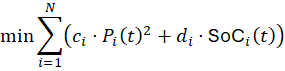
where  represents the total number of aggregated residential units,
 is the power output of battery
 at time
 ,
 denotes inverter conversion efficiency loss coefficients, and
 represents electrochemical degradation weighting factors.
Optimization models utilize mixed-integer linear programming (MILP) and model predictive control (MPC) frameworks. These algorithms forecast 24-hour ahead photovoltaic generation, household electrical load profiles, and dynamic wholesale electricity tariffs, scheduling optimal charging and discharging cycles to maximize financial returns for homeowners while fulfilling grid balancing commitments.
Peak Load Shaving Physics and Frequency Regulation Response
Virtual power plants provide two primary categories of grid service: energy-shifting peak load shaving and high-speed frequency regulation. Each service imposes distinct operational demands on aggregated home batteries.
Peak load shaving addresses predictable regional demand spikes occurring during late afternoon or early evening intervals. When aggregate grid demand threatens to exceed transmission capacity, VPP algorithms command aggregated home batteries to discharge stored energy locally, reducing net municipal load on distribution transformers and avoiding expensive peaking plant activation.
Conversely, frequency regulation requires sub-second response times to stabilize grid frequency deviations around nominal targets ( or
 ). When sudden generation dropouts or load surges cause frequency excursions, automated VPP algorithms deploy rapid frequency containment reserves (FCR). Inverter power electronics adjust active power output within 200 to 500 milliseconds, absorbing excess kinetic energy or injecting power to restore grid frequency equilibrium.
Technical Data Specifications of VPP Algorithm Parameters
| VPP & Aggregation Parameter | Engineering Specification Range |
|---|---|
| Cloud Telemetry Polling Interval | 1 second to 5 seconds real-time polling |
| API Command Execution Latency |  end-to-end signal delivery |
| Frequency Regulation Response Time |  to  for FCR activation |
| Aggregated Fleet Scale Range |  to  virtual capacity |
| Inverter Power Ramp Rate | Up to  rated power per second |
| State-of-Charge Calibration Accuracy |  via Coulomb counting and OCV |
| Fleet Availability Verification Rate |  operational uptime compliance |
Battery Degradation Minimization and Electrochemical Aging Control
Participating in virtual power plant dispatch cycles increases equivalent full cycles (EFCs) on residential lithium iron phosphate (LFP) battery packs, accelerating electrochemical aging if unmanaged. VPP optimization algorithms integrate advanced battery degradation models to prevent premature capacity fade and preserve asset warranty compliance.
Degradation mitigation strategies incorporate real-time health monitoring and equitable workload distribution across the fleet:
- State-of-Health (SoH) Weighting: Dispatch algorithms assign higher discharge weighting to batteries exhibiting higher initial capacity reserves, preventing localized degradation hot spots within the fleet.
- Depth of Discharge (DoD) Restrictions: Algorithms constrain individual battery discharge depth between 20% and 80% state of charge during routine VPP events, avoiding high-stress voltage extremes.
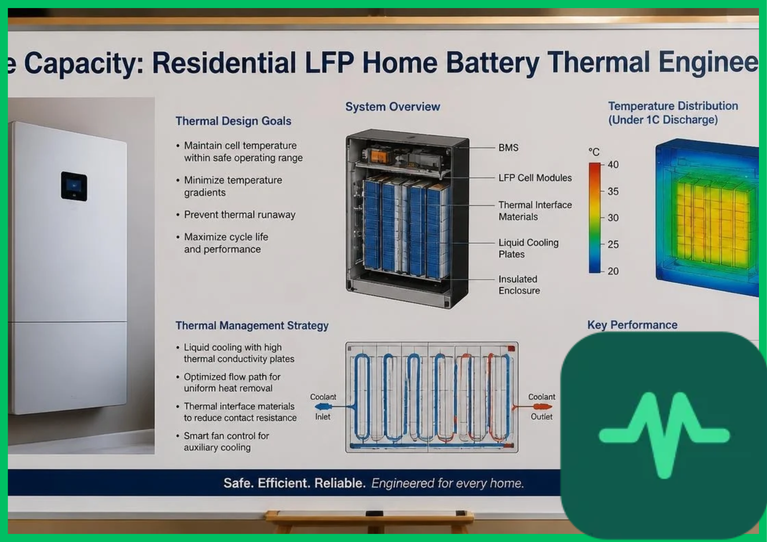
- Thermal Regulation Coordination: Prior to high-power VPP discharge events, algorithms signal residential HVAC and liquid thermal management systems to pre-cool battery packs into the optimal operating window (
 to
 [
 to
 ]), minimizing internal resistance heating and mitigating SEI layer degradation.
Cybersecurity, Data Privacy, and Aggregation Scalability
Coordinating thousands of residential energy storage systems across public telecommunications networks introduces severe cybersecurity vulnerabilities. Securing virtual power plant infrastructure against malicious cyber attacks and unauthorized grid interference is paramount.
VPP software architectures enforce end-to-end cryptographic authentication utilizing hardware security modules (HSMs) integrated within residential inverter gateways. Role-based access control (RBAC) and encrypted virtual private network (VPN) tunnels isolate aggregation servers from consumer home local area networks (LANs). Furthermore, decentralized edge computing architectures enable local hybrid inverters to execute autonomous safety fallback routines if cloud communication links fail, ensuring grid stability and customer load protection under all operating conditions.
The Final Take
Virtual power plant aggregation algorithms transform decentralized residential energy storage assets into responsive, high-performance grid resources. Citing International Energy Agency smart grid assessments and academic power systems literature, optimizing DERMS architectures, MILP dispatch models, and battery degradation algorithms unlocks gigawatts of flexible capacity. By orchestrating distributed fleets with sub-second precision, virtual power plants establish an indispensable digital foundation for global renewable energy integration and resilient electrical distribution networks.

Comments (0)
Login to leave a comment.
No comments yet. Be the first to share your thoughts!