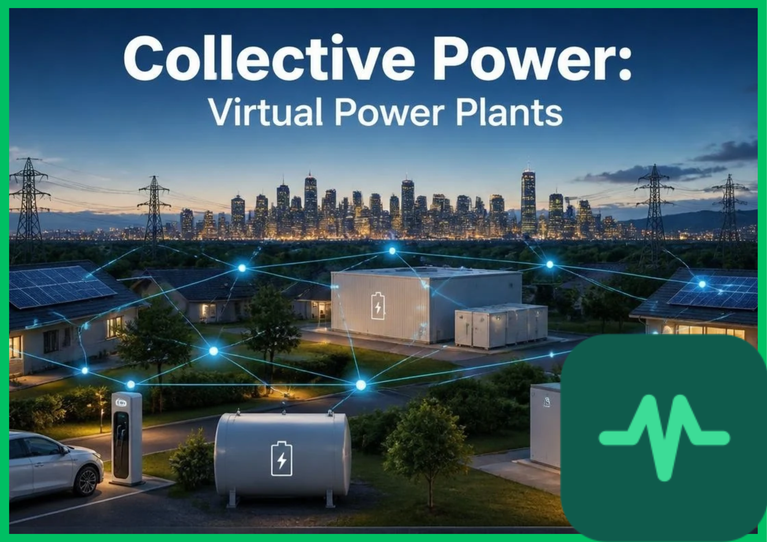
You plug your electric car into the home charger.
You look up at the rooftop solar panels resting quietly under the twilight sky.
You feel a quiet sense of independence.
You generated your own clean electricity today, powered your home, and stored extra energy in your household battery.
You never think about the massive power plants miles away.
For over a century, electrical grids operated on a top-down command.
A handful of giant coal, gas, and nuclear power stations generated all the electricity for an entire region, pumping power down long transmission lines to passive consumers.
That old centralized system is breaking down under the weight of climate change and rising electricity demand.
Millions of homes now produce their own clean energy using rooftop solar panels and garage batteries.
Yet when every homeowner acts in isolation, the grid struggles to balance sudden shifts in power.
We cannot build a stable, 100% renewable energy future while leaving millions of household batteries sitting idle in garages across the globe.
What if thousands of homes could link their batteries together into a single, coordinated energy network?
What if ordinary households could act like a massive power plant when the grid needs help the most?
A quiet, brilliant digital revolution is transforming neighborhood power grids across the globe.
According to global energy reports from the International Energy Agency (IEA), resource protection frameworks from the United Nations Environment Programme (UNEP), efficiency benchmarks from ENERGY STAR, and academic smart grid research, virtual power plant home battery aggregation is changing how our electrical infrastructure operates.
By using cloud software to coordinate thousands of residential batteries and smart appliances, we create flexible energy networks that stabilize regional power grids.
Here is how virtual power plants work, why decentralized battery sharing changes grid economics, and how collective power secures our sustainable future.
The Fragility of Top-Down Power Grids
To understand why virtual power plants matter so much, you have to look at the severe limits of traditional centralized power generation.
In the old days, when a heatwave hit a city and everyone turned on their air conditioning at once, utility operators fired up polluting fossil-fuel peaker plants to meet the sudden surge in demand.
Those dirty peaker plants ran for just a few hours a year, costing millions of dollars and pumping toxic exhaust into urban air.
Today, millions of households own solar panels and lithium-ion storage batteries.
Those batteries sit in garages, fully charged and waiting.
Yet utility companies could not access that stored power during an emergency because every home operated on a separate island.
Skeptics once argued that residential batteries were too small and fragmented to ever coordinate reliably with professional grid operators.
Software engineers and smart grid researchers proved those skeptics wrong.
When you connect thousands of small batteries through intelligent cloud software, small pieces add up to massive power reserves.
What Is a Virtual Power Plant?
A virtual power plant is an advanced cloud-based software network that aggregates thousands of decentralized residential batteries, electric vehicles, and smart thermostats, coordinating them in real time to function as a single, flexible power plant that supplies electricity back to the regional grid during peak demand hours.
Instead of building expensive, polluting fossil-fuel peaker plants, utilities tap into neighborhood energy reserves:
- Smart Device Integration: Intelligent software connects directly to home energy storage systems and smart appliances through encrypted internet protocols.
- Real-Time Fleet Coordination: When regional electricity demand spikes, the cloud platform signals thousands of enrolled household batteries to discharge small amounts of stored power simultaneously.
- Automated Market Response: The aggregated network responds to grid frequency drops within seconds, stabilizing local voltage automatically.
- Homeowner Autonomy: Homeowners set minimum battery reserve limits, ensuring their personal emergency backup power remains untouched while earning financial rewards for sharing excess energy.
You go about your evening while your home battery helps power your entire neighborhood during a grid emergency.
The Science of Decentralized Energy Swarms
How can software coordinate thousands of independent home batteries scattered across different neighborhoods without causing voltage surges or dropping power quality?
It comes down to distributed swarm intelligence and automated load frequency control.
Academic smart grid research shows that virtual power plants use decentralized control algorithms to manage power flows fluidly across thousands of nodes.
Instead of a single heavy turbine spinning in a centralized plant, power discharges in tiny, perfectly synchronized micro-bursts from garage walls and basement units.
Furthermore, ENERGY STAR and international electrical efficiency evaluations prove that decentralized storage aggregation reduces transmission line congestion and cuts the massive energy waste associated with pushing power over long-distance high-voltage lines.
Energy gets stored right where it is consumed, and shared right where it is needed.
Local generation meets collective resilience.
Environmental Integrity and Fossil Fuel Retirement
The environmental benefits of virtual power plant home battery aggregation extend far beyond lowering family electricity bills or helping utilities avoid blackouts.
They provide the ultimate weapon to retire dirty fossil-fuel peaker plants for good.
According to UNEP resource governance frameworks, shutting down fossil-fuel peaker plants eliminates localized air pollution in urban neighborhoods, protecting children and vulnerable populations from toxic respiratory toxins.
When a regional grid can rely on clean energy stored in household batteries during peak heatwaves, fossil fuels lose their last remaining justification for existing.
According to IEA clean energy roadmaps, scaling up virtual power plants and distributed energy resources is an absolute pillar to achieve global net-zero emissions targets.
When communities pool their clean energy together, our entire civilization takes a giant leap toward true sustainability.
Overcoming Regulatory Hurdles and Software Security
Scaling virtual power plants from pioneering utility trials into universal national grid infrastructure involves navigating real-world regulatory and digital security hurdles.
Traditional electricity market rules were written for giant centralized power plants, often making it difficult for homeowners to sell stored solar energy back to the grid.
Grid regulators, software developers, and utility companies are solving these challenges by updating wholesale electricity market rules, establishing secure military-grade cybersecurity protocols for smart home devices, and creating transparent compensation frameworks for participating homeowners.
As digital aggregation platforms mature and regulatory policies adapt worldwide, virtual power plants are transitioning successfully from experimental pilot projects into standard utility operations globally.
Harnessing Collective Power Toward a Sustainable Future
Virtual power plants prove that decentralized technology can unite ordinary households into a powerful force for global decarbonization.
We no longer have to accept that keeping our lights on during peak demand requires burning fossil fuels in dirty, centralized peaker plants.
By connecting rooftop solar panels and home storage batteries through intelligent cloud software, we build a resilient, shared energy network from the ground up.
We step away from vulnerable, top-down energy monopolies, embracing a collective, democratic, and enduring standard of power management.
Through brilliant digital software, rigorous academic research, and a deep respect for our planetary climate, collective power secures a clean, stable, and sustainable future for every community on Earth.

Comments (0)
Login to leave a comment.
No comments yet. Be the first to share your thoughts!