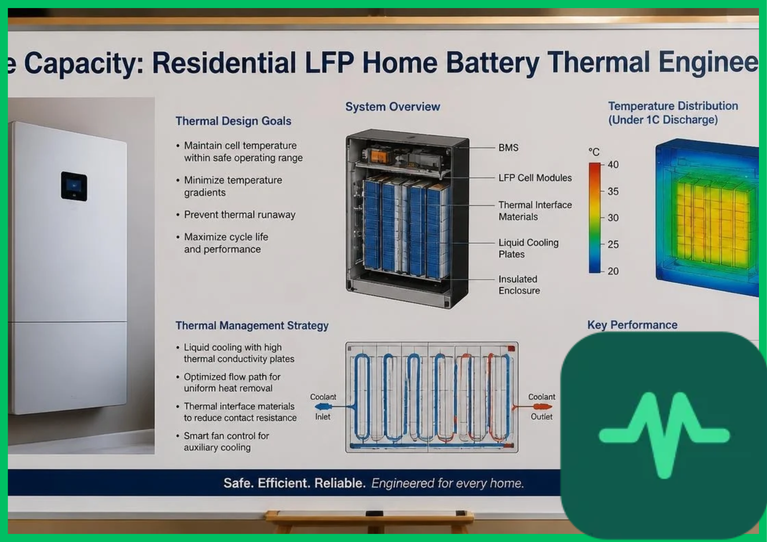
 ) chemistries provide superior thermal stability and extended cycle life compared to nickel-manganese-cobalt alternatives. However, multi-kilowatt-hour residential installations require rigorous engineering controls over cell-level thermal dynamics, active battery management system (BMS) balancing, and thermal propagation containment to eliminate fire risks and ensure multi-decade operational reliability.
Olivine Crystal Structure and Thermal Stability Physics
The foundational safety characteristic of residential LFP home batteries stems from the robust olivine crystal lattice of the  cathode. The crystal framework features strong covalent bonds between iron, phosphorus, and oxygen atoms (
 polyanions), which anchor oxygen within the crystal structure during high-rate cycling or elevated thermal stress.
Unlike layered transition metal oxide cathodes that undergo exothermic oxygen release at temperatures above  (
 )—triggering catastrophic thermal runaway—
 maintains structural integrity up to elevated temperatures exceeding
 (
 ). The absence of structural oxygen release prevents the secondary combustion of organic carbonate liquid electrolytes. Furthermore, LFP thermal expansion coefficients remain exceptionally low during lithium intercalation and de-intercalation, restricting isotropic volume changes to less than 6.8% across full charge-discharge cycles. This minimal volumetric strain prevents micro-cracking of active material particles and eliminates internal short-circuit pathways over thousands of cycles.
Active Battery Management System (BMS) Balancing and Monitoring
Maintaining safe residential battery operation requires active battery management system (BMS) architectures executing real-time telemetry tracking and cell-level balancing protocols. The BMS monitors individual cell voltages, module currents, and surface temperatures via negative temperature coefficient (NTC) thermistors positioned across every cell group.
Active balancing topologies utilize bidirectional DC-DC converter circuits or switched-capacitor networks to transfer energy dynamically from higher-voltage cells to lower-voltage cells during operation. This active energy shunting prevents overcharging and undercharging imbalances across series-connected cell strings.
When cell voltages exceed strict safety thresholds ( per cell) or temperatures surpass
 (
 ), the BMS triggers hardware-level contactors, isolating the battery pack within milliseconds. Precise state-of-charge (SoC) estimation algorithms—combining Coulomb counting with open-circuit voltage (OCV) calibration—prevent deep discharge events that accelerate solid-electrolyte interphase (SEI) degradation and copper dissolution at the anode.
Thermal Management Engineering and Liquid Cooling Integration
Residential energy storage systems generate substantial internal heat during high-power charging and discharging sessions due to ohmic resistance ( ) and electrochemical polarization overpotentials. Managing these thermal loads requires sophisticated active and passive thermal management systems.
Modern residential battery enclosures utilize active liquid cooling plates circulated with a water-glycol heat transfer fluid or closed-loop dielectric fluid. Centrifugal pumps maintain coolant flow rates between  and
 (
 ), extracting thermal energy from prismatic cell housings and rejecting heat via external variable-speed condenser fans or geothermal heat exchangers.
Maintaining internal cell temperatures within the optimal window of  to
 (
 to
 ) minimizes thermal gradients across the battery pack to less than
 (
 ). Constraining thermal gradients prevents localized aging disparities, where hotter cells degrade faster and induce capacity drift across the module string.
Technical Data Specifications of Residential LFP Battery Parameters
| Thermal & Electrical Parameter | Engineering Specification Range |
|---|---|
| Nominal Cell Operating Voltage |  per cell (  to  pack architecture) |
| LFP Thermal Runaway Onset Threshold |  to  (  to  ) |
| Optimal Cell Operating Temperature |  to  (  to  ) |
| Active Cooling Circulating Flow Rate |  to  (  ) |
| Cycle Life Retention (80% Capacity) | 4,000 to 6,000 equivalent full cycles (EFCs) |
| Maximum Allowable Cell Temperature Gradient |  (  ) across module array |
| BMS Voltage Measurement Accuracy |  per individual cell channel |
Thermal Propagation Barriers and Enclosure Safety
Despite the high intrinsic thermal stability of LFP chemistry, utility and residential safety standards mandate physical thermal propagation barriers within multi-cell modular enclosures to prevent localized faults from escalating. When severe external mechanical damage or localized electrical shorts induce thermal runaway in a single cell, thermal barriers contain the event.
Engineering containment protocols integrate high-performance insulation materials between individual prismatic cells:
- Silica Aerogel Blankets: Inserting
 to
 (
 ) hydrophobic aerogel sheets blocks conductive heat transfer due to an ultra-low thermal conductivity coefficient (
 ).
- Mica Partition Plates: Rigid mica sheets withstand radiant temperatures exceeding
 (
 ), preventing direct flame impingement and hot particle ejection onto adjacent cells.
- Deflagration Venting Plenums: Enclosures incorporate calibrated pressure-relief valves and exhaust ducts designed to vent non-toxic off-gases safely outdoors if internal cell venting occurs, preventing structural over-pressurization.
Residential Energy Storage Longevity and Lifecycle Metrics
Evaluating residential LFP home battery performance requires analyzing long-term capacity retention and cycle life metrics across multi-year operating horizons. Citing electrochemical research and IEA stationary storage data, high-quality LFP residential batteries maintain over 80% of their initial nominal capacity after 4,000 to 6,000 equivalent full cycles under controlled thermal environments.
Restricting operational depth of discharge (DoD) between 10% and 90% and avoiding high-rate charging when ambient temperatures drop below freezing ( or
 ) eliminates lithium plating risks. By combining olivine crystal stability, active liquid thermal management, advanced BMS cell balancing, and robust aerogel containment barriers, residential LFP home battery systems deliver safe, high-efficiency energy storage for global residential buildings.


Comments (0)
Login to leave a comment.
No comments yet. Be the first to share your thoughts!